Share article:


In this article:
- What is oxytocin, and why is it important?
- Is oxytocin important to the dog–human bond?
- Do dogs get an oxytocin boost from human interaction?
- How can I boost oxytocin levels for my dog?
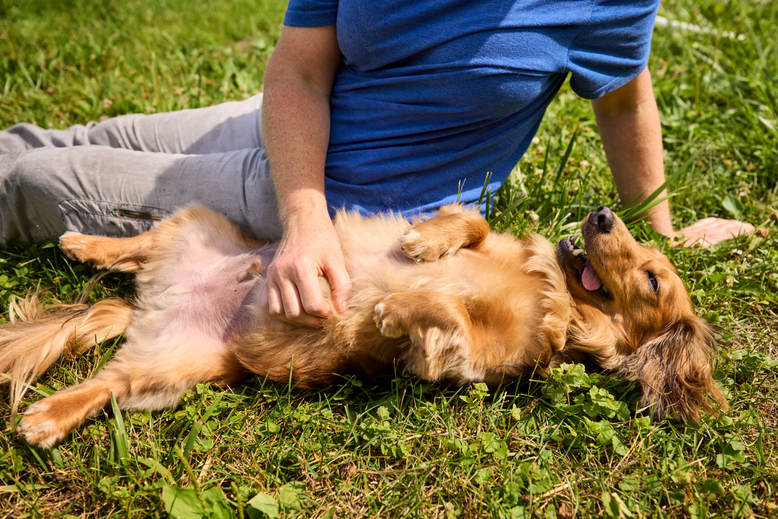
Snuggling, petting, or even just looking at your dog makes you feel good. The main explanation for this is that dogs are wonderful and make everything better—but, biologically speaking, part of this mood boost comes from a brain chemical called oxytocin.
We know that oxytocin is important for bonding between humans—and research suggests that it also plays a role in the bond between us and dogs.
Here’s what we know about how hanging out with our dogs floods their brains, and ours, with feel-good chemicals.
What is oxytocin, and why is it important?
Oxytocin is a chemical produced in the brain—specifically, a structure called the hypothalamus—that functions as a hormone and neurotransmitter. As a hormone, it’s released into the bloodstream by the pituitary gland and travels throughout the body to initiate various processes, most of which are related to reproduction, in humans and dogs. As a neurotransmitter, it delivers signals to neurons informing our responses to the environment.
The chemical’s best-known function may be its role in social bonding. Nicknamed the “love hormone,” oxytocin has been linked to feelings of closeness to others. For example, our brains produce the chemical when we fall in love with a romantic partner or gaze at our children. This capability has helped mammalian species, including dogs, persist for thousands of years—because when something makes us feel good, we want to do it again so we keep feeling good.
“[Oxytocin] motivates us to continue to seek out those types of social interactions that, evolutionarily speaking, would have been advantageous for us,” said Zachary Silver, PhD, an assistant professor of psychology at Occidental College, and founder and director of the school’s Canine Intelligence Lab.
The good feeling we get from those social interactions is our brains’ way of telling us to stay with a partner or child, creating a loop that increases the likelihood of successful procreation and child-rearing. You like your partner and your kid, so you want to stick with them.
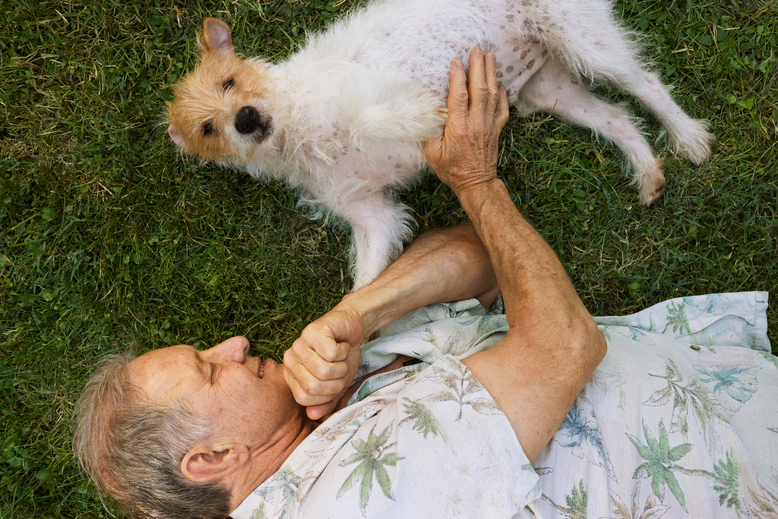
And evidence suggests that oxytocin-induced bonding is one reason you and your dog like to stick together, too.
Is oxytocin important to the dog–human bond?
It makes sense that oxytocin is a part of this dynamic, because both humans and dogs have enjoyed significant benefits from their relationship—which means there would be an evolutionary payoff to good interspecies vibes and the chemicals that come with them.
“Once we started interacting with dogs in the early stages of their domestication process,” Dr. Silver said, “doing so dramatically increased individual humans’ survival chances.” Notably, wolf and dog survival chances also increased, making this relationship mutually beneficial. These benefits came in the form of a hunting companion and protection from predators.
A 2022 paper published in the journal Comprehensive Psychoneuroendocrinology hypothesizes that oxytocin was pivotal to dog domestication, specifically in dampening dogs’ stress response so that they would feel safe enough to begin building a relationship with humans.
The history of the human–dog relationship began as long as 40,000 years ago. As humans and wolves cooperated to survive, they also built a powerful bond that persisted as wolves evolved into dogs and became domesticated. “One possibility is that oxytocin helped support those relationships and the change in behavior,” said Gita Gnanadesikan, PhD, an evolutionary biology and comparative psychology postdoctoral fellow at Emory University.
She added that the brain chemical may have been key to promoting interactions between humans and wolves who would’ve been physiologically predisposed to making contact rather than running away. “The individuals who had the biggest oxytocin responses to those interactions,” she continued, “might have been the ones that became dogs over generations.”
So oxytocin may have played a big part in turning wolves into dogs, and into shaping their relationship with humans over thousands of years. But what role does it play in your relationship with your dog today?
Do dogs get an oxytocin boost from human interaction?
The available evidence suggests that, yes, your dog is releasing oxytocin when you hang out together.
Some of the same interactions between humans that release oxytocin, particularly a loving gaze, may also map onto dog–human interaction. One paper Dr. Silver described as a “seminal study,” published in 2015 in the journal Science, explores how eye contact between humans and dogs may impact oxytocin levels in both. Researchers in Japan had dogs look at their owners for five or 30 minutes. The team collected urine from these dogs immediately before and 30 minutes after this gazing period. They found that dogs in the long-gaze group had an increase in their oxytocin levels while dogs in the short-gaze group showed a decrease.
But this experimental context is a bit contrived—most people don’t have 30-minute daily staring contests with their dogs. Some researchers have tried to see what this brain chemical looks like in a more natural setting.
One study, published in 2024 in the journal Psychoneuroendocrinology, analyzed how interactions between dogs and children impacted canine oxytocin levels. In this study, 55 children interacted with either their pet dog or a dog they were unfamiliar with, playing games or with toys or just sitting together. The researchers measured the dogs’ urinary and salivary oxytocin levels before and after these encounters. The pet dogs had increased levels of salivary oxytocin afterwards, but the unfamiliar dog (there was only one) had decreased levels.
While this paper shows that humans seem to be able to boost their pets’ oxytocin levels, the researchers noted that we can’t be sure that the discrepancy between pet dogs and the unfamiliar one was due to the pre-existing bond the pet dogs had with their children. That’s in part because past research has demonstrated that humans can, in fact, induce an oxytocin response in dogs they don’t have a relationship with.
A 2017 study published in the journal Frontiers in Psychology involved a group of 38 Labrador and golden retrievers split into two groups. Dogs in one group each spent 10 minutes interacting with a friendly stranger, while those in the other group rested alone for 10 minutes in a large pen while a human was in the same room, but didn’t interact with them—not even making eye contact. Analyzing saliva and blood samples collected from the dogs before and after the experiment, the researchers found that dogs who had interacted with the amiable stranger showed increased levels of oxytocin in both samples, while isolated dogs showed no increase. The authors concluded that, in the human interaction group, the degree of interaction between the dog and human predicted the extent of the oxytocin increase.
There’s also tons of variability in individual dogs, Dr. Gnanadesikan noted. Some dogs may get more joy out of interacting with any people they meet, and others may have a strong preference for people they’re already bonded to. Either way, rigorous research has already demonstrated that humans can indeed elicit an oxytocin response in dogs.
How can I boost oxytocin levels for my dog?
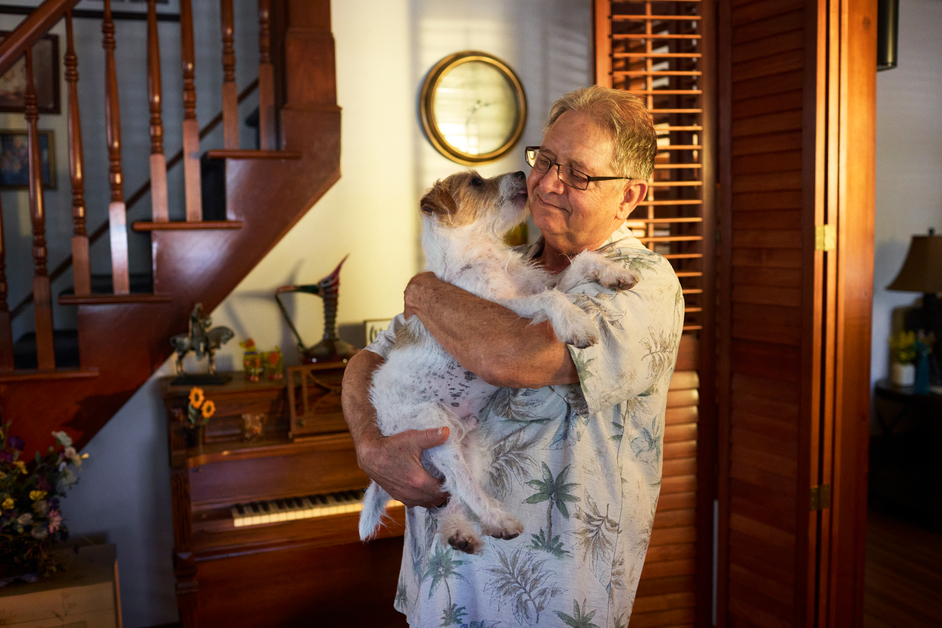
Putting this knowledge to use at home looks a lot like continuing to treat your best friend with love and respect. Perhaps the 2015 study will inspire you to spend some time looking deeply into your dog’s eyes. But if you want to try making your dog happy through some good old-fashioned cuddling, just make sure they are psyched about it, too.
“Your agenda is not necessarily your animal’s agenda,” said Dr. Gnanadesikan. “Just because you want to cuddle doesn’t mean that they want to cuddle.” If you’re not sure what your dog likes, try something called a “consent test,” which involves pausing after you try petting a certain way and seeing whether they show signs that they want more. Needless to say, if your dog seems to be trying to escape a squeeze, then that interaction is probably not flooding their brain with oxytocin.
Studies of the ways human–dog interactions impact oxytocin levels are fascinating, and can help deepen our understanding of why we’ve been so close for thousands of years. But you don’t need to know anything about psychoneuroendocrinology to grasp a simple truth—dogs and humans have stuck together for all these years because we love each other and make each other happy.
Related Topics
Related Topics
More on Lifestyle
Lifestyle, Training & Behavior • 8 minutes
Why Does My Dog Follow Me Into the Bathroom?
A dog’s love knows no bounds.
Health & Wellness, Lifestyle, Science & Research • 8 minutes
Is It OK if My Dog Licks Me?
We all know where those mouths have been.
Lifestyle • 15 minutes
Surfin’ D-O-G
What did you do this summer? These canine dudes and dudettes rode the waves.
Lifestyle, Training & Behavior • 8 minutes
Why Does My Dog Follow Me Into the Bathroom?
A dog’s love knows no bounds.
Health & Wellness, Lifestyle, Science & Research • 8 minutes
Is It OK if My Dog Licks Me?
We all know where those mouths have been.
Lifestyle • 15 minutes
Surfin’ D-O-G
What did you do this summer? These canine dudes and dudettes rode the waves.