Share article:


In this article:
- How do I prepare dogs to move in together?
- What do I need to know before combining households?
- How do I set up my new home for multiple dogs?
- What signs should I watch out for from my dogs?
- What if my dogs don’t get along?
Perhaps you recall the classic sitcom The Brady Bunch, in which six human children (and one dog!) from two separate families learned to live together over the course of five seasons.
If you’re planning canine Brady Bunching—that is, bringing your dog(s) to move in with someone else and their dog(s)—you’ll have your own challenges to overcome, and your own rewards to experience. While this merge can’t be accomplished in one quick 30-minute episode, you likely can successfully blend doggy households with forethought, communication, and attention to all dogs concerned.
With that in mind, here’s how your group can somehow form a family.
Start preparing your dogs early.
Preparing each dog for the eventual merge is the foundation of a future happy household. Key to prep is integrating the dogs, or acclimating them to each other, before they’re even housemates.
Integration requires time and planning. “In an ideal situation, integration begins long before moving day,” said Kate LaSala, a behavior consultant, certified dog trainer, and founder of Rescued by Training. (LaSala is a paid Dog Pro partner of The Farmer’s Dog, spreading the word about our food to her clients.) You and your prospective cohabitant ought to begin integrating your dogs, LaSala said, as soon as you’re considering moving in together—even if it’s not for another year.
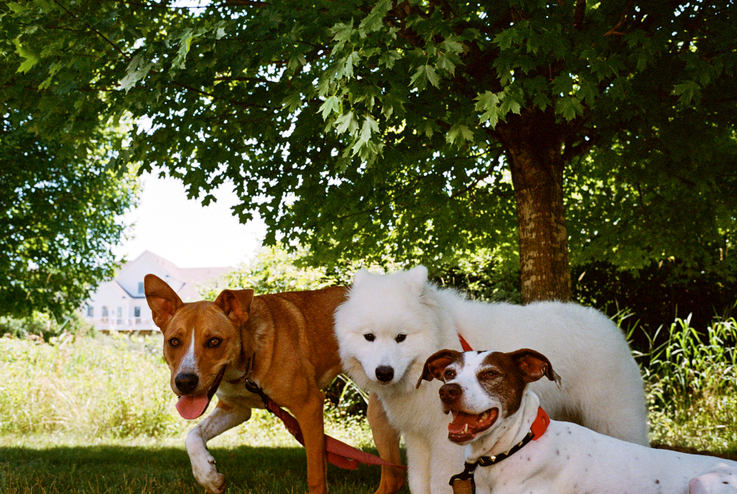
Introduce the dogs on neutral territory, like at the park or on parallel walks, then slowly help them learn to share other spaces. If you and your dog are moving into somebody else’s home, your next step can be visits. Kristi Benson, a certified dog trainer and behavior consultant in British Columbia, Canada, recommended that, once the dogs are acquainted, you drop by ahead of moving day for meals or sleepovers.
Know thy dogs.
Take into account each dog’s background: Have they been socialized to be around other dogs? Have they been relatively isolated until now? This knowledge can inform your understanding of how they may do living with another animal.
A dog who hasn’t spent time socializing with other dogs since puppyhood “may not have the skills to live in harmony with another dog,” LaSala said—at least not yet. While this doesn’t count them out from being able to live with another dog in the long run, you’ll need to help them learn and adjust. If your dog demonstrates difficulty interacting with other animals, consider contacting a trusted trainer or behaviorist to better understand your options for helping them adjust to life with a roommate.
And even if your pet does seem to easily make friends at the park, that doesn’t always mean they’ll take to their roomie-to-be. “We often assume that dogs like every other dog,” LaSala said. “Not every dog automatically likes every other member of their species.”
To better gauge how your dogs are faring in any situation, brush up on dog body language. This skill is always important for dog people, and is particularly crucial for protecting your dogs’ emotional well-being as everyone navigates living together. “Make sure that you’re aware of what stress in dogs looks like,” LaSala said, such as “prolonged, stiff staring; growling or snapping; [and] hiding or shutting down when the other dog is around.”
Set your home up for success.
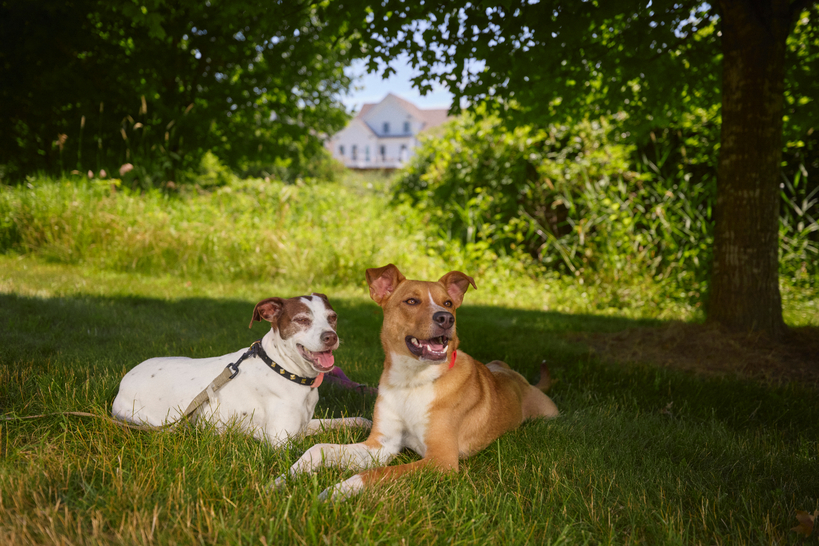
Say you and your partner have been integrating your dogs for months ahead of move-in day, and now the big move is complete. There’s still work to be done; while integration is crucial prep, it isn’t the same thing as day-to-day life together.
“One of the biggest mistakes that I see is that people have done parallel walks, they’ve gone to the park, [and] the dogs seemed fine,” LaSala said, “and then they throw the dogs into the house and think that everything is going to be fine. They assume that prior compatibility is going to transfer to sharing a home. And that is a fallacy.”
For this reason, integration must continue after moving day. “It’s a process, not a single event,” LaSala said. Being comfortable with a dog outside the home is one thing; sharing space, food, toys, and attention is another.
How to deal with resource guarding
“One common mistake that people make is assuming that all dogs naturally share,” Benson said. “Dogs may have big feelings about their beds, their toys, their food, and other things. This isn’t pathological or worrisome, but it can take some planning and training.”
Those big feelings can manifest in an instinctual behavior called resource guarding, where a dog stiffens up, growls, or even snaps when another dog or person approaches something they value, like their food bowl or a beloved toy. Your dog’s background may prime them to guard resources, especially if they have a history of living in shelters or on the street. But even dogs who have lived in happy homes their whole lives may guard their valuables against a perceived threat—and a new dog could elicit that response. If you already know that your dog guards their resources, then this critical knowledge can inform how you set up your newly shared space.
If dogs guard their resources around other dogs, what trainers call “environmental management” will be invaluable. In other words, LaSala said, “you’re going to need to keep separate spaces” for them. Utilizing tools like baby gates can keep the dogs—and their respective resources—separate.
Feeding the dogs in separate spaces and placing their beds in different rooms if possible can also be key aspects of this strategy. Especially if you know your dog is used to having some alone time, make sure there’s a spot where they can curl up undisturbed—even if it’s their crate. In fact, it’s a good idea for every dog to have a place where they can relax without being disturbed.
Benson suggested adding more dog beds and using positive reinforcement to teach dogs which things they ought to use. While everyone is adjusting to the new living arrangements, she recommended that dogs not be left together unsupervised.
Attention and quality time are valuable resources, too. LaSala advised that you and your new housemate be deliberate about spending one-on-one time with each dog, especially if they have different interests and abilities. Schedule intentional walks and playtime to help strengthen your bonds—the human–dog relationships are as important as the dog–dog relationships in this new home.
Handling mealtimes in a multi-dog household
When you have more than one dog, dinnertime can get dicey. Feed your dogs apart at first—even if they seem to get along. You don’t want to sow tension between them or create a sense of competition.
Use physical barriers and restraints—like a baby gate, an exercise pen, or a leash—to keep them separated. Though you’re feeding your dogs in different spots, feed them at the same time so there’s no FOMO. And pick up the bowls as soon as each dog finishes. This way, nobody scavenges another dog’s leftovers. Watch out for signs of stress in the dog, like freezing or hovering over their bowl, staring at another dog, or scarfing down their food faster than usual.
In some cases, separate feeding becomes the norm—and that’s okay as long as everyone feels safe and happy. When it comes to who gets fed first, switch it up.
Learn your green flags and red flags.
As everyone settles in, watch for particular behaviors that indicate how the dogs are getting along.
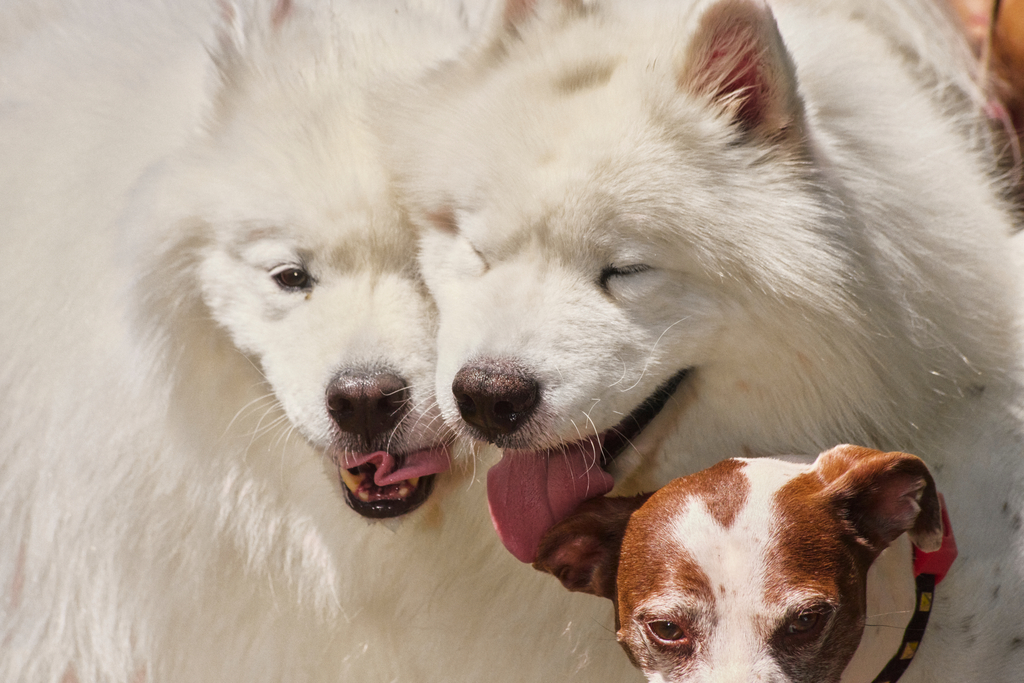
Dogs playing, sniffing each other’s front or behind, and lazing about in the same room are all green flags, Benson said. When you observe these behaviors, reward the dogs with praise. “We want to make it clear to our dogs that their shared positive experiences are great news for us,” she said.
Pay attention to the way they handle conflict, too. Benson continued that once the dogs have had several disagreements, they may arrive at their own etiquette or form of communication. A quick bark or snarl if someone feels encroached upon can get the message across—and as long as it doesn’t escalate further, that’s a good sign.
She also suggested watching for how the dogs respond to stressors like the doorbell when around each other. If they ignore the sound, or investigate it together, those are good signs. On the other hand, if disagreements or surprises set them both off such that they break into a fight, keep separating them with baby gates or crates.
As you notice more green flags, you can start to leave the dogs unsupervised—but do so with caution. Leave them for short periods and use a webcam to see how they do.
Be ready for worst-case scenarios.
“The vast majority of the time, when people blend their households, their dogs do just fine and get along well,” said Benson. “But occasionally, issues crop up.” Here’s what to do when that happens.
Aggression
If dogs growl or snap at each other, Benson recommended that owners try to identify a specific context in which the dogs behave that way—is it around a food dish, particular bed, or favorite toy? This may indicate resource guarding, which can be managed.
If you notice that a dog seems stressed, intervene by creating distance between the dogs and inserting a barrier, like the aforementioned baby gate. LaSala underscored that you shouldn’t punish or yell at your dog, which could weaken your bond and worsen problem behavior. “The goal is to de-escalate, not make things worse,” she said.
If a dog continues to snap or growl at other dogs at home one or two weeks after moving in, there are a couple of routes to consider. One is permanent environmental management, where the owners keep the dogs separated all the time using baby gates or a “crate-rotate situation,” LaSala said, where one dog is confined for a period of time while the other is out, and then they switch.
Another option, she said, is muzzle-training the aggressor dog, and potentially looking to a professional trainer or veterinary behaviorist for guidance. Identifying early on whether the status quo is improving or deteriorating is vital—the longer a bad situation goes on, the harder it will be to remediate those behaviors. Benson said that if one or both dogs growl and express fearful body language frequently around the other, then it’s best to keep them fully separated until a trainer can get on the scene.
In situations where there’s been an injury from a conflict, it’s time for hard conversations about potentially rehoming a dog or returning to separate households. These last resorts can be painful to confront, but sometimes must be considered for the sake of everyone’s welfare, including the dogs’.
“Predatory drift”
When you bring dogs of different sizes into the same home, LaSala said, there is a risk that the larger dog—particularly a predatory one like a bigger terrier or herding dog—could in certain contexts come to see the smaller dog as prey. This response is called “predatory drift,” LaSala said, and it’s distinct from aggression because the larger dog perceives the smaller dog as prey to capture rather than a rival to fight or drive off.
Don’t panic—this doesn’t happen in most cases. But, while predatory drift is unlikely, it’s not impossible. Here’s what you should know about it.
“It takes a single instance of that small dog squealing or yelping to flip a switch in the big dog’s brain so that suddenly [they think,] ‘This isn’t a dog, this isn’t my playmate—this is an item of prey,’” LaSala said.
LaSala has written that the only way to be sure you’ll avoid predatory drift is to keep large and small dogs apart. But if you have two different-size dogs, you can take certain precautions. Watch playtime closely. Immediately intervene if the small dog starts squealing or if the large dog has started chasing the small dog without the activity shifts you’d see in normal play.
Predatory drift can be “terrifying and heartbreaking,” Benson said, and “there is a small risk of injury or even death with a substantial size differential.” But she also described the scenario as rare and noted that “in the vast majority of cases, dog-friendly dogs who aren’t the same size live comfortably for their whole lives with no problems.” Her own pets—a 140-pound livestock guardian and a 45-pound spaniel-collie mix—are “perfectly happy and collegial.”
When it comes to assessing your dogs’ own risk, Marc Bekoff, PhD, professor emeritus of ecology and evolutionary biology at the University of Colorado, Boulder, put it this way: “It’s up to the humans involved to assess the situation and learn who the dogs are as individuals, and then monitor them closely.”
Enjoy your dogs!
Cohabitation is an adjustment for everyone involved—as anyone who’s ever had a roommate knows—so intention and attention are two musts when dogs come together under the same roof.
But, while there’s much to do to prepare all humans and dogs involved for living together, don’t forget the final step: enjoying your new life together. You’re probably going to love it.
“Living with multiple dogs can be a joy for everyone,” said Benson, “but you’ll need a great vacuum cleaner and more dog blankets than you ever thought possible!”
Related Topics
Related Topics
More on Lifestyle

Lifestyle • 3 minutes
How This Dallas Cowboys Cheerleader Helps Rescue Dogs
Turns out that walking adoptable dogs is as good for you as it is for them.
Dog People, Lifestyle • 11 minutes
A Dog Person’s Guide to San Francisco
The Bay Area is also a bark area.
Lifestyle • 7 minutes
Why It’s Dangerous To Let Kids Ride Dogs—Even Big Dogs
What might seem like goofy fun can hurt children and dogs alike.
Lifestyle • 3 minutes
How This Dallas Cowboys Cheerleader Helps Rescue Dogs
Turns out that walking adoptable dogs is as good for you as it is for them.
Dog People, Lifestyle • 11 minutes
A Dog Person’s Guide to San Francisco
The Bay Area is also a bark area.
Lifestyle • 7 minutes
Why It’s Dangerous To Let Kids Ride Dogs—Even Big Dogs
What might seem like goofy fun can hurt children and dogs alike.