Share article:


In this article:
- How can I train my dog to feel better at the veterinarian?
- How can I support my dog at the veterinarian?
- How can I read my dog’s distress signals at the veterinarian?
- How can I teach my puppy to enjoy the vet?
Vet appointments are vital—once a year for healthy adult dogs, and twice a year for healthy seniors—but they might not be fun or easy for your dog and, by extension, you.
To be fair, the V-E-T’s office can be quite scary. It’s full of unfamiliar people and sounds; it smells like antiseptic and even other animals’ fear; and, most obviously, it’s the place where your dog may get poked, prodded, and jabbed for reasons beyond their comprehension. Some dogs may also have traumatic experiences with veterinarians in their pasts. Even though you know the medical care is for your dog’s own good, there’s no way you can explain that to them. And these frightening incidents can create a negative association with going to the vet, evoking fear every time they’re due for a checkup.
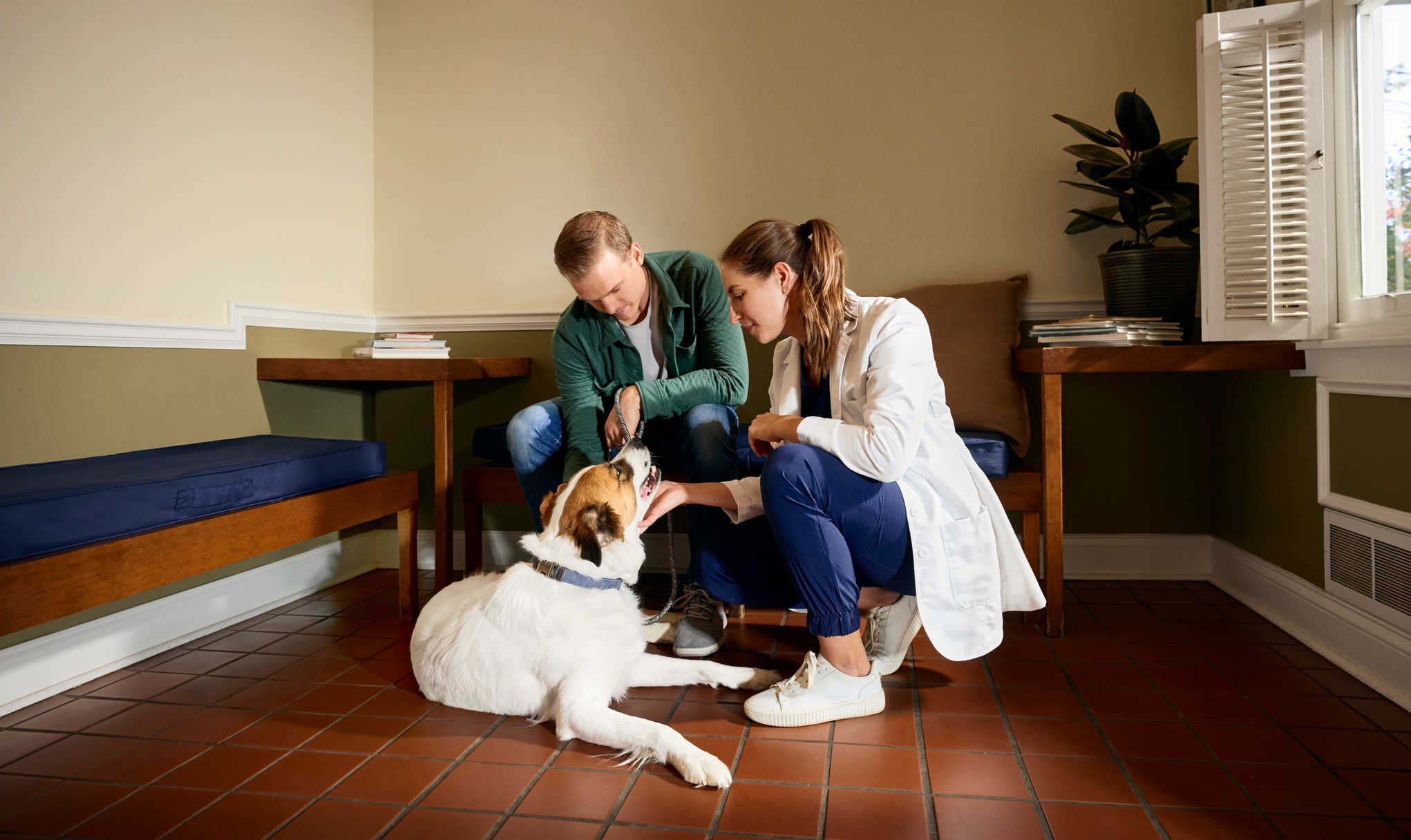
Veterinary professionals are acutely aware of this challenge, and want to cooperate with dog owners to help make the trip easier for all involved. The Farmer’s Dog has a partnership with Fear Free, an organization dedicated to educating the public about reducing patients’ stress at the vet and fostering stronger human-animal bonds.
You and your veterinary care team can do a great deal to mitigate your dog’s fear before, during, and after a physical. With some training, compassion, and advocacy, you can make vet visits less nerve-racking for your dog—and, believe it or not, maybe even fun.
How can I train my dog to feel better at the veterinarian?
If your dog loathes the vet, there’s plenty you can do to chip away at that negative association.
Creature comforts like food and favorite objects may go a long way toward reassuring your best friend and making the vet’s office a happier place. These treats and toys aren’t only useful as rewards for good behavior—they can build a reservoir of good feelings that your dog will recall for future vet visits.
“These are the basics of classical conditioning,” said Zazie Todd, PhD, an animal behavior psychologist, certified dog trainer, and author of Bark! The Science of Helping Your Anxious, Fearful, or Reactive Dog.
Dr. Todd recommends breaking out your dog’s favorite treats and dispensing them liberally. “So long as it’s okay with the vet, you can actually give some during the vet exam,” Dr. Todd said. Make sure you follow the 10% rule—that treats and other extras should never make up more than 10% of your dog’s daily diet—and adjust their food portions based on how many treats they get.
She described multiple ways to use treats. One route is the classical-conditioning approach, where you give your dog a treat immediately following something stressful or scary, like a vaccine. “You’re teaching the dog that the scary thing predicts the treats,” she said. Using classical conditioning to create new, positive associations with something your dog fears is called counterconditioning.
You can also use treats to distract your dog from what’s going on. This is a type of management. In this scenario, you’re giving treats throughout the procedure rather than immediately following it. “That’s a perfectly good way to use food, but it’s not necessarily going to have that training carryover or build a positive association in the long run,” Dr. Todd said.
It may seem as though your dog knows what’s coming before you even set foot in the vet’s office—especially if the lead-up involves a drive. If your dog only ever goes in the car for their annual checkup, consider taking them on joyrides year-round so they don’t see the vehicle as a harbinger of something frightening. During the drive, play some soothing music for them.
After stressful appointments, block off some time to help your dog calm down with a walk or playtime.
Be your dog’s rock
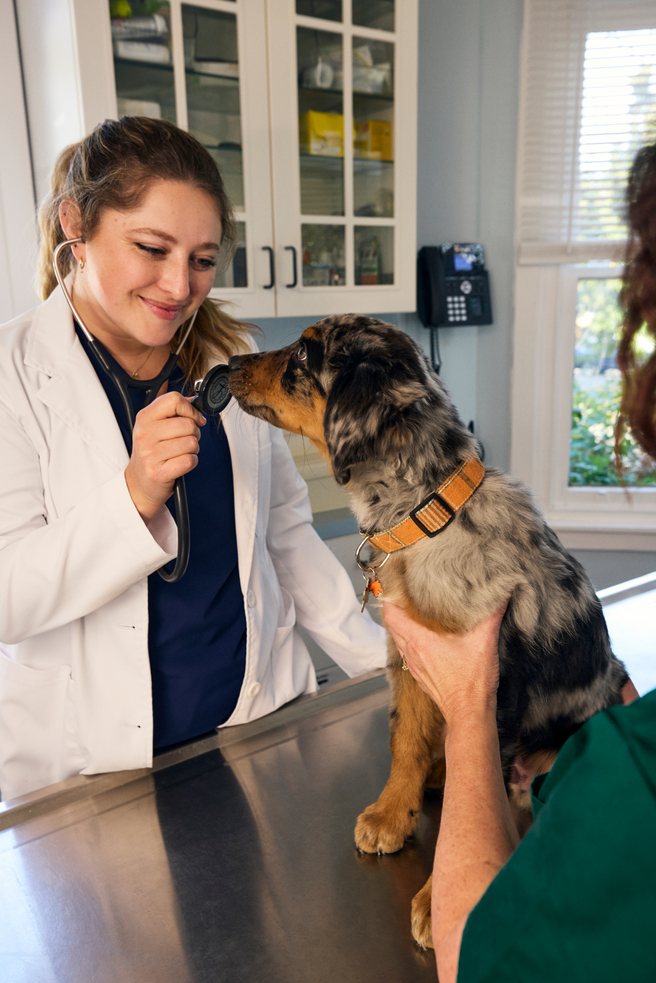
Even though it may seem like your dog loves treats more than you, your presence can be just as comforting as a tasty morsel. Maintaining a calm demeanor can go a long way for your pooch. “Pets feed off of our energy,” said Jennifer Merlo, DVM, vice president of veterinary affairs at Fear Free, “so if we start to get anxious, they’re going to get anxious.”
Dr. Todd corroborated the power of your proximity. “The owner’s presence during the vet exam can actually help the dog to feel more comfortable,” she said. A soothing tone, gentle touch, and serene vibe can make all the difference.
Dr. Merlo counsels dog owners to advocate for their pets whenever possible. “It starts with just asking,” she said. “There’s never any harm in asking.”
Questions you might want to ask include:
- Can we stay in the exam room?
- Is it possible for you to do everything that you need to do with my pet while I’m here?
- I think my pet is nervous right now; is there anything we can do for them?
Knowing a vet practice’s rules for accompanying your pet can also help you choose the best doctor for you and your dog. Dr. Merlo emphasized that a good vet will be receptive to and respectful of your needs, even in the event of a procedure that requires a brief separation.
“No veterinary professional should make you feel bad for advocating for what’s best for your pet,” she said.
How can I read my dog’s distress signals at the veterinarian?
Dogs have their own body language for communicating fear and stress. While growling and cowering may signal those feelings loud and clear, there are some subtler signs that can tip off humans before things get ugly.
“Every pet is going to be a little bit different, so we have to make sure that we’re reading their body language and the signals that they’re sending us,” Dr. Merlo said. These signs may include yawning when they’re not tired, licking their lips when there’s no food around, and holding their tail at body level or lower, even sitting on their tail tucked between their hind legs.
Humans often miss these early warning signs, Dr. Merlo said, which can escalate to clearer signals like growling. At this point, you may feel embarrassed that your dog is behaving “badly,” and even feel the urge to scold them. But, Dr. Merlo said, this isn’t the way. “Don’t tell your dog not to growl,” she said.
Dr. Todd agreed that a scolding is the last thing your dog needs. “That in itself is stressful for the dog,” she said. Scolding may even tip them over the edge into dangerous behavior, like biting.
“[Dogs] only move to aggression when they feel like they have no other way to let us know that they don’t want to do what we would like them to do,” Dr. Merlo said. “I actually prefer for them to growl, and not just learn to go from ‘nervous’ to ‘biting.’” Instead of scolding your dog, stop and assess what you can do to make things better for them in that moment—whether it’s trying a different holding technique for a procedure, introducing treats, taking a break, using a vet-approved sedative, or even asking to postpone.
If your dog resists every part of the appointment from start to finish, consider talking to your vet about treatment options for their anxiety or a referral to a veterinary behaviorist.
How can I teach my puppy to enjoy the vet?
If you have a puppy, you have the opportunity to build a positive association with the vet from the get-go. “The more we expose them to [the vet] in a positive way, the more we can prevent those negative associations from occurring down the road,” Dr. Merlo said.
Puppies have a sensitive period between three and 12 to 14 weeks old, Dr. Todd said. During that time, they’re open to all kinds of new stimuli —provided they’re pleasant ones. “If we give them lots of positive experiences during that time, it helps them get used to things that they’re going to come across as an adult,” she added.
Introduce your puppy to the vet through what Dr. Todd and Dr. Merlo call “happy visits.” These trips involve dropping by the vet’s office with no appointments or procedures scheduled—though you should call ahead of time to make sure the office isn’t too swamped and that the veterinarian is available. Your puppy can meet all the folks working there, and enjoy some treats to really drive home that positive association. “You might only be in there for a minute, but you can give a lot of [treats] in that time and make sure the dog thinks, ‘Oh, the vet is the best place ever because all these lovely things happen,’” Dr. Todd said.
Happy visits are also worthwhile for your adult dog in an effort to recondition them, though this association will take longer to build. They can help strengthen a positive association with the veterinarian’s office through desensitization, by letting your dog interact with something scary at low levels. Desensitization and counterconditioning generally go hand in hand, and you can read more about them in our full guide to helping a fearful dog.
Most crucially, comfort your dog as they need it. Don’t be stingy with your love at this moment. “You shouldn’t be leaving your dog to struggle,” Dr. Todd said. “It’s your job as the dog’s guardian to comfort them.”
Related Topics
Related Topics
More on Health & Wellness

Health & Wellness, New Dog • 21 minutes
Puppy Veterinary Care Guide: a Health Checklist for Your New Best Friend
What to know about keeping your new puppy healthy.
Health & Wellness • 12 minutes
These Are The Most Common Health Problems in Big Dogs
Large-breed dogs have a more substantial risk of these conditions.

Health & Wellness • 8 minutes
Why Is My Dog Limping?
Here’s what to do if your dog’s gait isn’t quite right.
Health & Wellness, New Dog • 21 minutes
Puppy Veterinary Care Guide: a Health Checklist for Your New Best Friend
What to know about keeping your new puppy healthy.
Health & Wellness • 12 minutes
These Are The Most Common Health Problems in Big Dogs
Large-breed dogs have a more substantial risk of these conditions.
Health & Wellness • 8 minutes
Why Is My Dog Limping?
Here’s what to do if your dog’s gait isn’t quite right.