Share article:


In this article:
- Can my dog stick their head out the car window?
- Can my dog ride shotgun?
- Does my dog need to wear a seatbelt?
Picture this: You’re cruising down the open road, gas tank full, horizon stretching before you, with your best friend by your side, their ears and tongue flapping in the wind as the world whips past through the open window. (This best friend is, of course, your dog.)
Appealing as this fantasy may seem, we regret to inform you that it’s not safe. Dogs should not stick their heads out the window of moving cars, and it’s dangerous for them to do so. But the good news is that there’s a veterinarian-recommended way to chauffeur your dog around—and it could make all the difference to their safety.
Whether you’re taking a cross-country road trip or just driving to the park, here’s everything you need to know about safely driving with your dog.
Can my dog stick their head out the car window?
The sight of a dog’s windswept head sticking out of a car’s open window is adorable enough to halt traffic. But allowing your dog to ride this way is unsafe for several reasons.
First, “it’s a high risk for their eyes,” said Nancy Welborn, DVM, an associate professor of community practice at Louisiana State University’s School of Veterinary Medicine. Fast-flying dust or debris can blow into a dog’s eyes and damage their cornea, or the eye’s surface, potentially giving rise to conditions like corneal ulcers. For this reason, “[veterinary] ophthalmologists very much say, ‘Please don’t do that,’” Dr. Welborn said.
Potential injuries for a dog playing Flying Ace don’t stop there. According to Kendra Dauenhauer, DVM, assistant professor of urgent care at the University of Minnesota College of Veterinary Medicine, other risks include “neck or head injuries caused by sudden stops, accelerations, or turns.” And, Dr. Dauenhauer said, “Dogs can also be escape artists if they have enough motivation.”
In other words: A stopped car with an open window and unrestrained dog could also spell trouble, as your dog may jump through it.
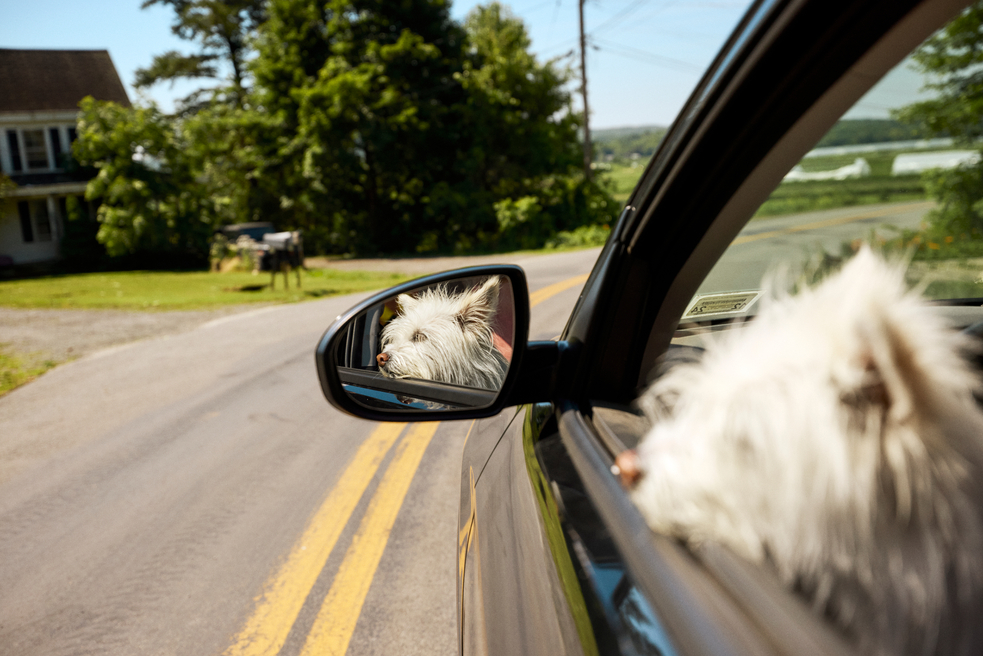
“Jumping out of the window could certainly result in significant trauma,” said Kara Carmody, DVM, associate professor of primary care at the University of Minnesota College of Veterinary Medicine. And, depending on where your dog gets loose—a busy main street, for instance—they could be in serious trouble even if they are unscathed from the jump itself. If they’ve run into traffic, pursuing them could be just as dangerous for you.
But there is a compromise. The reason dogs so relish this pastime in the first place is the plethora of smells whooshing through their nostrils, creating a “smorgasbord of sensory information,” Dr. Welborn said. “It’s a little field trip for their nose.” Since dogs’ noses are so sensitive, they’ll still get that olfactory adventure with the window cracked and their head safely inside the vehicle. “All that wind is still going to come in and they’re going to smell that,” she said, adding that circulating air through the car vent can also scratch that itch.
Can my dog ride shotgun?
You may always want your best bud by your side, but in the car that can’t be literal. Riding in the front seat is dangerous to your dog for the same reason it’s dangerous to a child: They could be seriously injured or even killed in a collision, either by the accident or airbags.
“An airbag can kill a dog if it hits them,” Dr. Welborn said.
Even if your large or giant breed dog seems heavy enough to safely sit right next to you, Dr. Welborn said that these dogs typically don’t fit comfortably in front seats, even in SUVs.
The safest way to commute your dog by car is to secure them in the back seat—but safety doesn’t stop there.
Does my dog need to wear a seatbelt?
As with a person, a sudden stop can send a dog tumbling out of their seat and possibly into the dashboard, console, or car door. For this reason, dogs must indeed buckle up.
In the event of an accident or even just an abrupt stop, “essentially the pet becomes a projectile,” Dr. Carmody said. This creates the risk of them colliding with a person or a hard surface like the dash or windshield.
Nor is it safe for them to ride under a seat or at your feet, where they are “more likely to become entrapped if an accident should happen,” Dr. Carmody said. Holding your dog on your lap isn’t safe, either.
And an unrestrained dog in the car isn’t just in danger should things go awry. They can also create a distraction to the driver by barking and moving around. Buckling them in for a car ride can minimize this potential for diversion and allow the driver to concentrate fully. “Loose animals run a high risk of injury if there is an accident or even a sudden stop, as well as being a potential distraction to the driver,” Dr. Dauenhauer said.
However, dogs can’t click it like us humans; they require a little extra equipment. Seatbelt-compatible harnesses, beds, crates, and car seats are available for dogs of all sorts. Crates can also be secured in connected trunks, like those in SUVs and hatchback cars. And if your dog has trouble settling down during a car ride, bring their favorite toys, treats, and blankets to make them more comfortable.
Going the extra mile for your dog’s safety is always worth it, especially in worst-case scenarios. While driving with your pet safely secured in a dog-friendly car seat with the window cracked oh-so-slightly might not be the idyllic daydream you envisioned, it’s what gives you the best chance of getting to your destination safely together.
Related Topics
Related Topics
More on Lifestyle
Lifestyle • 7 minutes
Why It’s Dangerous To Let Kids Ride Dogs—Even Big Dogs
What might seem like goofy fun can hurt children and dogs alike.
Lifestyle, New Dog • 8 minutes
Adopt One of These Dogs By March 15, and Start Them on Fresh Food for Free
Let’s meet some good dogs.
Health & Wellness, Lifestyle • 10 minutes
Do Dogs Need a Skin-Care Routine?
Healthy dogs don’t need a full-blown regimen, but you must still care for their skin.
Lifestyle • 7 minutes
Why It’s Dangerous To Let Kids Ride Dogs—Even Big Dogs
What might seem like goofy fun can hurt children and dogs alike.
Lifestyle, New Dog • 8 minutes
Adopt One of These Dogs By March 15, and Start Them on Fresh Food for Free
Let’s meet some good dogs.
Health & Wellness, Lifestyle • 10 minutes
Do Dogs Need a Skin-Care Routine?
Healthy dogs don’t need a full-blown regimen, but you must still care for their skin.