Share article:


In this article:
- Why do dogs growl?
- Why shouldn’t you punish your dog for growling?
- What should you do about a growling dog?
Ellen Furlong, PhD, an associate professor of psychology at Transylvania University in Kentucky, was at a microbrewery with her friends when she saw a cute Australian shepherd. She asked the dog’s owner a familiar, hopeful question: “Can I pet your dog?”
What happened next has stuck in Dr. Furlong’s mind as a cautionary tale.
“The person said, ‘Yes,’” she remembered. “I started to reach towards the dog, and she growled, so I stopped. And the owner said, ‘No, you have to pet her—because she needs to learn that she can’t growl at people.’ And I said, ‘No, thanks. She doesn’t want me to pet her; I don’t want to pet her…’ It wasn’t five minutes later that a child came up to that dog and was bitten.”
The story illustrates a too-common misunderstanding—a person believing that they need to “train” their dog not to growl—and its dangers: Such an approach can get people or dogs hurt. In the worst circumstances, it can result in serious injury or even euthanasia.
But if you watch your dog closely, you can address the root causes of their growling and make life better for both of you. Here are reasons not to punish growling, and what you can do instead.
Why do dogs growl?
When a dog growls, it’s the equivalent of them “using their words.”
“Growling is communication, and it’s a very important part of communication for dogs,” said Dr. Furlong. “It’s kind of [the dog] drawing a boundary and saying, ‘I’m not comfortable with this.’”
It might sound scary, but growling is one of the ways that dogs avoid escalating to potentially dangerous behaviors like snapping and biting.
“I love growling,” said Ian Dunbar, PhD, a veterinarian, ethologist, and trainer. His reason is simple: If a dog he’s working with is upset, he wants to know about it.
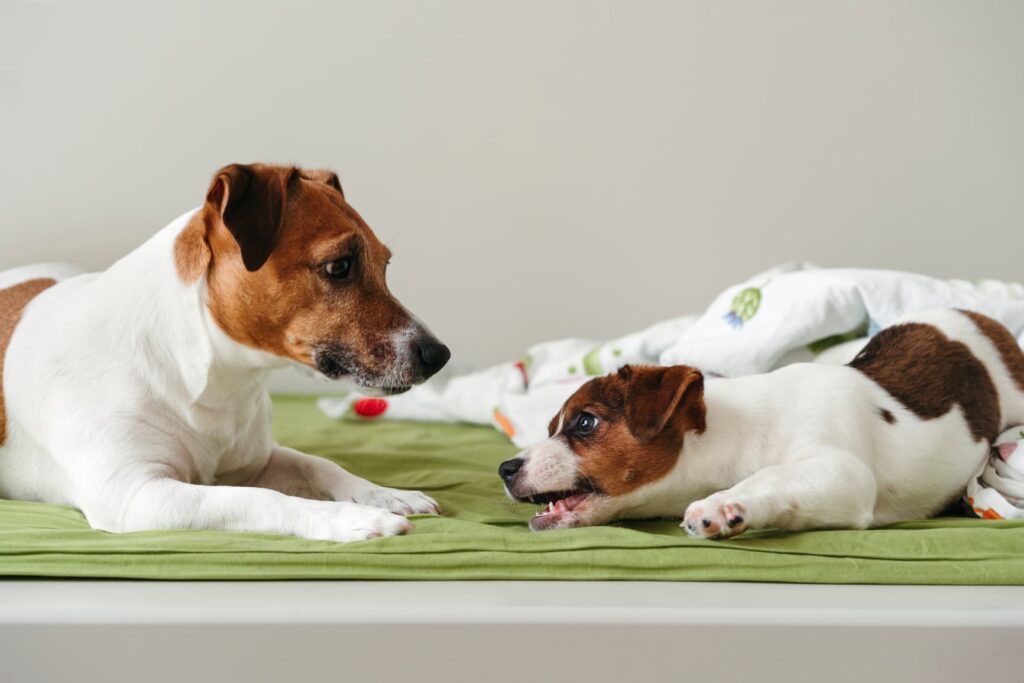
As with other dog behaviors, you do need to look at context when it comes to growling. There are times when a dog growls because they’re playing. If your dog and another dog are taking turns chasing each other, and they show happy body language—like loose, wiggly wags and an open, relaxed, “smiling” mouth—the growling sounds you hear may be a harmless part of play.
Why shouldn’t you punish your dog for growling?
If your dog finds out that they’re not allowed to growl, because you scold or otherwise punish them for vocalizing, they may look for other ways to deal with their feelings—including by snapping or biting.
“If you punish the dog for growling,” said Zazie Todd, PhD, a psychologist and certified dog trainer who wrote Bark! The Science of Helping Your Anxious, Fearful, or Reactive Dog, “you stop them from growling—but you don’t stop them from feeling uncomfortable, stressed, or unhappy in that situation. So you can actually end up with quite a dangerous situation where your dog is really stressed out, really anxious, really uncomfortable. And they can’t tell you by growling, because you’ve told them not to.” In those cases, she said, dogs “can be more likely to progress to a bite.”
“Growling is low on the rung of what we call the aggression ladder,” said Maddie Messina, a certified dog trainer and founder of Paws for Thought Dog Training. “If we don’t address the emotions, the dog will still potentially want to display aggression in certain situations. We can punish a behavior and make it stop happening. We can teach your dog not to growl. That just means that we don’t have any of those precursor steps to something like a bite.”
“Let’s imagine we have a railway crossing, and red lights flash,” Dr. Dunbar said. The red lights are not what’s slowing down your commute; that’s the train crossing in front of you. The lights are providing you with valuable information. “Why don’t you smash the red lights so they don’t work anymore? Now you have no warning. If we punish the dog for growling, he won’t warn us now when he’s upset. So he’ll get under more and more and more pressure till he explodes.”
Punishing growling can also damage your bond with your dog.
“When we’re thinking about your relationship with your dog,” Messina said, “we’re looking at reinforcement history. How much are your interactions weighted towards the positive and the pleasureful side, and how much are your interactions weighted to the aversive side? If you have a stronger history of providing aversive experiences, that could certainly damage your relationship [and] their perception of you.”
On the other hand, if you show your dog that you’re there to guide them through challenges, that will make them more likely to trust and follow you.
What should you do about a growling dog?
If your dog is growling, figure out what’s bothering them and either avoid it or change the way they feel about it.
“Most therapists, when humans are feeling fearful, don’t chastise them for that,” said Messina. “Because that’s not typically how to make a human feel better about a conversation with their boss or something.”
But you can help your dog overcome their fears through desensitization and counterconditioning.
Desensitization means exposing a dog to a stimulus at a low level that doesn’t bother them, and slowly increasing its intensity as they get used to it.
Counterconditioning means giving the dog good things, like treats, when they’re exposed to the stimulus, so that over time they start to think of it as a positive.
The key in both of these cases is to only progress at your dog’s pace, and when they are comfortable; don’t force your dog into a situation that’s making them panic and think you can solve the problem by putting a treat in front of their face.
Dr. Furlong talked about giving dogs options when facing necessary activities that may not be their favorites—like, for example, nail trimming. One method involves making it clear that, when they stand on a certain mat where that activity takes place, they get treats.
“When they’re on the mat, it’s a treat party,” Dr. Furlong said. “They can step off of the mat, in which case then they’re not getting that treat party, but they’re also not having their nails trimmed. And if they come back to the mat, then we’re going to trim the nails and have that treat party.”
So your dog has a choice, and you’re making it worth their while to make the choice you prefer.
Management is another tool you can use here; while you should equip your dog to handle situations they’re going to encounter, it’s fine and safe to avoid their triggers when you have the option.
Be there for your dog
You and your dog will fare best if you treat growling less like a problem, and more like the start of a conversation with your best friend.
“Your dog needs to be comfortable telling you that they feel uncomfortable,” said Dr. Todd, “because that enables you to do something about it.”
Related Topics
Related Topics
More on Lifestyle
Lifestyle, Training & Behavior • 8 minutes
How to Prepare Your Dog for Their Halloween Costume
Don’t spook your pooch on Halloween! Here’s how to ease them into their costume.
Lifestyle, Training & Behavior • 8 minutes
Why Does My Dog Follow Me Into the Bathroom?
A dog’s love knows no bounds.
Health & Wellness, Lifestyle, Science & Research • 8 minutes
Is It OK if My Dog Licks Me?
We all know where those mouths have been.
Lifestyle, Training & Behavior • 8 minutes
How to Prepare Your Dog for Their Halloween Costume
Don’t spook your pooch on Halloween! Here’s how to ease them into their costume.
Lifestyle, Training & Behavior • 8 minutes
Why Does My Dog Follow Me Into the Bathroom?
A dog’s love knows no bounds.
Health & Wellness, Lifestyle, Science & Research • 8 minutes
Is It OK if My Dog Licks Me?
We all know where those mouths have been.