Share article:


In this article:
- Do dogs know when time is passing?
- Do dogs understand daylight saving time?
- Can dogs adapt to changes in people’s schedules?
- How can I help my dog adjust to daylight saving time?
This article was originally published in February of 2025, and has been updated.
Dogs are smart, talented creatures. As a species, they have a knack for problem-solving and communication. Some of them run complex obstacle courses and amass large vocabularies. And, yes, to some extent, they can tell time.
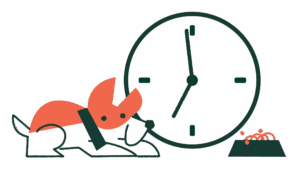
But what do dogs make of daylight saving time, humans’ divisive practice of setting clocks ahead in summer so that the sun will be out later (or, more precisely, when the clock says it’s later)? Do they immediately grasp what’s going on? Does it turn their world into a Dalí-esque mess of melting timepieces, unmooring them from reality? Or is it a mildly confusing experience that, in most cases, passes quickly? The short answer is: Most of the time, it’s the third thing. But the long answer is more nuanced. As we prepare to set our clocks back one hour on November 1, we decided to take a deep dive into the subject. Here’s what we learned.
Do dogs know when time is passing?
It’s not true that dogs live only in the moment; there’s ample evidence that they know time is passing. That’s why yours may complain if you are a few minutes late serving them dinner or taking them out for a walk. Plus, you may notice that dogs tend to greet people more exuberantly after long absences than short ones.
Like most living beings, dogs have a circadian rhythm—a 24-hour cycle impacting sleep, appetite, and much more. Stanley Coren, PhD, professor emeritus at the University of British Columbia, told us that sunlight is a key factor in dogs’ sense of what time it is. “We know that dogs respond to the lightening and darkening that occur during the daily cycles,” he said, “and there are small things we can pick up.” Dr. Coren said to watch when your dog gets ready for routine occurrences like going out for a bathroom break. “They will very often sync that,” he said, “to what the light level is.”
Alexandra Horowitz, PhD, who leads the Horowitz Dog Cognition Lab at Barnard College, has said that dogs might also be able to “smell” time, tracking how much their people’s scents have dissipated since their departures. EEthologist Marc Bekoff, PhD, professor emeritus of ecology and evolutionary biology at the University of Colorado, Boulder, wrote about this ability in his book Dogs Demystified. “They’re not really telling time like we do,” he said, but “may associate a certain odor [with] when, for example, someone arrives home, and then wait for that person or persons as if they know they will be there.”
Dogs may pick up on other patterns, too. Dr. Coren cited “changes in the traffic level” as a subtle cue that can clue a dog in about what time it is.
And, of course, when it comes to eating or taking a bathroom break, dogs will experience natural sensations that can become more urgent with time: They’ll feel hungrier, or more like they “have to go.”
But one way that dogs do not tell time is by reading clocks.

Do dogs understand daylight saving time?
There’s no evidence that dogs understand our human systems of timekeeping, so they may be temporarily confused by daylight saving time. Neither the rate of smells’ dissipation nor light levels change when we set our clocks differently, so as far as dogs know nothing has shifted except our schedules.
Even people, who know about the time shift, sometimes struggle with different daylight hours—so it’s natural that dogs, without this knowledge, can also have some difficulty with it.
When you “fall back” as daylight saving time ends, your dog may become annoyed or confused. “If you’ve just moved the clocks backwards,” said Dr. Coren, “then they’re going to get their morning feeding later. And some animals will become quite insistent: ‘Hey, stupid, get up and feed me.’”
But Dr. Coren said that, for most dogs, this is no big deal and they’ll get used to it. Under normal circumstances, they should acclimate to the changes within a few days—or, certainly, weeks. And you can make it easier by shifting your dog’s schedule gradually (i.e., 15 minutes at a time). That way, they won’t have too long of a gap between meals.
Can dogs adapt to changes in people’s schedules?
“The vast majority of dogs,” said Dr. Coren, “are patient enough that they put up with our disruptions to their normal scheduling.”
“There’s an easy experiment people probably have conducted without even noticing it,” he said: taking a vacation in a different time zone. “You will be eating your dinner and your breakfast according to the new time zone,” Dr. Coren said, and most of the time your dog will adjust to this smoothly enough. In fact, your own family’s rhythms will be an important part of your dog making sense of their new schedule. “I think that dogs will be much more responsive overall to the shifts in the activity level of the family they’re living with,” Dr. Coren said, “rather than the light levels or the clock.”
How can I help my dog adjust to daylight saving time?
As noted above, if your responsibilities allow, you can shift your dog’s meals and other activities by 15 minutes at a time instead of one hour all at once, easing them into a new normal. And remember to be patient with your dog if they do have some trouble with daylight saving time—they have no idea what’s going on, and do like routine.
But if your work or school schedule requires you to be out the door at a new time, don’t stress too much as long as you’re giving your dog an appropriate amount of food, exercise, and company and they seem happy.
And what about when you “spring ahead” and your dog gets fed an hour early? In that case, they may just think it’s their lucky day.
Related Topics
Related Topics
More on Dog People

Dog People, Lifestyle, Nutrition • 8 minutes
The
Racer’s
Dog
Ryan Blaney goes fast for a living. His two dogs help him slow down.
Dog People • 5 minutes
The Chef’s Dog
Molly Baz shares how her dachshund, Tuna, turned her into a dog person.
Dog People • 6 minutes
What New York Giants Star Cam Skattebo Learned From His Dogs
And why he “rides with” dachshunds.
Dog People, Lifestyle, Nutrition • 8 minutes
The
Racer’s
Dog
Ryan Blaney goes fast for a living. His two dogs help him slow down.
Dog People • 5 minutes
The Chef’s Dog
Molly Baz shares how her dachshund, Tuna, turned her into a dog person.
Dog People • 6 minutes
What New York Giants Star Cam Skattebo Learned From His Dogs
And why he “rides with” dachshunds.