Share article:


In this article:
- Why do dogs love to lick their people?
- Are dogs’ mouths really cleaner than humans’?
- Are dog licks safe for people?
- When is it risky for a dog to lick a person?
- Which people are at the greatest risk of illness from a dog lick?
- Where should you not let a dog lick you?
- What else makes a dog lick particularly risky?
- How worried should I be if my dog kisses me on the mouth?
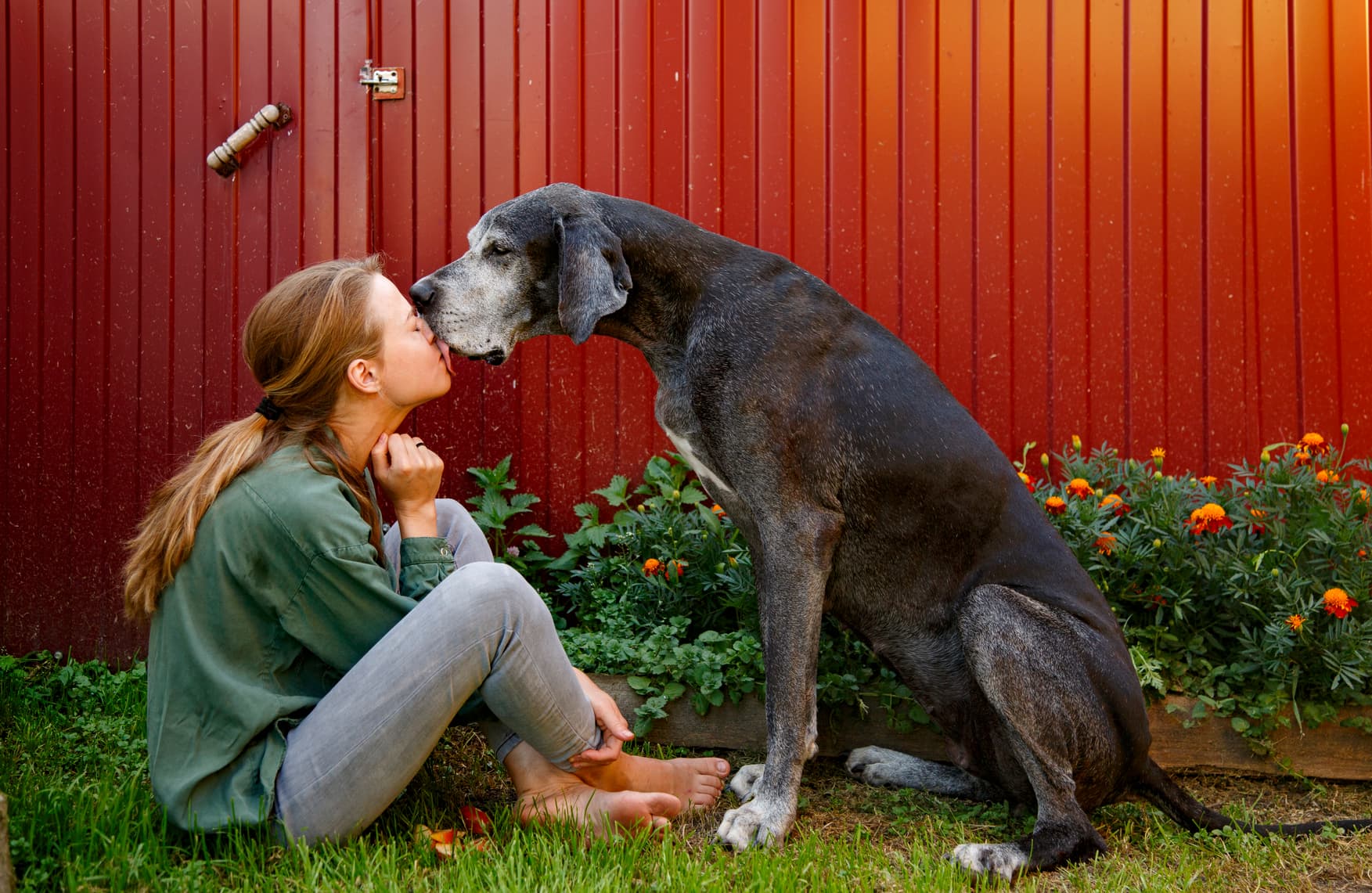
For many a dog person, it’s an honor to be on the receiving end of a dog kiss. But if we’re really honest with ourselves, it’s tough to blame anyone who thinks they’re gross. As much as we love our dogs, we’ve also probably seen them lick their own rear ends at least once—and it takes a whole lot of love to erase that kind of memory from one’s mind.
But how dangerous are dog germs, anyway? Do we need to panic when a dog smooch accidentally lands on our lips, or when an errant, drooly tongue grazes our eyeballs? And is it definitely OK for our best friends to lick us on the forehead or the foot? Despite occasional horror stories about people contracting meningitis or dying from rare infections after a single lick, Don Schaffner, PhD—department chair, distinguished professor, and extension specialist in food science at Rutgers University—said dog kisses are generally OK.
Harmful effects from a dog’s kiss tend to require a “perfect storm” of risk factors, Dr. Schaffner said—an immunocompromised person, the right bacteria, and contact with a vulnerable area. “Otherwise, we’d see people keeling over all the time from letting their dogs lick them.”
That’s just a small taste of what we’ve learned. Here’s why dogs lick their humans, how to accept canine kisses safely, and whether it’s really true that your dog’s mouth is cleaner than your own.

Why do dogs love to lick their people?
Licking is often what dog behaviorists call an “appeasement signal.” According to certified dog trainer Maddie Messina, founder of Paws for Thought Dog Training in New York City, these behaviors mean something along the lines of, “I mean no harm.” But there are other reasons dogs lick themselves, humans, and other dogs.
Some dogs like to lick the salt off a sweaty human’s body, Messina said. Others might lick “exploratively” to investigate new surroundings, people, or objects. And sometimes, dogs might use licking as a polite way to tell us we’re in their way. For example, Messina said, “if I place my leg in front of my dog on the couch, she will lick it ’til I move it.” In some cases, licking can signal underlying emotional and medical issues like anxiety or gastrointestinal distress.
And if you think your dog licks you because they love you, you’re not alone. Stanley Coren, PhD, Professor Emeritus at the University of British Columbia, a frequent Digest source, wrote in Psychology Today that “licking appears to be a natural activity that dogs may have learned from the grooming and affection given to them by their mothers when they are pups,” and “licking, or being licked, may provide comfort to the dog and may be regarded by the dog as a means of showing warm feelings toward a person.”
Are dogs’ mouths really cleaner than humans’?
We’ve all heard the saying that dogs’ mouths are cleaner than ours—and if that fun “fact” led you to raise an eyebrow, your skepticism was well founded. As it turns out, it’s not true. In fact, research has shown that the bacteria in our mouths and dogs’ mouths are barely comparable—meaning that, strictly speaking, it’s impossible to say which is cleaner.
How much bacteria is in a dog’s mouth? Unsurprisingly, it seems to depend, at least in part, on their oral hygiene. A 2022 study published in the American Journal of Veterinary Research swabbed the mouths of 51 dogs—some with healthy mouths and some with mild, moderate, or severe periodontal disease—and identified 714 bacterial species. On one hand, ew! On the other, this is not so different from common estimates of the number of bacterial species in human mouths, so perhaps we shouldn’t judge.
Are dog licks safe for people?
For most healthy adults, dog kisses are usually safe, as long as they don’t touch any open wounds, or areas like our eyes, noses, and mouths. Still, we don’t need studies to know our dogs’ mouths are not the most hygienic places on earth. If you’re wondering how risky an accidental French kiss from your French bulldog might be, Dr. Schaffner said, “Just think about where your animal’s mouth has been.” He meant this in a literal sense—if your dog’s mouth has recently gotten into something like poop or uncooked meat, for example, a kiss will be riskier.
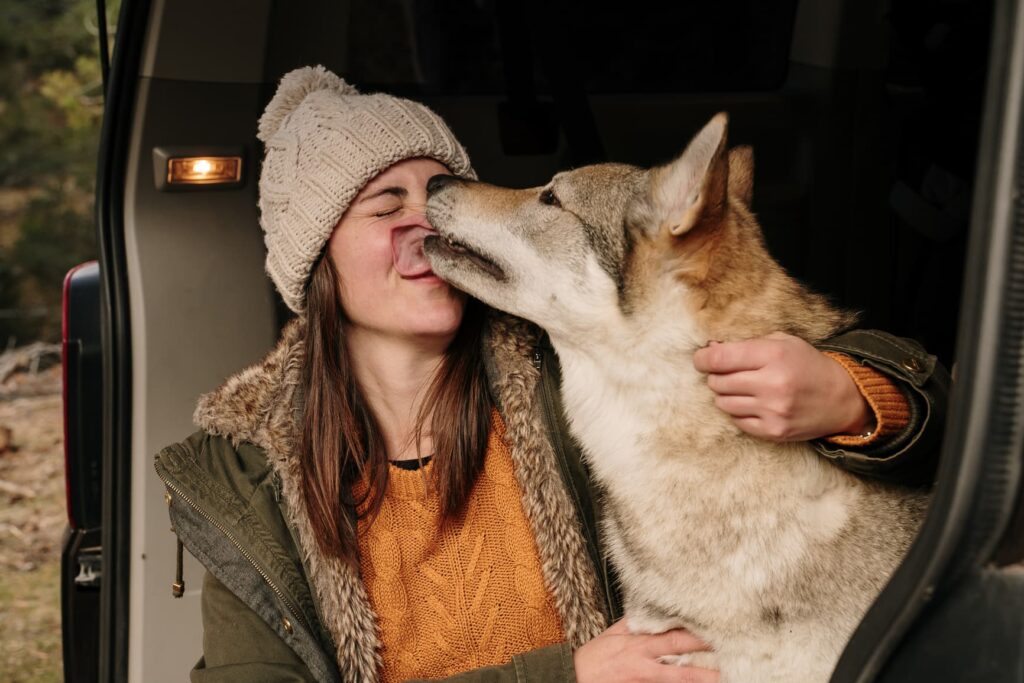
When licking might become a problem
Usually, dog kisses are nothing to worry about—even if, as Dr. Schaffner put it, they’re “not the most hygienic thing.” That said, there are a few risk factors to consider.
People at greater risk
Bacteria is a given when we’re talking about contact with any mouth, so it’s not a good idea to let your dog kiss you on the lips no matter what. And there are people at higher risk who should avoid dog kisses of any kind.
This includes:
- Babies and toddlers
- The elderly
- Pregnant women
- Those who are immunocompromised for any reason, including due to illness
- Cancer patients and others taking immunosuppressant medications
Areas to avoid
Although it’s generally safe for dogs to lick healthy skin, we should keep their tongues away from any area that provides direct access to our body systems. That includes open wounds, which can become infected, and parts of our body with mucous membranes—like the eyes, nose, and mouth.
“Part of why mucous membranes are riskier is because they’re wet,” Dr. Schaffner explained, “and so that’s going to allow more of the bacteria to transfer versus, let’s say, dry skin.”
Other risks to consider
Some dogs’ mouths might be incubating more harmful bacteria than others. For example, Dr. Schaffner said, “It’s very trendy right now to feed your pets raw meat as a raw meat diet.” But doing so can carry risks to human health. If your dog just finished chowing down on a raw chicken cutlet, “they may still have salmonella in their mouth. And if they give you a kiss, well, guess what? Now you’ve got salmonella on you.” This is one of many good reasons not to feed your dog raw meat, which can also be risky for them.
Poor dental health might carry additional risks as well: The 2022 American Journal of Veterinary Research study found that certain bacteria appeared more abundantly in dogs with more severe periodontal disease.
Researchers could not determine whether the disease led to the bacteria or vice versa, but either way, it suggests that dogs with more severe disease may have more bacteria percolating in their mouths. Some diseases, like rabies, are transferred through saliva, which is one of many reasons that it’s important to keep your pets up to date on their vaccines.
How worried should I be if my dog kisses me on the mouth?
If you have a dog who loves to lick, chances are their tongue will end up in your mouth at one point or another. “Having experienced this before,” Dr. Schaffner said, “my natural reaction is to say, ‘Yuck.’” And, no, it’s not something you should intentionally let your dog do. But there’s likely no need to panic.
“I think if you are worried and you have some mouthwash, this might be a perfectly good time to use it,” Dr. Schaffner said. “It’s probably not necessary, but again, it depends on the dog. It depends on the person. It depends on whether you have mouthwash handy or not.”
If you’re still worried, symptoms to watch for would include fever, vomiting, and diarrhea—all of which would cause concern with or without an errant kiss from a dog. If your dog licks you and you find yourself, say, running a fever within the next one to three days, it might be worth mentioning to the doctor when you visit. “They may just go ahead and treat the symptoms and give you antibiotics or tell you to take Tylenol,” Dr. Schaffner said. But at least they’ll have all the information.
Most of the time, however, a dog’s kiss is just a sweet (and, yes, kinda gross) reminder that no matter what, they’ll always love us—sometimes, a little too much.
Related Topics
Related Topics
More on Health & Wellness
Health & Wellness • 12 minutes
What Should I Do If My Dog Isn’t Eating?
Here’s veterinarians’ advice for what to do if your dog loses their appetite.
Breeds, Health & Wellness, Nutrition, Training & Behavior • 17 minutes
The Corgi Care Guide
Don’t let the tiny legs and infectious smiles fool you—these working dogs need a lot of physical and mental exercise.
Health & Wellness, Nutrition • 14 minutes
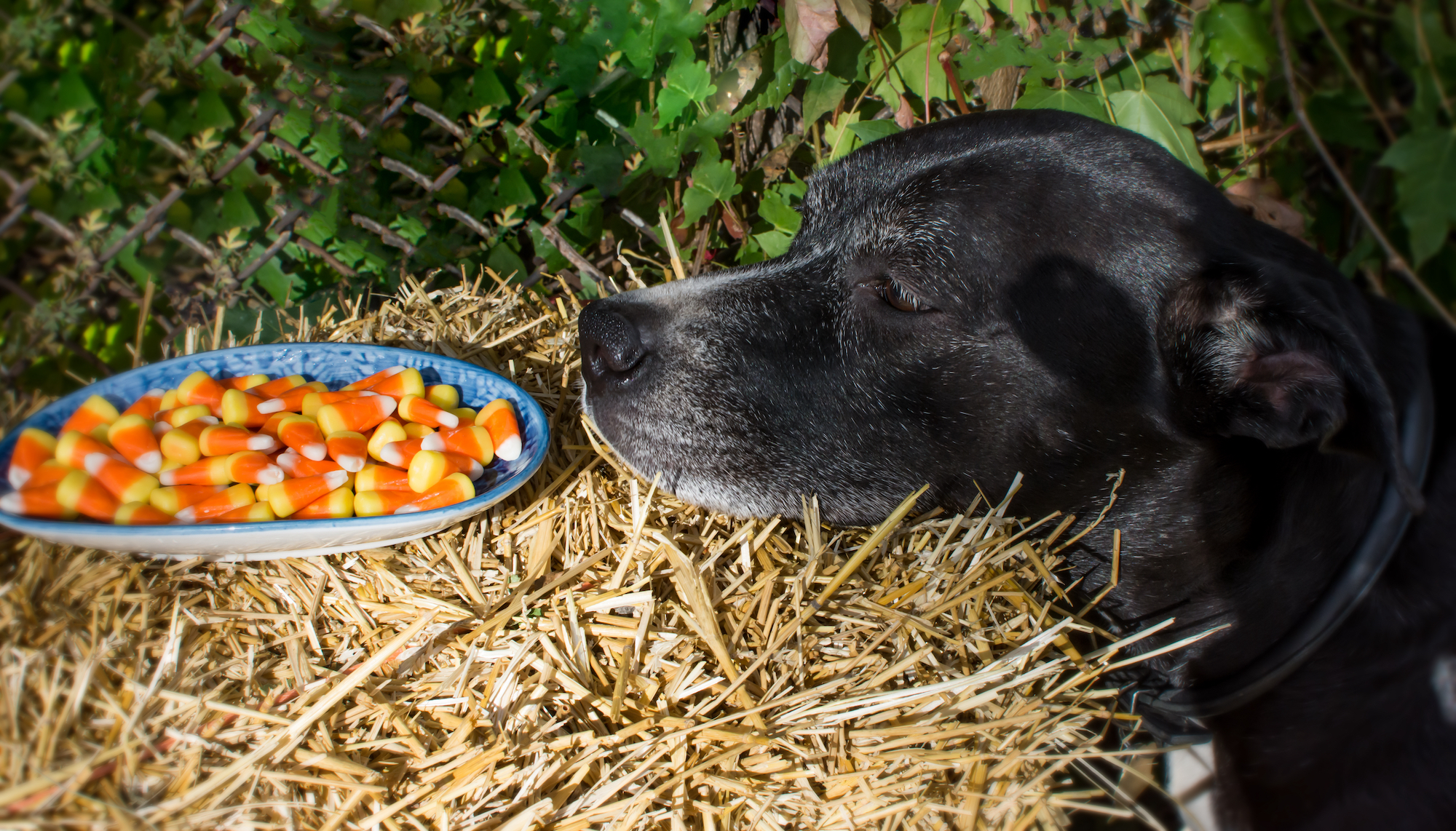
Can My Dog Eat Halloween Candy?
Many spooky-season treats are downright scary for dogs. Here’s how to keep yours safe.
Health & Wellness • 12 minutes
What Should I Do If My Dog Isn’t Eating?
Here’s veterinarians’ advice for what to do if your dog loses their appetite.
Breeds, Health & Wellness, Nutrition, Training & Behavior • 17 minutes
The Corgi Care Guide
Don’t let the tiny legs and infectious smiles fool you—these working dogs need a lot of physical and mental exercise.
Health & Wellness, Nutrition • 14 minutes
Can My Dog Eat Halloween Candy?
Many spooky-season treats are downright scary for dogs. Here’s how to keep yours safe.