Share article:


In this article:
- What is spaying or neutering a dog?
- Why should I spay or neuter my dog?
- What factors determine when I should spay or neuter my dog?
- Should I spay before or after my dog’s first heat?
- When should I spay or neuter my large-breed dog?
Spaying or neutering your dog brings many benefits. In addition to preventing unwanted pregnancies and pet overpopulation—important considerations when so many dogs are already waiting for their forever homes—the procedure greatly reduces the risks of severe health issues like pyometra.
That said, not everyone agrees about the best time to spay or neuter a dog. According to Brian Collins, DVM, Diplomate of the American Board of Veterinary Practitioners, with the Cornell Richard P. Riney Canine Health Center, precisely when to spay or neuter a dog is a “controversial topic.” Over the course of his career, the standard guidance has evolved.
“[Veterinarians] pretty much had a standard of waiting till they’re around six months” to spay or neuter, Dr. Collins said. “But then more and more thought has been given into waiting potentially longer for some breeds, and trying to determine if there is an ideal minimum age to spay and neuter.”
Even now, there’s no single, definitive answer. “If you ask 10 veterinarians, you’ll probably get eight different answers,” said Kaitlyn Krebs, DVM, Diplomate of the American Board of Veterinary Practitioners (canine/feline).
The timing of a spay or neuter is a decision best made together with your veterinarian, whose expertise and knowledge about your pet’s history and needs make them your best partner for health decisions. Having said that, here are some different factors to consider in deciding when to spay or neuter a dog.
What is spaying or neutering a dog?
Spaying refers to the removal of a female dog’s ovaries, fallopian tubes, and uterus (though in some cases, just the ovaries are removed), while neutering refers to the removal of a male dog’s testicles. (If you confuse these terms, remember that “spay” and “she” start with the same letter.) Both of these are surgical procedures that make a dog unable to reproduce, and eliminate behaviors related to breeding and heat cycles.

Why should I spay or neuter my dog?
According to the American Veterinary Medical Association, “Spaying and neutering are important for preventing unplanned or unwanted litters, and reducing pet overpopulation.”
But there are health and behavioral considerations to spaying and neutering, too. We’ll describe the specific health benefits associated with spaying or neutering a dog at different points, but in general these procedures can reduce the risk of certain cancers, orthopedic problems, urinary incontinence, and other health conditions.
Spayed dogs also don’t go through an estrous cycle or attract as much attention from intact males. Intact females release pheromones, or chemicals detected by smell, that indicate whether they’re in heat. Neutered dogs, meanwhile, are less likely to roam in pursuit of female dogs, a behavior that can be frustrating for humans and sometimes dangerous to dogs.
What factors determine when I should spay or neuter my dog?
When to spay or neuter varies based on several factors, including your dog’s size and their risk of developing certain health conditions. In general, some dogs can be spayed as early as 5 months or neutered at 6 months, while others ought to wait as long as two years.
Size
Sex organs impact dogs’ growth via the release of hormones. As puppies reach sexual maturity, testes in males release testosterone and ovaries in females release estrogen, both of which contribute to musculoskeletal growth. While spaying and neutering don’t affect a dog’s full size, they do result in a longer growth period because the dogs’ bones take longer to finish growing.
From an orthopedic point of view, there’s an advantage to waiting until a dog is finished growing to spay or neuter them, because it decreases their risk of developing a bone or joint problem, like a cranial cruciate ligament (CCL) tear. Large-breed dogs take up to two years to finish growing, and have an increased risk of orthopedic conditions, so there’s arguably more at stake behind the timing of this decision for them than for smaller dogs. By the time large female dogs reach age 2, they’ve reached sexual maturity and have undergone heat cycles—the two- to three-week periods during which they can get pregnant.
“From a purely orthopedic point of view, it would be ideal if you could wait until skeletal maturity [to spay or neuter],” Scott Rutherford, Diplomate of the European College of Veterinary Surgeons, Fellow of the Royal College of Veterinary Surgeons, and assistant professor at The Ohio State University College of Veterinary Medicine, told us.
A 2024 study by the University of California, Davis analyzed health outcomes in different dog breeds who were spayed or neutered at different points. With this paper, the school offered suggested spay/neuter timelines on over 40 breeds, recommending certain dogs undergo the procedure at 6, 12, or 24 months. That same paper recommended that female golden retrievers never be spayed.
Dr. Collins expressed skepticism about this paper’s findings, because they came from a retrospective study—one based on existing data that wasn’t randomized. He said that, while these recommendations can offer some insight on the relationship between spay or neuter timing and the development of certain conditions, they shouldn’t be considered definitive, and that more scientific research is necessary.
Similarly, Dr. Rutherford said that while this study suggests neutered dogs may be more prone to diseases like elbow dysplasia or CCL, larger prospective studies would be necessary to produce rigorous data on these risk factors.
Small dogs reach skeletal maturity as early as 6 months—which is also around when they reach sexual maturity—so an earlier spay or neuter is less risky for them.
Health conditions
The timing of spay and neuter brings crucial health implications beyond reproductive organs.
According to the American Animal Hospital Association (AAHA), waiting to neuter your dog until he’s fully grown can “decrease the risk of certain cancers and bone, ligament, and joint problems in some breeds.”
This decision is trickier for spaying. While, as the AAHA notes, spaying later can decrease risk of some cancers and orthopedic problems, spaying a dog before her first heat cycle can greatly reduce the risk of mammary cancer—and eliminates the risk of unwanted litters entirely.
Another condition common to unspayed dogs is pyometra, which is a uterine infection caused by hormonal changes. According to the Merck Veterinary Manual, it’s reported most in dogs older than 5 years, and the infection occurs four to six weeks after a heat cycle, “[when] the uterus is more prone to infection,” Dr. Collins said. The uterus can fill with pus, resulting in a life-threatening condition whose treatment “almost always requires surgery” to remove the uterus and ovaries. He added that in cases of pyometra, a dog may be older and sicker than they would be at a typical age for a spay, making the procedure and recovery more difficult.
He added that intact males are at risk of developing testicular cancer and perineal hernias, or hernias that protrude around the anus, as well as benign tumors in the same spot. These tumors can grow “quite large,” but can regress after neutering, Dr. Collins said.
Lifestyle
If your dog—female or male—is allowed off-leash, then Dr. Collins recommended a spay or neuter before sexual maturity to prevent unwanted litters of puppies. A dog can even become pregnant or impregnate another dog in a setting like a dog run.
Rescue status
If you’re adopting a dog from a shelter, then they’re likely already spayed or neutered, potentially from a young age, for population-control reasons. Dr. Collins said that vets “are very comfortable” sterilizing dogs as young as 8 weeks old, especially if they live in a shelter where they need to be spayed or neutered before getting adopted.
Should I spay before or after my dog’s first heat?
This is yet another question where veterinarians differ.
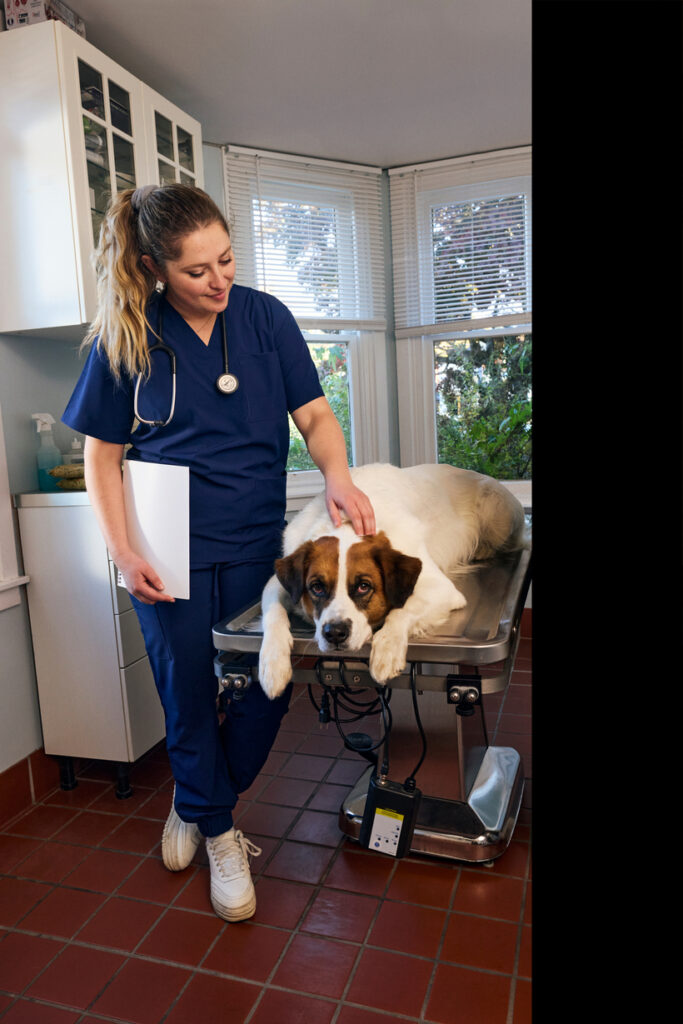
Dr. Krebs and Dr. Rutherford both suggested waiting to spay a dog of any size until after her first heat. Dr. Krebs highlighted the “beneficial hormonal influence” from reaching sexual maturity, and Dr. Rutherford mentioned that waiting until after she’s had a heat cycle also brings her closer to full growth.
Dr. Collins said that, weighing all of the risks, he’d rather spay a dog before her first heat cycle. However, he would also recommend holding off until later “when the evidence is strong…that waiting until [sexual] maturity could be beneficial.” Essentially, this is a complex decision to work through with your vet, who will have the most context on your dog’s individual needs and risks.
Dr. Krebs added that if you do spay your dog once she’s had a heat cycle, she recommends waiting until at least two months after. That’s because, during heat, a dog’s body directs more blood toward her reproductive organs, which increases the risk of bleeding during the procedure.
When should I spay or neuter my large-breed dog?
Dr. Rutherford, as a veterinary orthopedic surgeon, focused on the importance of waiting until skeletal maturity to spay large and giant breeds, considering their increased risk of bone and joint problems.
Dr. Collins supported waiting to spay or neuter when evidence supports a benefit to waiting, but only for up to about one year.
While Dr. Collins recognized the risks of sterilizing a large breed too soon, he said, “I’m probably not going to be waiting much more than a year to recommend spaying a large- or giant-breed dog.” In part, he said, this is because waiting too long to spay a giant dog brings its own set of potential issues. He said that a fully grown female giant-breed dog, with a larger body, larger organs, and more body fat, has an increased risk of bleeding and other complications during the procedure.
This is a complex issue, and there’s no single “right” answer about when to spay your dog. But, armed with this knowledge and working together with your veterinarian, you can make the decision that works best for you and your dog.
Related Topics
Related Topics
More on Health & Wellness

Health & Wellness, Training & Behavior • 8 minutes
Why Do Dogs Love to Roll in Smelly Things?
Here’s where they get their passion for pungency, and what to do about it.
Health & Wellness • 8 minutes
How to Bond With Your Dog at Mealtime
Feeding time is a built-in chance to strengthen trust and communication.
Health & Wellness, Lifestyle, Science & Research • 8 minutes
Is It OK if My Dog Licks Me?
We all know where those mouths have been.
Health & Wellness, Training & Behavior • 8 minutes
Why Do Dogs Love to Roll in Smelly Things?
Here’s where they get their passion for pungency, and what to do about it.
Health & Wellness • 8 minutes
How to Bond With Your Dog at Mealtime
Feeding time is a built-in chance to strengthen trust and communication.
Health & Wellness, Lifestyle, Science & Research • 8 minutes
Is It OK if My Dog Licks Me?
We all know where those mouths have been.