Share article:


In this article:
- Why does my dog love fall leaves?
- Is it safe for my dog to play in leaves?
- Is it safe for my dog to eat leaves?
- What should I do after my dog plays in leaves?
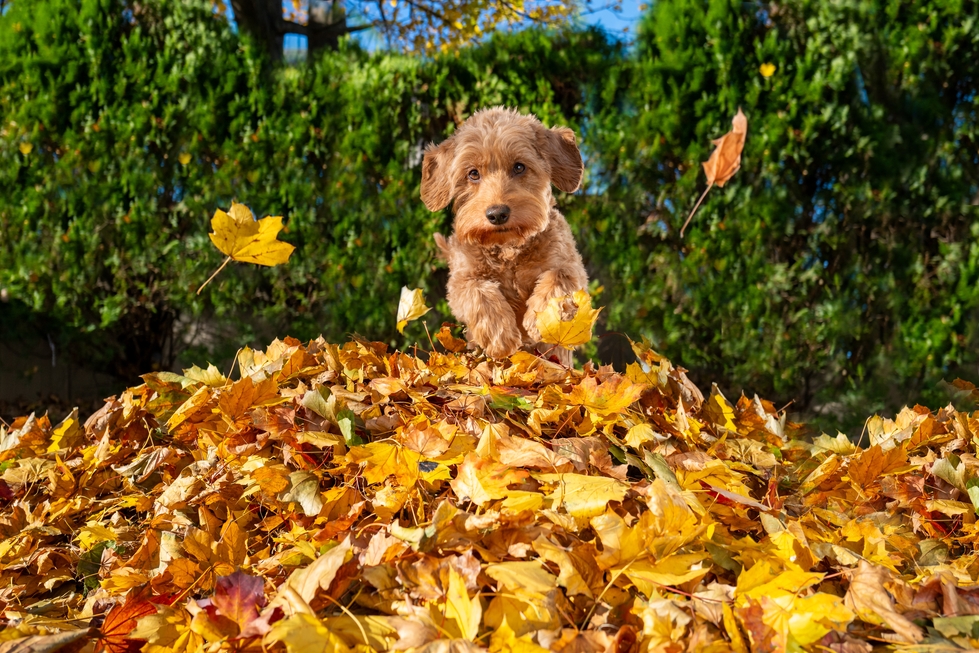
On a crisp autumn day, a yellow Lab named Stella (star of TikTok and Instagram accounts conveniently labeled “@dognamedstella”) is galloping across a leaf-strewn yard. Eyes fixed ahead, she’s racing toward a target: the motherlode of leaf piles. Just before reaching this mountain of tree detritus, her paws lift off the ground. She sails into the mass with a satisfying whoosh. She’s subsumed except for her tail, which wags gleefully. Inside the leaf pile, she’s treated to a plethora of smells and sounds that only a fortress of crinkling leaves can offer.
Now 13 years old, Stella has been celebrating autumn this way since 2015, along with fellow yellow Lab and leaf enthusiast, 6-year-old Mabel. Mabel and Stella live in Maine with their owner, Jody Hartman, who personally rakes every leaf pile they enjoy. Earlier this month, the pair marked the season’s start with their first leap, as reported by CBS News.
You may recognize this behavior in your own pooch, but not know why they lose their mind over dead leaves. It turns out that this crunchy, vibrantly colored plant matter offers an excellent opportunity for sensory enrichment and mental stimulation.
“Dogs experience life through their noses,” said Lisa Radosta, DVM, Diplomate of the American Board of Veterinary Behaviorists and owner of the Florida Veterinary Behavior Service, and a leaf pile is chock full of interesting smells.
Below, we offer you the opportunity to take your own leap into a metaphorical pile of fun facts about leaves’ appeal to dogs—plus tips on how to make sure that your dog enjoys them safely.
Why does my dog love fall leaves?
Your dog may obsess over leaves for a number of reasons, according to Dr. Radosta.
They like the smell
Dead leaves offer some intriguing odors to a dog: soil, fungi, insects, and prey animals like squirrels. If your dog seems jazzed to smell some fallen leaves on their walk, let them enjoy it. “Sniffing is powerful enrichment for dogs,” Dr. Radosta said.
Imagine those myriad scents surrounding you, paired with the rustling sounds and crunchy feeling from every move. To a dog, a leaf pile is a sensory-immersion extravaganza.
And if your dog loves rolling in leaf piles, it may be so they can carry that earthy stink with them. “That scent gets all over the dog, and they love to smell like earthy stuff,” Dr. Radosta said.
They crave novelty
Your dog may love leaves just because they’re something different. Your dog constantly absorbs information through their senses, and may spend most of their day in a single, generally static environment. A leaf pile offers novel opportunities to tunnel and romp as they take in outdoor sounds and smells. Maybe this is your dog’s first encounter with a pile of leaves. Or, after a long day inside, they might want to investigate a structure bursting with sounds and smells they can’t get at home.
They can play
Playtime offers crucial mental and physical stimulation to dogs, and leaves might as well be a heaven-sent toy. Jumping in leaf piles and other leaf-related play is “kind of a game for them,” said Renee Schmid, DVM, Diplomate of the American Board of Veterinary Toxicology, director and senior veterinary toxicologist at the Pet Poison Helpline.
Make a game of throwing a toy into a freshly raked leaf pile for them to find. (Just make sure the toy is big enough for them to come across, and you may want to opt for a toy with a smooth surface, like a rubber ball instead of a plushie, for easy cleaning.) This way your dog gets the benefit of smells, plus the mission of a toy hunt. But avoid leaf piles that you didn’t make yourself, since they may hide dangers your dog could run into, like feces or another animal.
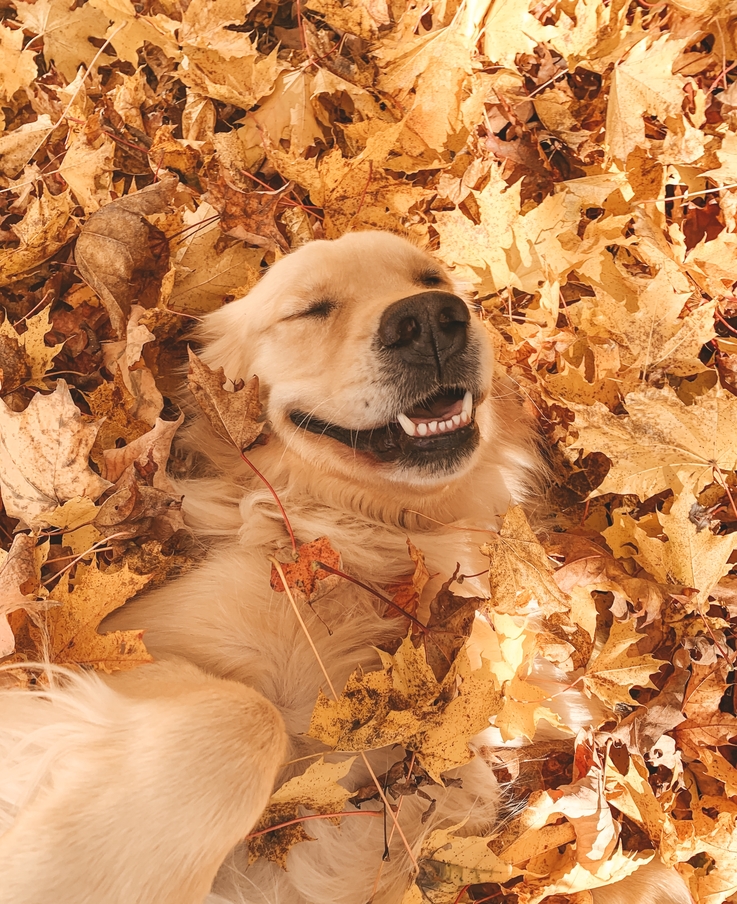
And play is great for dogs. “It’s self-rewarding through the positive emotional state that the dog is in when they engage in that behavior,” said Dr. Radosta. Stella and Mabel are queens of diving, hiding, and lounging in leaf piles, but there are plenty of ways to play among the fall flora. “What is [more] common is dogs rolling in piles of leaves, digging in them, zooming through them, eating them, and carrying leaves around,” she said.
Your dog stands to benefit from playing in leaves—as long as they do so safely. (More on that later.)
They learned to enjoy it
Depending on how you respond to your dog’s casual investigation of a stray leaf or leaf pile, you may train them to love leaves. “If a dog investigates a leaf pile once and the pet parent gets excited over their behavior, that can be rewarding,” Dr. Radosta said, “causing the dog to investigate it further.” Your dog learns that when they interact with leaves, they receive praise or positive reinforcement through your response, so they’re incentivized to repeat that behavior.
Or, you may inadvertently teach your dog what fun it is to dive in a leaf pile. For example, if you’re playing fetch and accidentally throw their ball into a leaf pile, in retrieving it they may realize that leaves are really where the party’s at. Congratulations—you just taught your dog one of the joys of autumn, even if you didn’t mean to.
Is it safe for my dog to play in leaves?
We’ve established that leaves are fun for many dogs, and why. Unfortunately, they can also be risky. Ticks, mold, and other dangers that could sicken or injure your dog may reside in an innocent-looking leaf pile.
But you can take precautions to help your dog play in fall foliage safely.
Beware of what lurks under the leaves
Never let your dog play in an unexamined leaf pile, especially if it’s wet or damp. “My biggest concern would be the development of mushrooms and fungus,” Dr. Schmid said. Festering leaves may nourish fungi and mushrooms. They can also hide ticks ready to latch onto your dog. Lurking in these mounds could also be acorns, other harmful plant matter, and animal feces that could be dangerous should your dog ingest them while leaf diving. Any of these could make your dog sick.
Sharps or other foreign objects are also potential dangers in an un-vetted leaf pile. The bottom line is that there’s a reason “look before you leap” is a phrase. And when it comes to your dog, you’ll have to do the looking.
If you can’t see your dog, neither can anyone else
Never let your dog play in a leaf pile anywhere near a road or driveway, as drivers won’t know to look for them. Likewise, keep them away from storm drains and grates where they may catch their paws or even fall through.
The safest move is to rake your own leaf pile
If your dog loves leaf-leaping as much as Stella and Mabel, one thing you can do is rake up a pile for them yourself in the yard or park, like Hartman does. (Hartman even uses a portable hairdryer to cure the leaves, and then shelters the piles under a tent so they stay dry.) This way, you can make sure you know what went into the pile, and keep out anything that might be a hazard to your dog. While this doesn’t guarantee an insect-free experience (get ready to tick-check afterward), you can have peace of mind that your dog is frolicking in a mountain of dry, freshly fallen leaves that isn’t decaying.
Is it safe for my dog to eat leaves?
Some leaves are relatively harmless for dogs to ingest, but others can be hazardous.
As fallen leaves go, oaks are “the largest concern,” Dr. Schmid said. Both oak leaves and acorns, when ingested in large quantities relative to the dog’s size, can cause liver damage, kidney damage, and white blood cell changes, signaled by vomiting, diarrhea, and lethargy.
As a behavior, trying to eat leaves is normal for dogs. “Dogs, like toddlers, put everything in their mouth,” Dr. Radosta said. That’s why you have to be on the lookout and make sure that they don’t ingest anything that puts them in danger.
In addition to the dangers of poisonous leaves like those from oak trees, acorns can be dangerous to dogs. They can obstruct the digestive tract, and are particularly dangerous to small dogs who can’t easily pass them. Dr. Schmid said if a small dog eats three to five acorns, that could poison them or block their large intestine. If you have oaks in your yard or along your walking route, keep an eye on your dog to make sure they don’t eat any acorns or leaves; if they do, call the vet.
Black walnut trees are another risk—not because of their leaves, but the walnut hulls, the bark, and the twigs that break off from branches. Ingesting any of these could cause neurologic issues such as tremors.
A number of other non-tree plants also pose danger, especially if their leaves and branches get swept up into leaf piles. Dr. Schmid flagged oleander, azaleas, rhododendrons, and yew plants as highly toxic flora that affect the heart. If you have these plants in the yard where your dog plays, make sure you dispose of their trimmings separately, and don’t sweep up their debris into any leaf piles. (She also noted the sago palm in warmer climates as toxic to dogs.)
Never let your dog eat damp or wet leaves, especially if they’ve been on the ground for a while. These leaves likely nourish mushroom-growing fungi as they decay. When ingested, Dr. Schmid said, “some mushrooms just cause stomach upset, [while others] cause liver failure and neurological signs,” like difficulty walking and tremors. Some fungi produce tremorgenic mycotoxins—compounds from mold that, when ingested, can cause tremors or seizures that last hours or days. Signs of intoxication may begin as soon as one hour after ingestion or up to several hours later. They include:
- Vomiting
- Tremors
- Sensitivity to touch, temperature, sound, or light
- Trouble walking
- Heart-racing
- Seizures
If you suspect your dog has eaten unidentified mushrooms, moldy leaves, poisonous leaves, or a large quantity of any leaves, call your vet.
What should I do after my dog plays in leaves?
Check your dog for ticks immediately after leaf-pile playtime. Dr. Radosta said that, if your dog doesn’t allow you to touch their ears or feet for a tick check, they shouldn’t play in leaf piles at all.
Ticks may carry bacteria that can infect dogs with life-threatening diseases like Lyme. These diseases can infect your dog just hours after the tick latched on. Ticks may be as small as a poppy seed or as large as a fingertip.
Check for ticks with a feel test by running your hands along your dog’s body. Starting at the head and working your way back, run your fingers through your dog’s fur, next to the skin, like a fine-toothed comb.
Concentrate around these areas:
- Head, including around eyes, inside and behind ears, and under chin
- Neck, including under the collar
- Feet, including bottoms of paws and spaces between toes
- “Armpits” where the front legs meet the body
- Under their tail
There are also a number of products and medications on the market to protect against ticks; talk to your vet about what’s right for your dog. Read more about how to prevent bites and remove ticks here.
And if your dog got extra down and dirty in the leaves, you may want to brush or bathe them to get all the detritus out. Just be warned that your best friend might soon be eager to lose that fresh dog-shampoo aroma in another crunchy, smelly leaf pile.
Related Topics
Related Topics
More on Lifestyle
Lifestyle, Training & Behavior • 8 minutes
How to Prepare Your Dog for Their Halloween Costume
Don’t spook your pooch on Halloween! Here’s how to ease them into their costume.
Lifestyle, Training & Behavior • 8 minutes
Why Does My Dog Follow Me Into the Bathroom?
A dog’s love knows no bounds.
Health & Wellness, Lifestyle, Science & Research • 8 minutes
Is It OK if My Dog Licks Me?
We all know where those mouths have been.
Lifestyle, Training & Behavior • 8 minutes
How to Prepare Your Dog for Their Halloween Costume
Don’t spook your pooch on Halloween! Here’s how to ease them into their costume.
Lifestyle, Training & Behavior • 8 minutes
Why Does My Dog Follow Me Into the Bathroom?
A dog’s love knows no bounds.
Health & Wellness, Lifestyle, Science & Research • 8 minutes
Is It OK if My Dog Licks Me?
We all know where those mouths have been.