Share article:


In this article:
- How did the University of Washington get Dubs comfortable with football games?
- Who does Dubs live with?
- Who trains Dubs?
- When will Dubs retire?
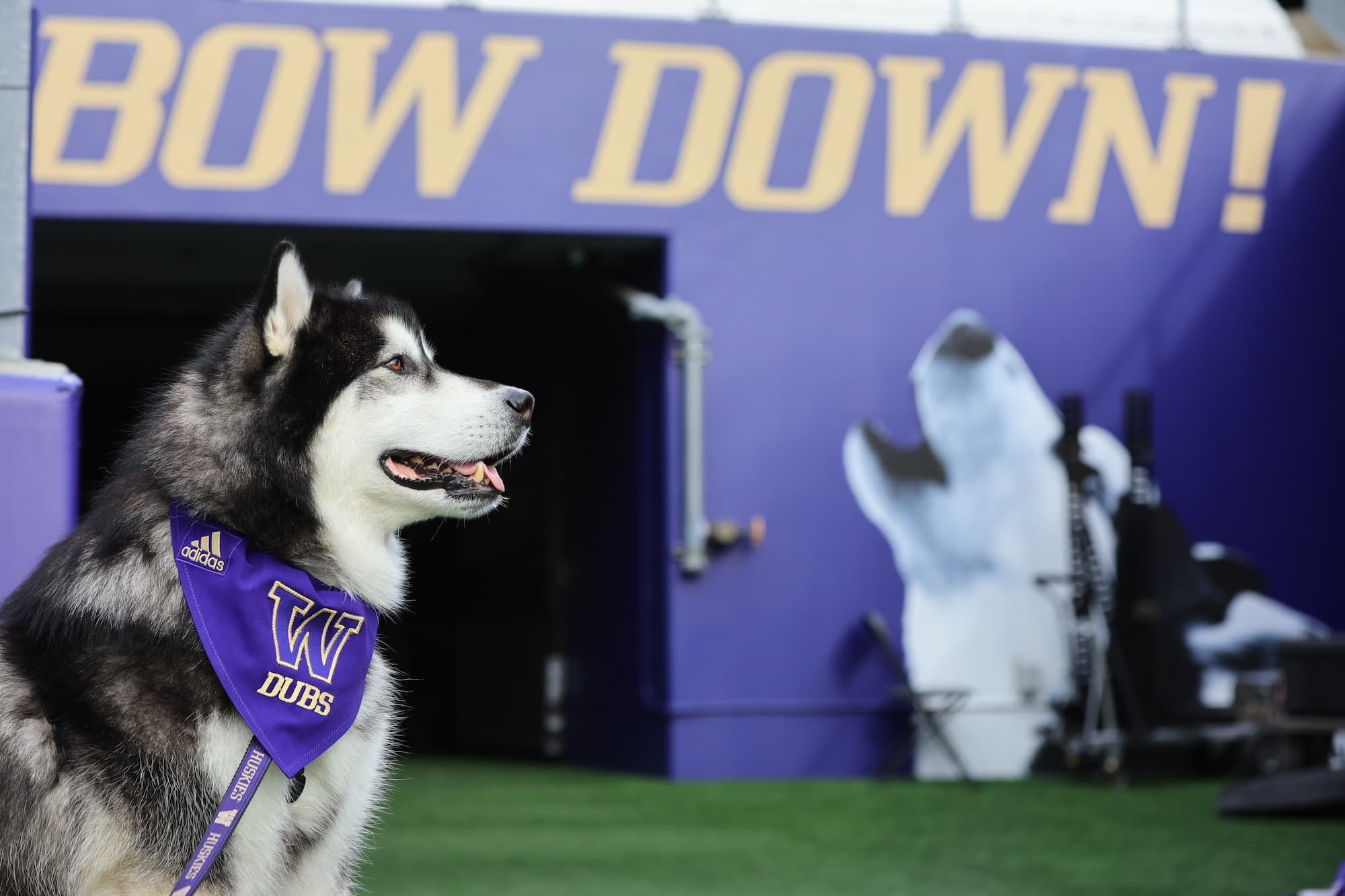
Before kickoff at University of Washington football games, a handsome 8-year-old dog named Dubs leads the charge onto the field. Before the players, the cheerleaders, and even Harry the Husky (the costumed mascot, played by a human being in a Husky suit), Dubs is the first to bound onto the turf.
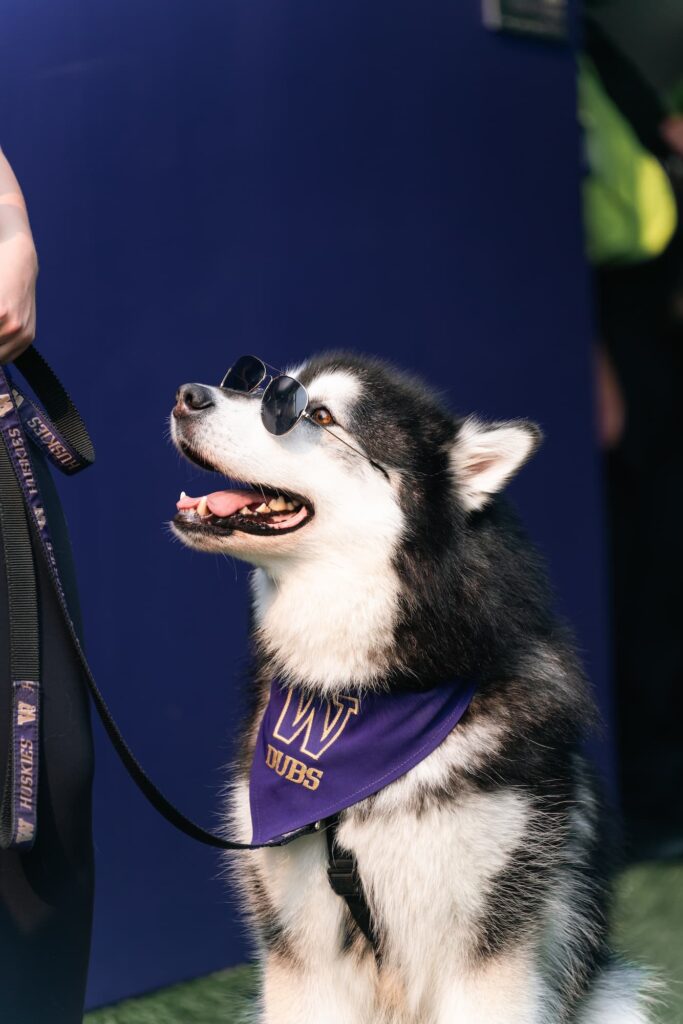
With all due respect to the many prominent players who have donned purple and gold, Dubs—an Alaskan malamute, the largest and strongest of the sled-dog breeds—may be the biggest star on campus. Wherever he goes, fans want photos… especially if they see him wearing his signature sunglasses (the school sells a version in the campus bookstore). Dubs’s devotees want to give him belly rubs, and he’s happy to oblige.
He can even do radio interviews: prompted by a hand signal, he can offer a well-placed “woo woo” to let his opinion be heard over the airwaves.
And, while correlation does not equal causation, his tenure has come with on-field success: The Huskies football program suffered an 0–12 season in 2008, the season before Dubs I filled the vacant live-mascot position. Dubs II seamlessly took over in 2018 after his predecessor’s retirement. In the Dubs II era, the team has posted a solidly winning record and, in January of 2024, a Sugar Bowl victory.
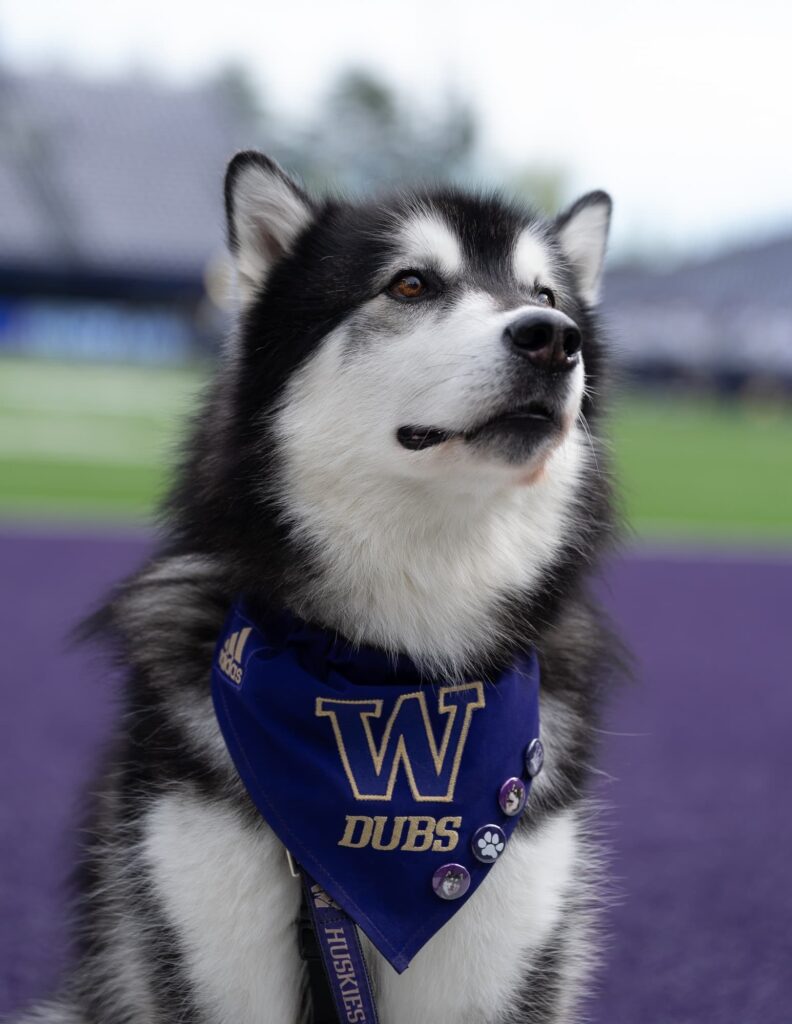
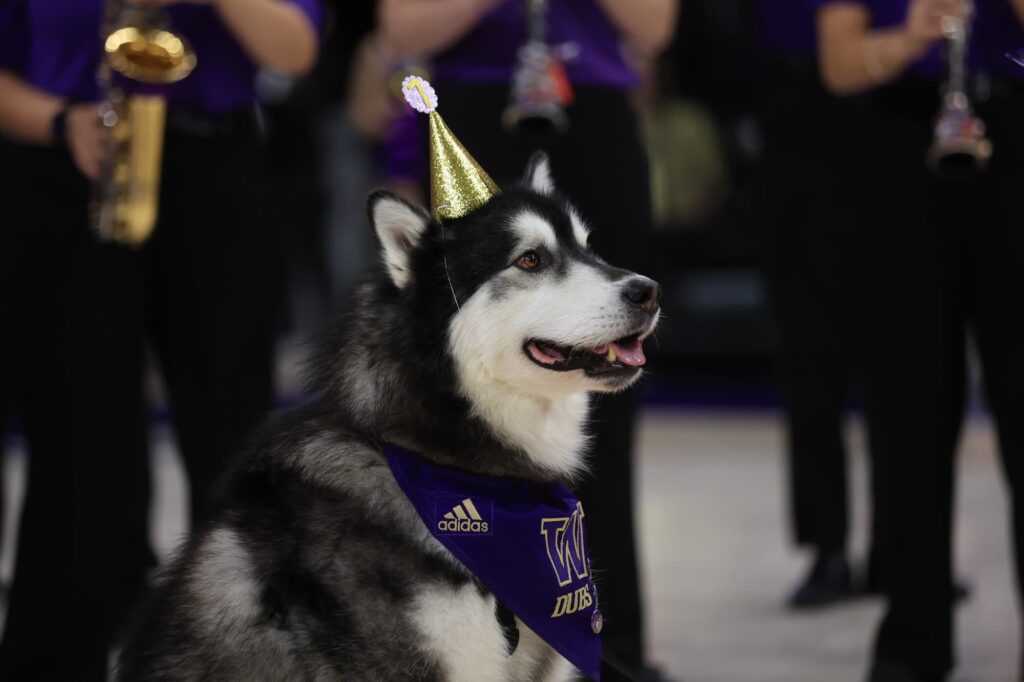
Dubs loves his job. When his work uniform, a UW bandana, comes out, his tail wags and he howls happily. But, behind the scenes, a lot of work goes into making sure he can boost school spirit and stay a happy, healthy dog while doing it. Here’s how it’s done.
Positive experiences
In general, dogs and fireworks don’t mix. That’s why we have a whole article about how to protect your dog during Fourth of July fireworks. But Dubs’s handlers, led by Anne-Lise Knight, the Live Mascot Program Coordinator at the University of Washington, who graduated from the school in 2014 with a BS in Psychology and Animal Behavior, knew from the beginning that they’d want him to be a part of large-scale football games that sometimes involve pyrotechnics. Fortunately, the fireworks go off on a planned schedule, so through preemptive desensitization and counterconditioning Knight and her team were able to make them something he liked. They gradually increased the volume of fireworks noise around him, starting at a low level that he noticed, but never one that he found frightening. They associated the sound with a cue, “bang,” that was always followed by a treat.
Now, when fireworks are about to go off, they let Dubs know by saying “bang.” He prepares himself and listens for the sound. Then his handlers pay up. “He gets his treat,” Knight said, “and then he carries on like nothing ever happened.”
It’s one of many situations that might look like magic, but have taken years of careful preparation.
One key principle in Dubs’s training has been that he’s never forced to do anything. The Husky Marching Band can be loud. When he was first trained to walk with them, he got ample treats and praise any time he moved forward. But, Knight said, “If he ever wanted to stop, we waited.” Dubs was never flooded or forced to “face his fear” if it got to be too much for him. Instead, he was invited to continue when he was having a good time and excited to receive his treat. “He had that ability to choose,” Knight said, “and giving the learner that choice, you get a braver learner.”
The same goes for Dubs’s incredible patience with photo lines. Hannah Knopping, a senior at UW who majors in environmental science, and one of Dubs’s student handlers, said that she loves seeing Dubs light up when the cameras come up and fans gather around him. “He knows that he is the star,” she said, and “that everyone is there for him.”
Dubs has so much experience receiving treats and praise when it’s picture time that the mere sight of cameras signals to him that good things are about to happen.
“We joke that we buy every smile on his face with a snack,” Knight said. “He does not work for free.”
The work to prepare Dubs for his unusual job began from his very early days.
“Even prior to him getting placed with his family,” Knight said, “we brought him to Husky Stadium, started doing socialization and getting him comfortable in all of these different environments. When he was little, we attended a lot of football practices. There’s lots of noise. The players are huge. Then you add the helmets and the pads and everything, and they can look very scary.”
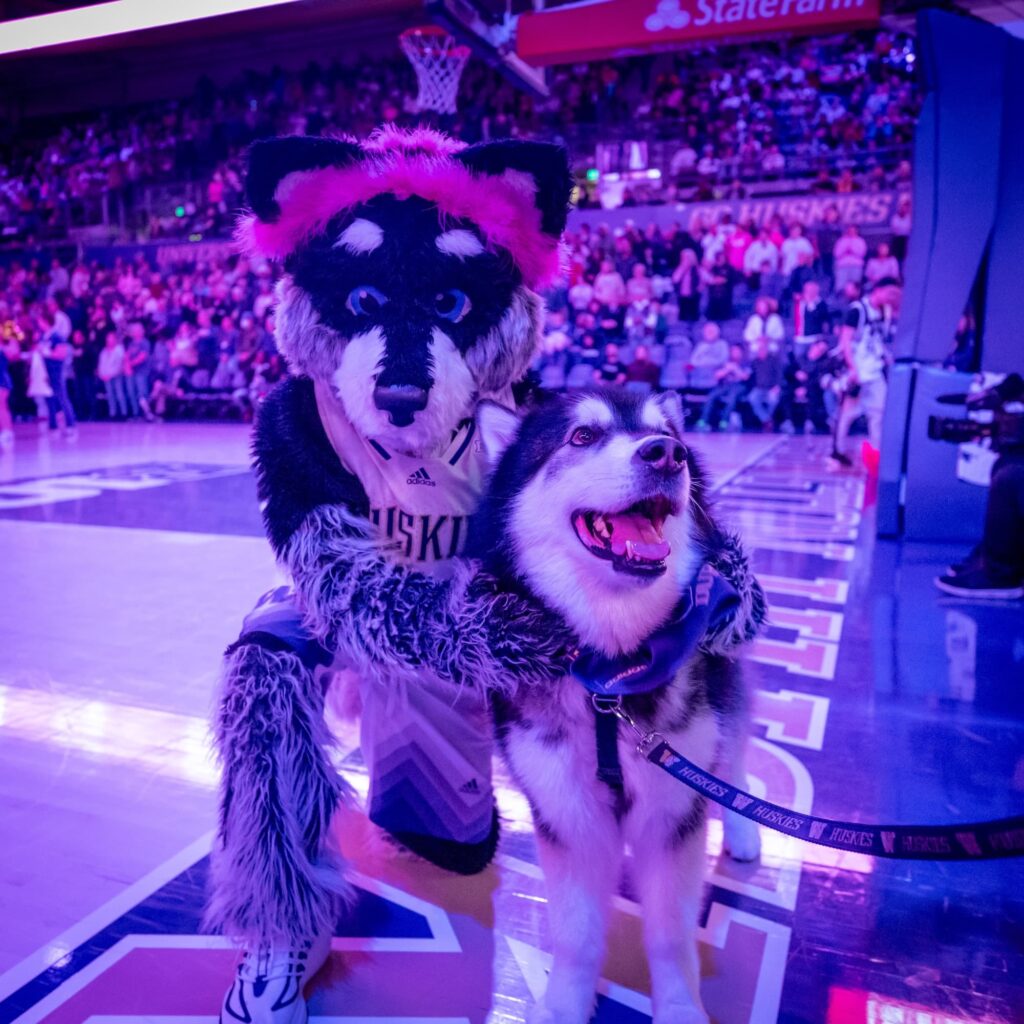
Harry the Husky, with his dog-esque suit and gigantic, unblinking eyes, was another challenge. But, through a patient process involving slowly introducing different elements of the costume, plenty of treats, and specific instructions to make sure the people playing Harry don’t scare him, Dubs learned that Harry was a friend. Now Dubs knows that this bizarre, dog-like, bipedal creature means high-fives and great treats.
Knight remembered a recent conversation with a player who’d been on the team when Dubs was a puppy. “Coach yelled at us all the time for being distracted by the puppy,” he told Knight. But the players’ giving Dubs early positive experiences is a big part of why he’s comfortable on the field now.
A loving family
Dubs lives with UW alumni Davina Gruenstein and Brett Knudson, who’ve raised him since he was a puppy. Gruenstein and Knudson have two children, now 19 and 17, who were elementary-school age when he joined the family.
When he’s not working, Dubs is a normal family dog. “They didn’t want to always feel like he had to be on,” Gruenstein said of UW’s philosophy when they were seeking the right people to look after Dubs.
This is in part because, at the University, Dubs is always the center of attention. To some extent, all dogs are treated like minor celebrities during walks (most of our readers probably never get stopped by someone gleefully exclaiming, “Oh my God, what an adorable person!”). But when you’re the mascot of a large public university, the attention is more intense and constant.
On campus, Gruenstein said, “anytime someone comes by, people want pictures with Dubs. They want to pet him.” Dubs loves attention, but it would be exhausting to face this constantly. That’s one reason Gruenstein is glad they live in Sammamish, Washington, and not on campus.
At home, they don’t ask him to pose for photos, or even to do many tricks. Mostly, he just hangs out. “He loves back scratches,” said Knudson, “so he’ll walk up to me and I’ll scratch him all over up and down his back, and he loves that, and he’ll do his long stretch out.”
Dubs is fond of camping trips in the Pacific Northwest, and when he’s not on duty he finds other things to focus on. During one recent sojourn to Lake Wenatchee, Dubs saw a squirrel descend into a hole in the ground and locked in. He spent hours staring, waiting for his target to emerge. Don’t worry—the squirrel was unharmed. “He came out one time while [Dubs] was away,” Gruenstein said. Dubs rushed back to the hole, but to no avail.
A dedicated team of trainers
Knight has help from a team of student handlers who work with Dubs, one of the most prized jobs on campus. She herself started working with live mascots as a handler for Dubs I when she was a student.
To get the gig, new applicants have to go through a sort of interview with Dubs himself.
Jaiden Wire, a senior at UW in public health and psychology, initially sought out the job because she was a fan of Dubs and wanted to spend time with a dog on campus. She’d followed him on social media and, back when she was just a fan, pursued him after a baseball game. His shift was over, but he gamely accepted pets in exchange for one of his handler’s treats.
She told us about the process of auditioning for the job. She had to demonstrate that she could give Dubs cues by voice and hand signal. For consistency, Knight explained, “we’re all operating on the same dictionary of cues.” And Wire also had to show Knight and Dubs’s family that she could keep him safe in various situations.
“[Other] handlers and their friends pretended to be people at an event,” she explained, “trying to slip him treats, trying to get in your way. That was very nerve-wracking.” She passed, and is now entrusted with protecting Dubs in real life.
Taryn Kerker is a UW sophomore majoring in industrial and systems engineering. She found it particularly rewarding when Dubs decided he could open up to her. “I love it when he comes up and asks you to scratch his butt,” she said. “That’s his favorite thing. I just think that’s so cute, because it’s a sign that he likes you and trusts you.”
Lots of downtime
When we interviewed Knight, Dubs was taking a nap, splayed out on the floor of an office with his paws straight out in front of him. Knight turned off the blur on her Zoom background to show us. This is not the side of Dubs fans usually see, but it’s a crucial part of making sure he has fun in his role (which, of course, he didn’t ask for—he’s a dog and didn’t apply to the position).
“Typically he works no more than two days in a row before he has a break,” Knight said. “We want to make sure we’re seeing that he’s putting on his harness and he’s ready to go—he’s excited to work.”
Like any hard worker, he needs his time off.
“Football game days are long days,” Gruenstein said. “He gets naps, but he’s still on campus. You have to nap between this time and this time and then you’re back on again, right? So we don’t ever schedule anything after a game day.”
Dubs surely appreciates it, and after the busy schedule of a game day he’s ready for a rest. “After the game,” Gruenstein said, ‘he zonks out in the back of the car on our drive home.”
A retirement plan
Dubs isn’t expected to work forever. After around 10 years, he’ll get to give one last fond howl to his adoring fans and be a regular family dog who can hang out full-time with his favorite people.
But, right now, Dubs is excited to keep up his official duties. “You can see the joy on his face as he’s running,” Knight said. And, she said, while football is higher profile, Dubs loves the soccer field the most. “There is something about the real grass field,” she said. When Dubs hits it, “he starts spinning donuts out of excitement.”
Kerker agreed that Dubs has a particular affinity for the natural grass. “When we are at soccer,” she said, “we usually take pictures with the fans beforehand, and then he walks onto the field with the teams—and that’s when he gets really excited.” He lets out his famous “woo woo,” celebrating the feeling of the grass on his paws.
“Although it involves similar socialization, his training is different from what’s required for a service animal trained to assist somebody with disabilities, where there is no room for error,” Knight said. “He has extensive training, and he’s very comfortable in those environments, but we encourage that personality to show, too—there’s that comical release where people see, ‘Oh, he’s having fun. He’s a dog.’”
Dubs, from the University of Washington, is one of five live college dog mascots who are part of a newly announced, paid multiyear partnership between The Farmer’s Dog and five college athletic departments. The others are Uga, from the University of Georgia; Smokey, from the University of Tennessee; Jonathan, from The University of Connecticut; and Goldie, from the University of Tulsa.
Related Topics
Related Topics
More on Breeds

What’s the Best Dog Food for Beagles?
Real, human-grade, pre-portioned food has all sorts of benefits for beagles—from weight maintenance to allergy management.

What’s the Best Dog Food for Corgis?
Real, human-grade, pre-portioned food’s benefits for corgis include weight maintenance and supporting a glossy coat.
What’s the Best Dog Food for Shih Tzus?
Real, human-grade, pre-portioned food has all kinds of benefits for shih tzus—from weight maintenance to supporting a glossy coat.
What’s the Best Dog Food for Beagles?
Real, human-grade, pre-portioned food has all sorts of benefits for beagles—from weight maintenance to allergy management.
What’s the Best Dog Food for Corgis?
Real, human-grade, pre-portioned food’s benefits for corgis include weight maintenance and supporting a glossy coat.
What’s the Best Dog Food for Shih Tzus?
Real, human-grade, pre-portioned food has all kinds of benefits for shih tzus—from weight maintenance to supporting a glossy coat.