Share article:


In this article:
- Why do people want dogs to talk?
- Are dogs who use soundboards “talking?”
- Can you “translate” dogs’ barks?
- How do dogs communicate with people?
- Why do some dogs sound like they’re talking?
- How can you listen to your dog?
Brian from Family Guy, Dug from Up, and Bluey (from Bluey) are all talking dogs. They’re also cartoons. In real life, all available evidence suggests that dogs lack the understanding of syntax and the physical capability to produce anything that we’d recognize as spoken language. They’re adept at communicating with humans, but do so in their own ways.
Still, as a recent literature review in Biologia Futura noted, humans have long been fascinated by the idea of finding a way to translate dogs’ thoughts into words—what they might say, and how we might benefit from knowing what they want to tell us. After taking a deep dive into the subject, the article’s authors wrote, “We conclude that while dogs have acquired remarkable human-directed social and communicative skills, the feasibility and desirability of spoken language in dogs remain questionable.”
In other words: Dogs can’t speak, and we don’t need them to.
But, per Marc Bekoff, PhD, professor emeritus of Ecology and Evolutionary Biology at the University of Colorado, Boulder, “dogs are talking to us—in their own language.” To understand dogs’ messages, he said, humans should watch them closely and learn their individual signs. “Watch their tail,” he said. “Watch their ears.”
Ian Dunbar, PhD and DVM, agrees. Dr. Dunbar consulted with Pixar on the movie Up—he’s thanked in the credits—and told us that he came up with Dug’s famous “squirrel!” line. He loves movies with talking dogs, but said that in real life your best bet for interspecies communication is to engage with your canine companions on their own terms.
“To me,” Dr. Dunbar said, “nothing beats understanding your dog while he talks to you in all his many languages. You should know [when] he’s upset, and you should damn well do something about it.”
In that spirit, here’s everything you ever wanted to know about how close your pet dog is to becoming a real-life Bluey, and how you can better understand what they need from you.
Why do people want dogs to talk?
The authors of the Biologia Futura article traced interest in talking dogs back a long way. “In 1912, in the pages of Science,” they wrote, “Harry Miles Johnson reviewed the report of Don, a ‘talking’ dog from Germany, written by none other than Oskar Pfungst, who was already famous for debunking the counting horse, Clever Hans.” For the uninitiated, Clever Hans couldn’t count, but fooled a lot of people into thinking he could.
Unsurprisingly, Pfungst concluded that Don was not talking, but merely making sounds that resembled speech. In the face of such vocalizations, many humans want to believe they’re hearing a dog talk.
“We love our dogs and spend a lot of time with them,” said Zazie Todd, PhD, the psychologist and certified dog trainer who wrote Wag: The Science of Making Your Dog Happy, “so I think we like anything that might help us to understand them better. We’d love to be able to see inside their minds and learn more about what makes them happy, and even though we know our dogs love us, I think we’d all love to hear them say ‘I love you’ in words instead of just through their body language.”
Research into dogs “talking” with buttons is pretty new
If you’re a dog person who’s spent any time on social media in the past couple of years, there’s a good chance you’ve seen video footage of dogs purportedly “talking” using buttons on soundboards. Some people make claims that their dogs are not merely asking to go outside or get a treat, but also performing such complex verbal tasks as explaining their dreams. Experts doubt that this is the case.
Still, even if button-pushing dogs are not “talking” the way humans would, that doesn’t mean such devices are useless. “I think soundboards can have value as enrichment,” Dr. Todd said. “Anything that is a joint activity that both the dog and person enjoy, and that is safe, can make a fun enrichment activity—and this falls into that category.”
Dr. Todd also noted that buttons can be one more way to give a dog choices—an important part of keeping them happy. “I feel like if I tried it with my dog,” she said, “he would forever be asking for treats and I’d have to keep disappointing him because we have to watch his weight! But if I did try it, I would start with just a few words that are most relevant to him and that he might use to ask for things.”
On the other hand, she said, buttons are not a necessary ingredient for offering dogs choices. “I feel like he already can ask for these things,” she told us. “He just sits down if he’d rather be carried.”
There are different types of dog barks… but translating them into English is a stretch
Because barks are sounds dogs make using their mouths and vocal cords, some people regard them as our best friends’ version of speech. There are even apps that promise to “translate” barks into human language. The experts we spoke to were very skeptical of these products—there is no equivalence between the sound of a bark and a human word—but dogs’ barks can convey useful information.
Many humans who’ve lived with a dog can tell the difference between a bark that means something more like “hello,” one that means “hurry up with dinner,” and another that means “I’m worried about a sound in the hallway.”
Still, the notion of one-to-one translation of these sounds to a sentence in English strikes Dr. Dunbar as ridiculous. To illustrate, he told a story. “Once in a seminar I was giving,” he said, “I had a dog psychic in the front row.” The self-proclaimed canine clairvoyant interrupted his talk and claimed to know what dogs were thinking. Dr. Dunbar recalled then approaching a golden retriever in the front row. “I knelt on the ground,” he said. “I stuck his chin in my hand, I put my forehead on the dog’s forehead. Everyone went quiet. I said, ‘No, the dog says you’re lying.’”
Dr. Bekoff told us that differences among dogs are another factor that could make a translation app especially tricky. He allowed that, maybe, with considerable effort, it would be possible to create an app relevant to a particular dog’s sounds and body language. But at that point, he said, “You also might know what they’re asking by just paying attention to their behavior.”
Indeed, while understanding dogs’ own ways of communicating can take work, it doesn’t require advanced technology of any kind.
Dogs talk to us all the time (in their own language)
Dr. Dunbar says that barks are not as helpful as other signals in decoding dogs’ messages. “Certainly all these barks have different meanings,” he said, noting that there’s a difference between an alarm bark and a demand bark, “but there are many other languages that dogs use, which I think are far more important to understand.” For example, he said: “Body language, and the language of proximity or closeness.”
He said that, as humans, we understand the importance of body language even among our own kind. “If you sit at a bar and you watch people come in,” he said, “you can look at, say, a married couple and tell how well they’re getting on. Do they sit side by side? Are they touching each other? Are they leaning into each other? Right away, proximity is this wonderful insight into how well this relationship is going—and it’s so important for animals.”
Having established the importance of proximity, Dr. Dunbar encouraged this experiment when you meet a new dog. “Before you put your hands on the dog,” he suggested, “offer him a treat. If he takes the treat, you’re off and running.” The dog’s willingness to voluntarily get close to you counts for a lot. “But if he doesn’t,” Dr. Dunbar said, “we want to know what’s wrong… if he doesn’t take the treat from me, but he takes it from the owner, it is so obvious that he’s scared of me—and that’s what we have to resolve right away.”
Dr. Todd says that watching dogs’ signs will tell humans much of what they need to know about what worries their best friends, makes them happy, and interests them.
“Many people miss signs that their dog is stressed,” she said, “such as turning the head away, moving away, and licking the lips (when not anticipating food). You have to look at the whole of the dog, including tail, mouth, eyes, and posture.” While understanding these signals can be challenging at first, she said, “it gets easier with practice.”
Dr. Todd said that body language can help people get past their assumptions about their dogs and pay more attention to how they’re feeling. “I think people often assume at baseline that their dog is happy and content,” she told us, even when that’s not the case. “Sometimes it can help to think: Is this a situation in which many dogs are stressed (like at the vet, or if the dog is being hugged)? And then ask: ’Is my dog stressed?’ Because that can prompt people to look more closely. One common thing that people misunderstand is a yawn, because they assume it means their dog is tired, but actually it might mean that the dog is stressed.”
You may have seen videos of dogs making sounds that resemble speech, or your own dog might do so (my dachshund loves to answer “who’s a good girl?” with a howl that has something in common with “who?”). More than a century after Pfungst debunked the case of the “talking” German dog, and many years after the origin of the famous joke about a dog who could tell you that the greatest baseball player of all time was “Ruth” (though we defy a dog to make a bark that sounds like “Ohtani”), people are still endlessly amused by such tricks.
Sometimes dogs sound like they’re talking
When we wrote about social learning in dogs, Stanley Coren, PhD, Professor Emeritus at the University of British Columbia, told us that sometimes this “speech” is a result of imitation. “Babies,” he told us then, “tend to repeat a single syllable with a vowel in it… like ‘ah ah ah ah ah.’ In three instances, I think, people have told me that their malamute has come over and mimicked that behavior—the malamute would go ‘ah ah ah ah ah,’ with his eyes on the baby at the same time.”
Maddie Messina, a Certified Applied Animal Behaviorist and Founder of Paws for Thought Dog Training, says that dogs may also make sounds that resemble speech because they like the attention it gets them. “Babbling can be reinforced by humans,” she told us. “It’s as simple as your dog does a cute sound, and you turn around and you go, ‘What’s going on?’ That kind of attention—both physically with your body and verbally—is reinforcing a dog’s choice to continue to be vocal in different environments.”
If you enjoy hearing your dog make these kinds of noises, there’s no harm in continuing to do so—but the evidence suggests it’s something much different from human speech.
Dogs work hard to listen to people, and we can do the same for them
Dogs are exceptional at understanding what humans want them to know. Research shows that they’re wired to follow our gestures, for example, and if you look at your own dog you’ll be sure to notice that they’re watching you and trying to figure out what you need from them. The least we can do is return the favor.
“Dogs pay a lot of attention to us,” Dr. Todd said, “and they like it when we talk nicely to them.” So: Instead of hoping that your dog will develop the gift of speech, keep in mind the tremendous power you have to influence them.
“If you don’t already,” she said, “make time to talk sweetly to your dog and tell them nice things. And if there are specific things you’d like your dog to understand, try to stick to the same word or phrase each time to make it easier for them to pick it up.”
The answer to “do dogs talk?” depends on what you mean by “talk.” But the more important question may be: Do humans listen? Dogs pay close attention to what we say and do—and if we watch them closely, they will also tell us what they want and need.
Related Topics
Related Topics
More on Dog People
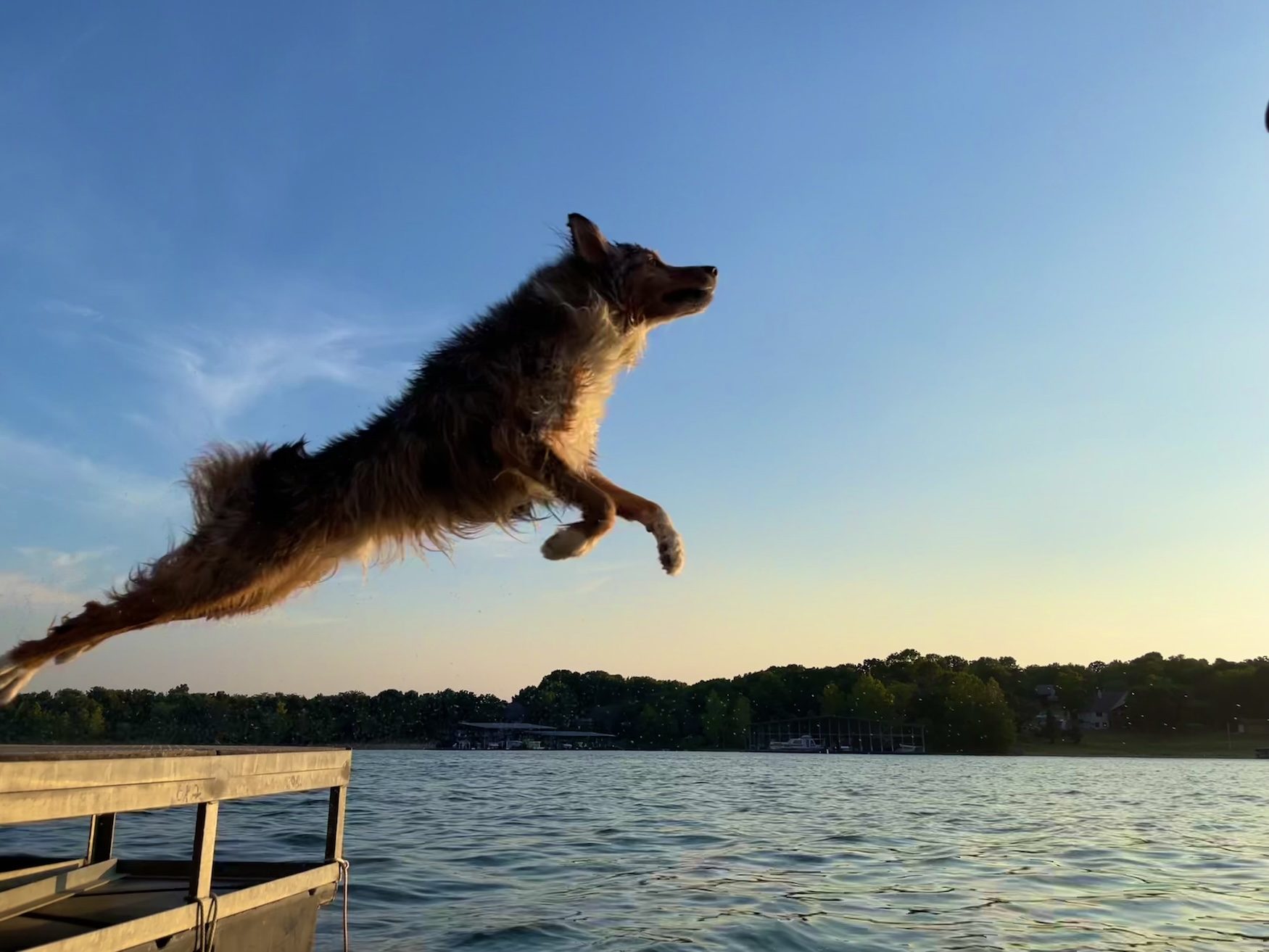
Dog People • 7 minutes
Meet Frank, the 9-and-a-Half-Year-Old Dock-Diving Star
This Australian Shepherd is staying competitive into his golden years.
Dog People • 2 minutes
Top Dog News of 2025
The year’s top stories included a dog and a crow who became best friends, and one very special senior-dog balloonicle.
Dog People • 4 minutes
Best of Digest 2025
Here are some of our (and your) favorite articles from the past year.
Dog People • 7 minutes
Meet Frank, the 9-and-a-Half-Year-Old Dock-Diving Star
This Australian Shepherd is staying competitive into his golden years.
Dog People • 2 minutes
Top Dog News of 2025
The year’s top stories included a dog and a crow who became best friends, and one very special senior-dog balloonicle.
Dog People • 4 minutes
Best of Digest 2025
Here are some of our (and your) favorite articles from the past year.