Share article:


In this article:
- What are the differences in regulations for dog and baby toys in the US?
- Why shouldn’t babies and dogs share toys?
- Is it OK for my dog and baby to put the same toy in their mouths?
- What can I do about my dog’s resource guarding around my baby?
- How should my dog and my baby interact?
There’s something you quickly learn raising a baby along with a dog: Often, they have similar interests. Both get around on all fours; both put things in their mouths; and both enjoy a good toy, especially if it squeaks or is highly chewable.
“Babies use toys the same way dogs do, and that means everything goes in the mouth,” said Jennifer Shryock, founder of Family Paws, a nearly 25-year-old organization that educates families, as well as dog trainers that work with families, on how to incorporate a dog into a home with a baby, or vice versa.
Shannon Feeney, Associate Director of Behavior Programs at the San Diego Humane Society, added that dog toys and baby toys are “designed somewhat similarly in that they’re meant to engage the senses, so a lot of times they’re both attracted to them.”
Dog and baby toys can both be squishy, poky, hard, soft, and about the same size. But similarity doesn’t mean safety. Despite their resemblance, baby toys and dog toys exist in completely different regulatory universes, designed for completely different mouths, hands, and levels of force. And mixing them up can create hazards for both your baby and your dog.
Different rules for different drools: Regulations for baby and dog toys
In the United States, baby toys fall under the jurisdiction of the Consumer Product Safety Commission (CPSC), which enforces the ASTM F963 standard. This standard covers everything from choking hazards to lead content to flammability. Toys intended for children 12 and under must undergo third-party testing at CPSC-approved laboratories and come with a Children’s Product Certificate (CPC), which proves compliance. Among other measures, this certificate covers choke-proofing toys by testing the size of every part that goes into them and ensuring that their lead content is under 90 parts per million.
Additionally, the Food and Drug Administration restricts Bisphenol A (BPA) and certain other chemicals in products that are intended to be used with food, like bottles.
Dog toys, by contrast, face no specific federal safety standards. While their materials must comply with general consumer product regulations—wood toys must meet wood product standards, textile toys must meet textile regulations—there’s no equivalent to the ASTM F963 standard for pet products. Manufacturers can voluntarily apply children’s toy standards to pet toys, but they’re not required to do so.
Baby toys just aren’t up to dog durability standards, and dog toys might be choking risks for babies
One risk in sharing toys is durability. Feeney pointed out that dogs’ tooth and jaw strength tend to be greater than babies’ by a factor of a lot. Dogs are exceptionally good at shredding, biting, and chewing—behaviors that are completely normal for them. Baby toys, designed for gumming, throwing, and gentler exploration, aren’t always built to withstand that kind of force.
Shryock learned this lesson the hard way when she, a parent with small children, adopted a ball-obsessed four-year-old German Shepherd. “Within two minutes of coming into the house, it was like the ball massacre. Moose just took out every ball, and I had two little boys that were like, ‘Oh my God, this dog.’” The dog’s toy obsession extended beyond balls to helium balloons and even Hot Wheels cars, and Shryock had to make sure to keep those things out of the house.
“You’ve got to know your dog’s sensitivities and plan around them,” she said.
A plush rattle might survive months of baby handling but disintegrate in minutes when a determined terrier gets hold of it. Plastic teething toys can crack or splinter. Toys with electronic components, buttons, or small decorative elements can break apart, creating choking hazards for both dogs and babies—or exposing them to wiring or batteries, which contain toxic materials.
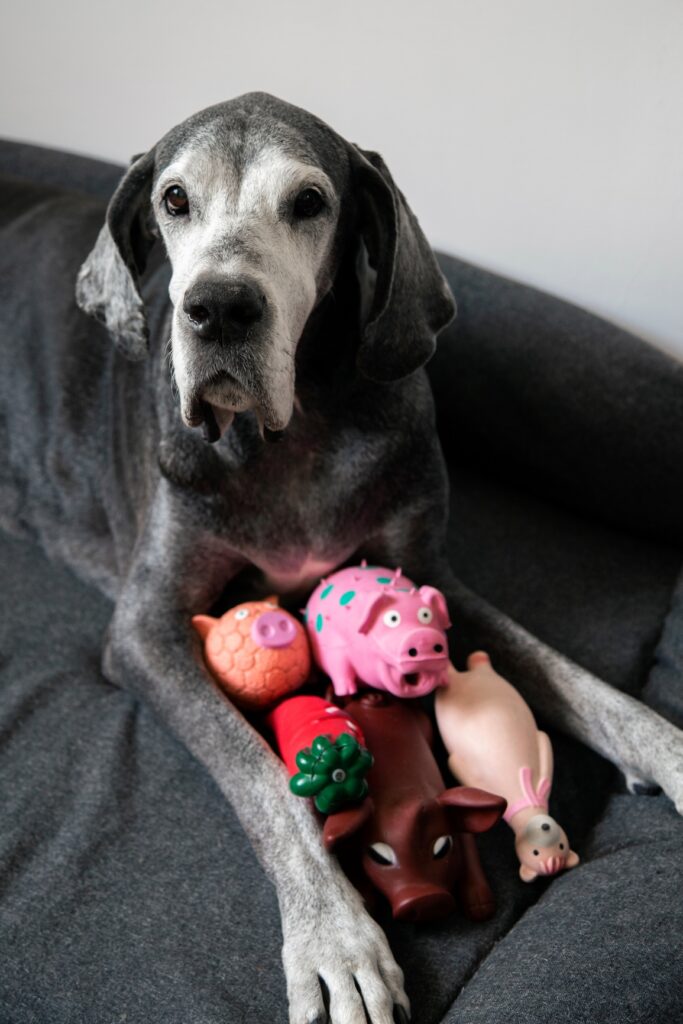
“If your dog is into de-stuffing things, then you need to know that probably teddy bears are going to be de-stuffed unless you put them out of reach,” Shryock said. And that’s not just disappointing because there goes a cute teddy bear; it can also send cotton stuffing around a room, which presents one more choking hazard to babies and dogs.
Many dog toys pose choking or other kinds of hazards for babies, too. Rope toys can fray into string-like pieces. Puzzle toys designed for dogs to manipulate with their mouths and paws may have openings that babies’ hands can get stuck in but can’t easily get back out of. These are items designed with intended uses in mind, and babies and dogs have different skills and talents.
A note about hygiene
Then there’s the drool. Brian Collins, DVM, a veterinarian with the Cornell Riney Canine Health Center, told Digest last year for another story that dog saliva can pose a danger to babies. For most healthy adults, dog saliva isn’t an enormous risk (and can potentially be good for the microbiome). But babies are different. Collins explained that children under five are more prone to infection than adults because their immune systems haven’t fully developed. While serious infections from dog saliva are rare, babies are among the groups of people that should be extra cautious.
Collins noted as well that dogs’ saliva can increase in risk dramatically if they’ve consumed fecal matter or eaten raw meat—both of which can introduce harmful bacteria like E. coli, salmonella, or listeria.
What can I do about my dog’s resource guarding around my baby?
There’s also the behavioral consideration. Feeney notes that it’s “not uncommon for dogs to guard” food and toys. Resource guarding—when a dog becomes protective or aggressive about valued objects—is dangerous around babies.
“Babies cannot be expected to have the critical thinking ability to notice that and respond appropriately,” Feeney said. A baby reaching for a toy that a dog is guarding creates a potentially serious situation that the baby has no capacity to navigate safely.
Shryock’s experience has shown her that dogs who guard resources from other dogs will likely guard them from toddlers too.
“If they guard against other dogs, that toddler is not seen as an adult,” she said. “That toddler is seen as another unpredictable moving creature that they will guard their toys from.”
Remove high-value items
Because the stakes are high with resource guarding, and the chaos of a full house makes it difficult to pay 100 percent attention, 100 percent of the time, Shryock recommended management techniques over training solutions (or in addition to training solutions).
“Management is your best friend,” she said. “Resource guarding is one of the hardest behaviors to deal with when it comes to kids and dogs. If a dog is one that is going to covet their items—whether it’s toys, food, people, space—that is an extraordinarily difficult behavior to work with when you have a toddler in the house.”
For dogs with guarding tendencies, Shryock recommended removing high-value items from the house entirely during the toddler years.
Create separate, managed spaces
Because it’s understandable that a dog owner would want to give their dog an item that they love, like a bully stick, they should only offer it at a time and place where the child definitely can’t get to the dog—for example, “in their safe space, like a crate.”
Feeney added that keeping the toys in completely different parts of the home with very clearly set boundaries can be helpful. She suggested that this separation “could be as simple as engaging with [dogs and babies] with their toys only [in designated areas].” This doesn’t mean your dog and baby can never be in the same room—it means being intentional about when toys are present and accessible.
Baby gates, X-pens, and crates are valuable tools here. “I’m a huge fan of those for early parenting,” Feeney said, noting that these barriers aren’t just about safety—they’re about helping your dog and baby develop positive associations with each other over time. Every interaction matters when it comes to their long-term relationship.

Teach your dog to relax
Feeney suggests teaching your dog that baby playtime is also a good time for them. You can condition your dog to relax in their designated spot, like behind a pen or gate, with their own toys or a food-dispensing puzzle while the baby plays nearby with baby-safe toys. Training them to “go to place” is helpful for this.
Teach your baby to simply wave
Babies are learning constantly, so teach them smart behavior from the start.
Feeney recommended showing babies how to simply wave at dogs, instead of touching them (and, if they do touch them, then go for under the chest; not straight for the head.) It’s generally easier to teach young children what to do, rather than what not to do, so learning to simply wave at dogs is a useful alternative to touch.
What good play interaction looks like
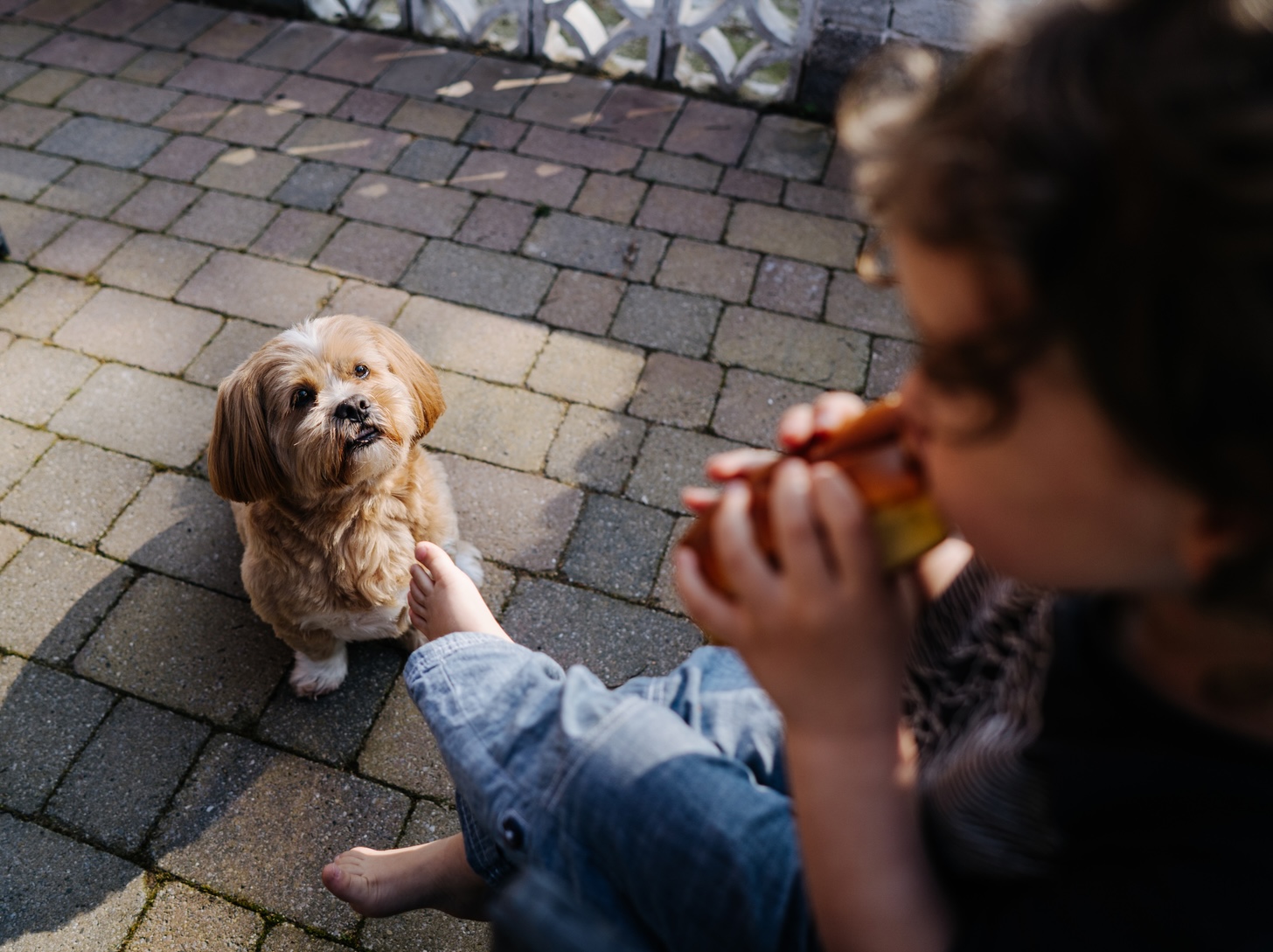
If and when your baby and dog do interact, Feeney recommends short, controlled sessions with close supervision. And be mindful of your own actions toward your dog, since children mirror others’ movements. Feeney recalled a friend who regularly petted her dog with her foot—a casual habit that her baby observed and then attempted to replicate by kicking the dog.
“The baby was watching her do what she did with her feet and then tried it out, but with so many things missing that are crucial to being able to do that appropriately,” Feeney said. Modeling the wave is a good bet—save the pets and snuggles for after the baby goes to sleep.
Feeney points out that “there are these fleeting interactions between babies and dogs” that parents read too much into. The relationship between your baby and your dog will develop over years. Right now, during this early phase when everything is new and unpredictable, the best thing you can do for both of them is maintain clear boundaries. Allowing them to grow alongside each other at a safe, respectful distance will get you that much closer to the ultimate dream: kid’s and dog’s shared interests turning into fetch, frolicking, and mutual love and respect.
Related Topics
Related Topics
More on Lifestyle
Lifestyle, New Dog • 8 minutes
Adopt One of These Dogs By March 15, and Start Them on Fresh Food for Free
Let’s meet some good dogs.
Health & Wellness, Lifestyle • 10 minutes
Do Dogs Need a Skin-Care Routine?
Healthy dogs don’t need a full-blown regimen, but you must still care for their skin.
Lifestyle, Science & Research • 8 minutes
Dogs Release This “Love Hormone” Around Their Favorite People
Here’s the adorable and scientifically accurate truth about what happens when you hang out with your best friend.
Lifestyle, New Dog • 8 minutes
Adopt One of These Dogs By March 15, and Start Them on Fresh Food for Free
Let’s meet some good dogs.
Health & Wellness, Lifestyle • 10 minutes
Do Dogs Need a Skin-Care Routine?
Healthy dogs don’t need a full-blown regimen, but you must still care for their skin.
Lifestyle, Science & Research • 8 minutes
Dogs Release This “Love Hormone” Around Their Favorite People
Here’s the adorable and scientifically accurate truth about what happens when you hang out with your best friend.