Share article:


In this article:
- Is tap water safe for dogs?
- Is filtered water better for dogs than tap?
- When should dogs not drink tap water?
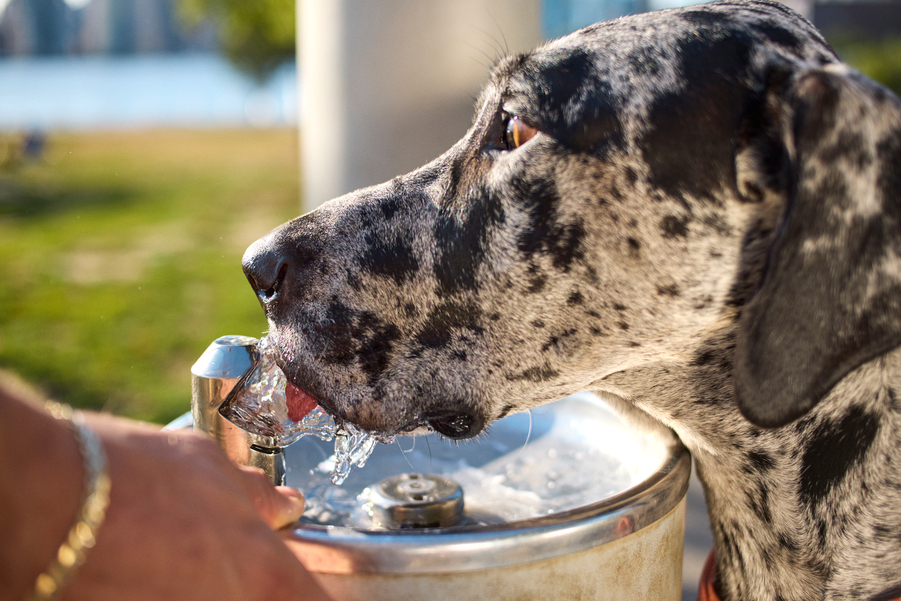
Providing your dog with fresh water every day—and keeping their bowl clean—is a simple but vital part of helping them stay happy and healthy.
While carrying out this quotidian task, you may have wondered if you should upgrade their water bowl’s contents from straight-out-of-the-tap to the filtered water you might pour yourself from a refrigerated pitcher.
The basic rule is simple: If water is safe for you, it’s likely safe for your dog. Here’s a deep dive into the details.
Is tap water safe for dogs?
Ideally, tap water should be clean and safe for people and dogs to drink. Drinking-water safety is regulated by the United States Environmental Protection Agency (EPA), which sets legal limits on over 90 contaminants, including arsenic, lead, certain chemicals, and bacteria like E. coli. While the EPA sets these limits for human health, they also serve the interests of our pets.
“If tap water is safe for people to drink, it is also safe for dogs and other pets,” said David Dorman, DVM, PhD, a professor of toxicology at North Carolina State University.
On the other hand, when drinking water is unsafe for humans, it impacts our pets, too. A 2017 paper published in the Journal of the American Veterinary Medical Association looked at 331 dogs living in Flint and East Lansing, Michigan following a declared water crisis and measured their blood for levels of lead. Lead is a known toxin to humans and dogs that can build up in the body over time, and high enough levels can be dangerous. Dogs in Flint—the center of the crisis—had higher blood-lead concentrations than the control population in East Lansing.
Is filtered water better for dogs than tap?
Most at-home commercial water filters use porous, activated carbon, which improves aesthetic qualities like taste and color.
“Even when tap water is safe, its taste can vary,” Dr. Dorman said. And aesthetic improvement can go a long way, especially if your home’s tap water has a distinct flavor. “In some cases, filtered water may taste better to dogs and encourage them to drink more.”
Just make sure you stay on top of replacing your filter, which after about two months or 40 gallons of water starts to collect bacteria.
Some pitcher filtration models can also reduce levels of substances including asbestos, and heavy metals like lead and mercury—but they won’t make your tap water safe if it has dangerous levels of those materials.
Heavier-duty filters, like reverse osmosis (RO) or home filtration systems, surpass the abilities of commercial pitcher filters. RO systems connect to single fixtures—on a countertop or under the kitchen sink, for example—and use pressure to force water through a filter, separating it into a stream of clean, treated water and a stream concentrated with contaminants like lead, volatile organic compounds, bacteria, and more.
“Filtering helps minimize exposure to substances that could potentially have harmful effects with long-term exposure,” said Renee Schmid, DVM, Diplomate of the American Board of Veterinary Toxicology, director and senior veterinary toxicologist at the Pet Poison Helpline.
When should dogs not drink tap water?
In some cases, tap water is dangerous for dogs and humans to drink. If a water supply is contaminated, the law requires public water systems to inform customers of any short-term health risks to people. If you find out drinking the water is risky for you, you should assume the same is true for your dog.
One short-term risk may be from water contaminated with harmful microorganisms. This contamination could result in a boil-water advisory, during which residents must boil water to kill bacteria before consuming it—this is true regardless of what filtration system you may use. “If a boil-water advisory is in effect, dogs should drink boiled and cooled water,” Dr. Dorman said.
In some parts of the country, deleterious chemicals or metals may render tap water unsafe to drink. Dr. Dorman listed arsenic, radium, nitrates, lead, and per- and polyfluoroalkyl substances (PFAS) as a few possible contaminants. And “no single home-water filter removes all contaminants,” Dr. Dorman said.
Substances like lead may leach into your water from old pipes in an aging house or apartment building. If you’re concerned about this, Dr. Schmid recommended testing your water to better inform your choices about the water you and your dog drink; the EPA offers resources on lead testing.
Ultimately, you should give your dog water you would drink yourself. That can be straight from the tap or filtered. Just know that, if there are hazardous materials in what’s coming out of your tap, a typical store-bought pitcher filtration system won’t make it safe.
Related Topics
Related Topics
More on Health & Wellness
Health & Wellness, Science & Research • 3 minutes
New Studies From The Farmer’s Dog Reveal Hydration Advantages in Fresh, Human-Grade Dog Food
Dogs on fresh food drink less, but get more water. Here’s why.
Health & Wellness, Science & Research • 4 minutes
New Study From The Farmer’s Dog Shows That Fresh Food Can Support Healthier Aging in Dogs
Dogs fed fresh food showed a rapid, sustained metabolic shift after just one month.

Health & Wellness, Lifestyle • 10 minutes
Do Dogs Need a Skin-Care Routine?
Healthy dogs don’t need a full-blown regimen, but you must still care for their skin.
Health & Wellness, Science & Research • 3 minutes
New Studies From The Farmer’s Dog Reveal Hydration Advantages in Fresh, Human-Grade Dog Food
Dogs on fresh food drink less, but get more water. Here’s why.
Health & Wellness, Science & Research • 4 minutes
New Study From The Farmer’s Dog Shows That Fresh Food Can Support Healthier Aging in Dogs
Dogs fed fresh food showed a rapid, sustained metabolic shift after just one month.
Health & Wellness, Lifestyle • 10 minutes
Do Dogs Need a Skin-Care Routine?
Healthy dogs don’t need a full-blown regimen, but you must still care for their skin.