Share article:


In this article:
- Why do dogs and humans get along so well?
- Are livestock guardian dogs friends with the flocks they watch over?
- Can cats and dogs be friends?
- Unlikely friendships: cheetahs and dogs
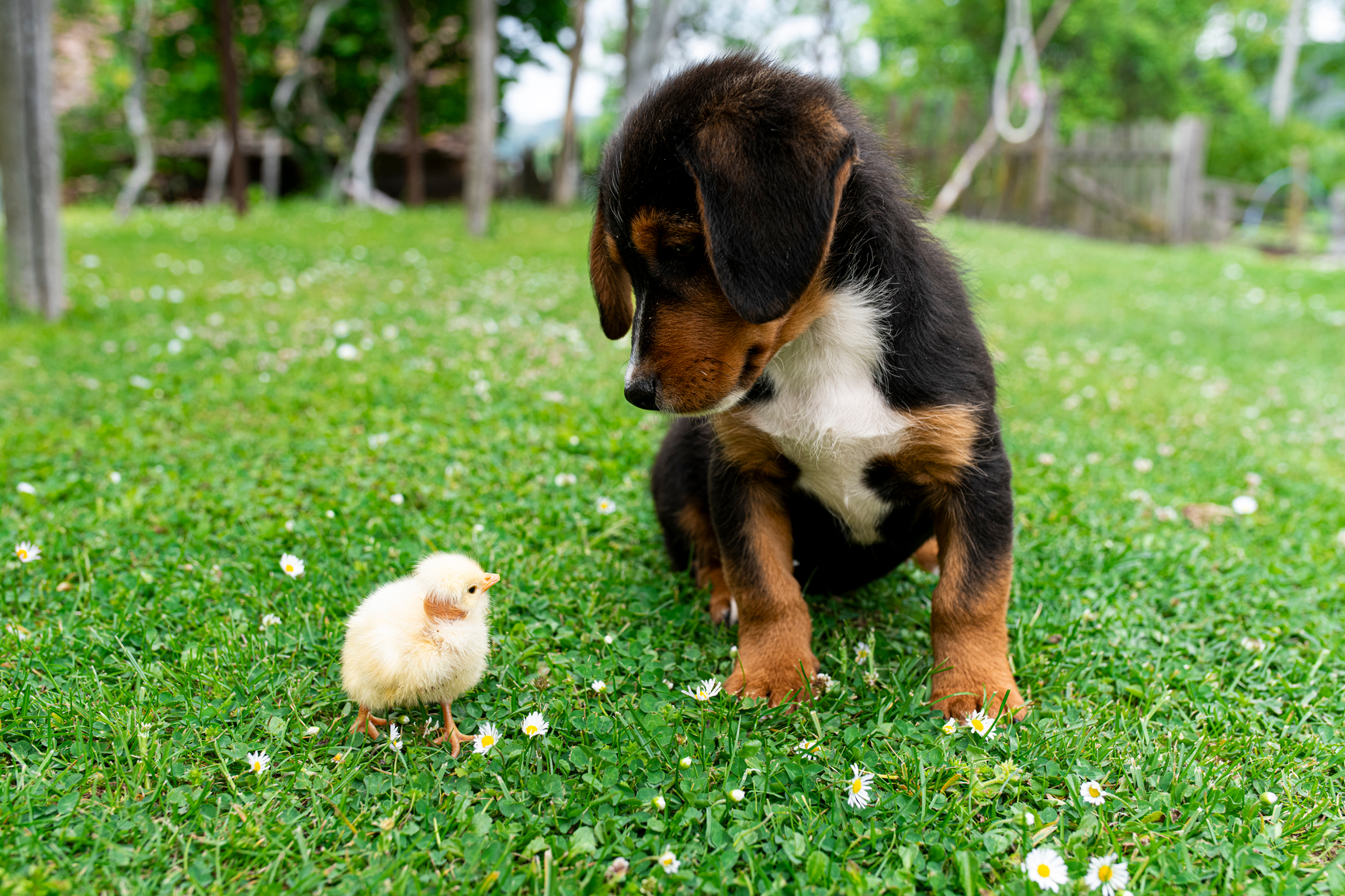
There’s a type of video that stops me in my tracks every time it floats to the top of whatever feed I’m scrolling: Dogs befriending other animals. I can’t not watch a clip of a dog and, say, a donkey or a crow (named Russell!) playing together, sleeping alongside each other, eating near each other, or just existing peacefully in each other’s presence. I don’t know what it is. Perhaps it’s the novelty. Perhaps it’s the age-old question, What do those two even talk about? Perhaps it’s the joy in realizing that other animals get to see what we see in man’s best friend.
Dogs are built for friendship, genetically speaking. Recent-ish scientific research has delved into dogs’ “hypersociability,” a genetic predisposition that allows them to form bonds across species. And this ability may extend beyond dogs’ relationship with people—though we are, of course, partial to that relationship.
The scientific community is partial to that one too, in part because dogs’ connection with humans has been crucial to both species’ development over thousands of years. There have been books written on this subject, and research that attempts to work out who domesticated whom. Below, we’ll focus on a few peer-reviewed studies published in the last couple of decades. They show how well-rounded dogs are in the human-befriending department—and point to how they can bond with members of other species as well.
Dogs are humans’ best friends
A study from 2016 found that dogs have a talent for recognizing humans’ facial expressions despite the fact that our faces are quite different from theirs (and despite the fact that we often misinterpret their signals. Read more about that in our story about dog smiles.)
This ability to read humans is one of the things that distinguishes dogs from wolves, according to another oft-cited study from 2003. Essentially: dogs listen and respond to humans. They seek help from us. Wolves, less so. One of the ways researchers tested this dynamic was through various trials in which dogs who couldn’t solve a task would ask for a hand from a human nearby. Wolves were less likely to do that.
A different study likened some isolated genes in “hypersocial” dogs to genes in humans that are found in people with Williams-Beuren syndrome, a rare disorder that—in addition to causing a number of physical and developmental impacts—makes people extremely empathetic and affectionate, even to total strangers. Behaviors that fall under the hypersociability banner include extended proximity seeking, prolonged gazing, heightened oxytocin levels, and inhibition of independent problem-solving when humans are present. In plainer terms, dogs want to be near us, gaze into our eyes, feel the good-feeling hormones that we both get to feel when together, and ask for our help.
The researchers who published these studies often explain that their work is a piece of the great evolutionary puzzle of how we got dogs from wolves. But I read them differently. To me, these studies confirm something I already suspected: My dog is…in love with me.
And, if my dog had been given the opportunity, she could have loved a sheep. Let me explain.
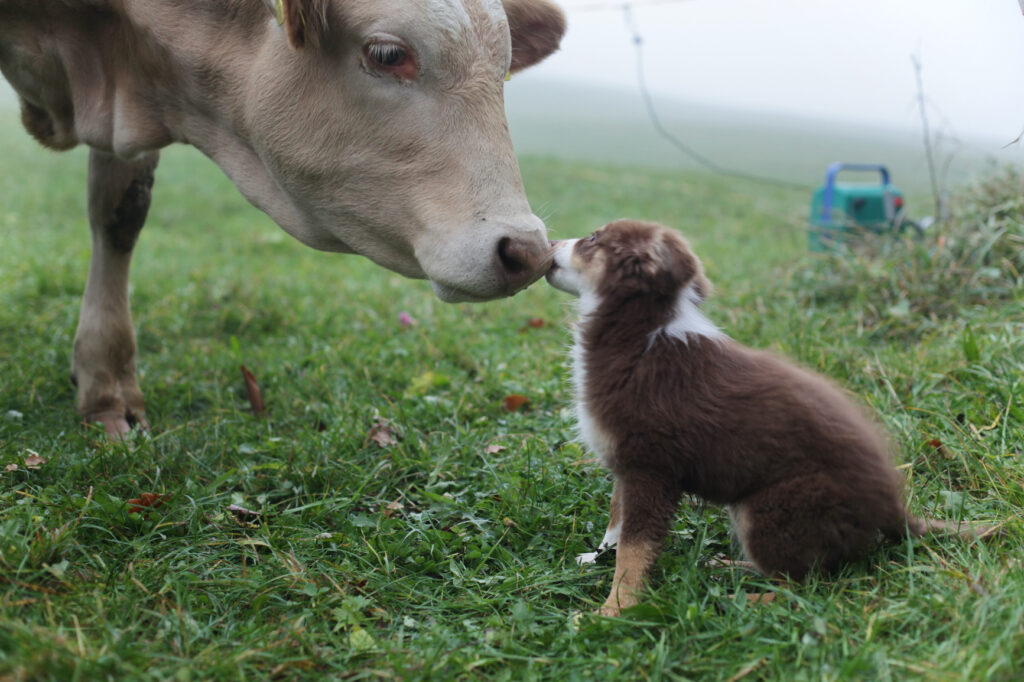
Dogs can get along with the animals that they’re hired to guard… especially if they meet them when they’re young
Yet one more piece of research, published in 2019, found that, while dogs’ ability to form relationships with humans is special, it isn’t unique. Dogs are capable of forming similar relationships with other animals. It turns out that, according to the study’s authors, “pet dogs’ relationships vary rather individually than according to partner’s species.”
This brings us to an interesting test case, and a foundational study on livestock guardian dogs from the 1980s, which tracked working dogs over the course of 10 years, with special attention to the social bond that develops when dogs are kept with livestock from an early age.
There was a practical reason for this study. Those who raised livestock were looking for a way to protect their flock from predators. Guardian dogs could fit the bill—if they could manage not to become predators to the flock.
The study measured “trustworthiness,” “attentiveness,” and “protectiveness” on the part of these dogs towards their flocks, and found them in large part bonded. These traits are important in getting dogs not to mess with the animals they’re protecting.
But this peaceful dog-livestock relationship did not arise on its own. The connection that turns a potential predator into a protector is rooted in a dog’s early bonding with the animals. Farmers intentionally encourage this bonding early in dogs’ lives, during developmentally significant periods.
Authors citing the above work wrote in a 2022 study on guardian dogs, “Dogs’ success in guarding or herding livestock depends upon their ability to form social bonds with other species and change their behavior accordingly.” In other words, it’s a working relationship—but it also appears to be a genuine social bond that removes any adversarial aspect between the dog and the flock.
Zazie Todd, PhD, psychologist, author, and certified dog trainer, offered context for why age of introduction is important to so-called unlikely friendships—it has a lot to do with a dog’s brain.
“Puppies have plastic brains that are open to new experiences,” Dr. Todd wrote Digest in an email. “During the sensitive period for socialization, which is from three until about 12–14 weeks, positive exposures to other species can help puppies learn to be friendly and prosocial with that species. We also know these days that there isn’t a sudden cutoff at 14 weeks—and puppies’ brains remain plastic afterwards (even if the most important time is over).”
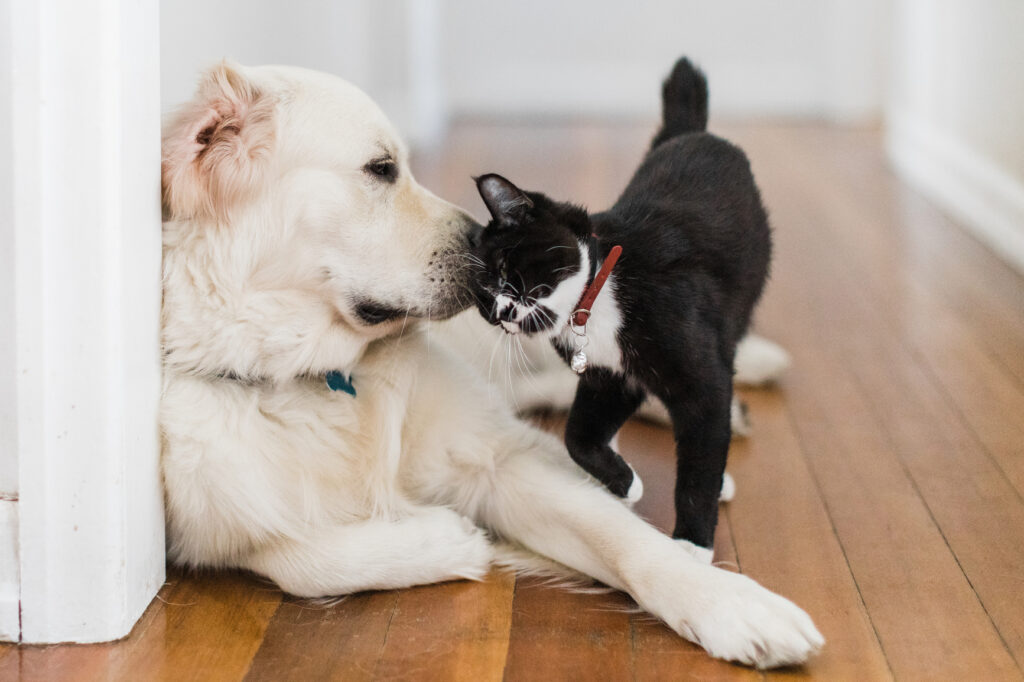
Cats and dogs: friendlier than you might think
Thanks to our domestic pet conventions, cat-dog pairings are ripe for study. Some assume that the two are destined to be natural enemies. But the research, as limited as it is, is starting to tell a different, more cordial story.
A 2020 survey of 1,270 households with both species in the home confirmed what many of us already knew—cats can develop genuine interspecific social bonds when they’re familiar with dogs, and vice versa.
Another questionnaire-based study from 2018 found that whether the relationship was successful or not generally depended on how comfortable the cat was.
Dr. Todd shed some light on why this might be the case. “As well as being predators, cats are also a prey species, and sometimes they can literally be at risk from a dog,” Todd wrote. “Cats like to be able to hide, and this is their natural response when they feel threatened. So in a dog-cat home, the cat’s comfort with the dog is actually a really important part of how they get along.”
Dr. Todd recommended that owners of both dogs and cats “pay attention to the home environment from the cat’s point of view, and make sure that they have plenty of hiding spaces and high-up spaces, and can always get away from the dog if they want to.”
Likewise, introducing cats and dogs should be a thoughtful, intentional, and slow process. For more on some best practices, so that friendship has a chance, head here. It’s important because, as Dr. Todd wrote, “If there’s a bad first impression, it can take a long time to put that right, unfortunately.”
What about big cats?
The good vibes can extend to big cats as well. One of the most unexpected interspecies friendships out there is the one that some dogs have with cheetahs. Starting with conservation biologist and writer Laurie Marker’s work in the 1970s and continuing with research teams at facilities like the San Diego Zoo, scientists have documented how dogs can serve as emotional support companions for captive cheetahs. (Still, we don’t recommend letting your own dog hang out with large predators.)
Despite their reputation as natural-born predators, cheetahs can be anxious creatures. Research beginning with the pairing of a cheetah named Khayam with a Lab-mix companion in a Cheetah-breeding program in the 1970s showed that dog companions could significantly reduce stress in cheetahs and improve their socialization. The dog-cheetah friendships are authentic—they play together like siblings, rest near each other, and seem to derive real comfort from their unusual companionship.
Some dogs’ openness to cross-species connection is just one of the things that makes them special in general, and special to us. And while their friendships with each other, with cats (including big cats), and sheep are all extraordinary, it’s their love for us and our love for them that is most worth celebrating this time of year and all year round.
Related Topics
Related Topics
More on Lifestyle
Dog People, Lifestyle • 11 minutes
A Dog Person’s Guide to San Francisco
The Bay Area is also a bark area.
Lifestyle • 7 minutes
Why It’s Dangerous To Let Kids Ride Dogs—Even Big Dogs
What might seem like goofy fun can hurt children and dogs alike.
Lifestyle, New Dog • 8 minutes
Adopt One of These Dogs By March 15, and Start Them on Fresh Food for Free
Let’s meet some good dogs.
Dog People, Lifestyle • 11 minutes
A Dog Person’s Guide to San Francisco
The Bay Area is also a bark area.
Lifestyle • 7 minutes
Why It’s Dangerous To Let Kids Ride Dogs—Even Big Dogs
What might seem like goofy fun can hurt children and dogs alike.
Lifestyle, New Dog • 8 minutes
Adopt One of These Dogs By March 15, and Start Them on Fresh Food for Free
Let’s meet some good dogs.