Share article:


In this article:
- When should I start training my dog for my kid’s solid-food journey?
- What if I’m already in too deep?
- How can I make “place” more appealing than the mess?
- Is it possible to get a dog to actually relax?
- What else can I do?
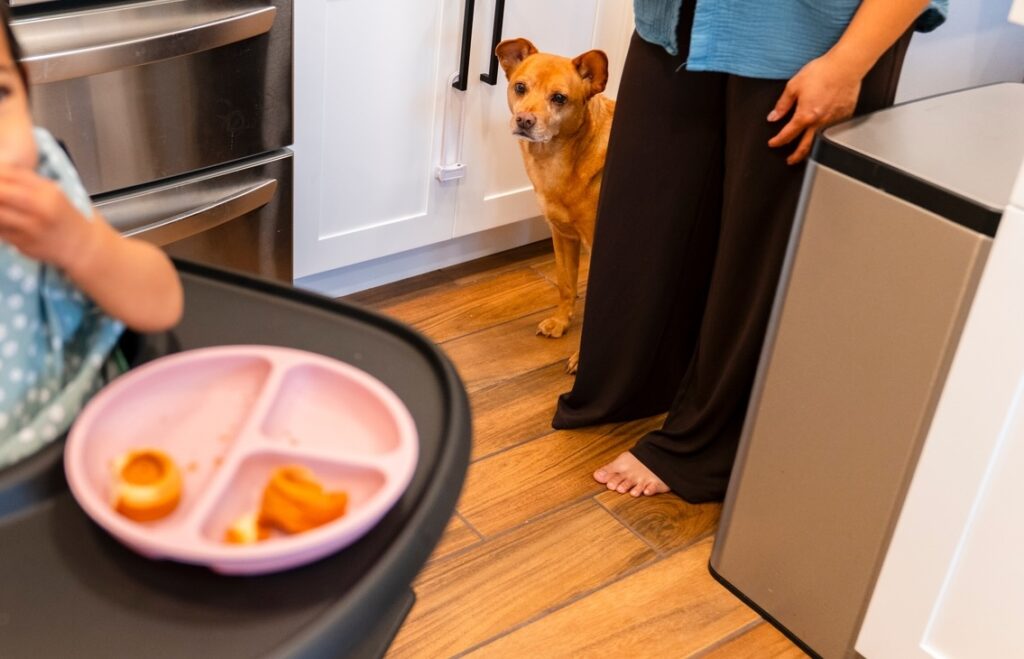
When babies graduate from their all-liquid diet, it’s an exciting milestone. And as thrilled as you and your baby may be, your dog might be under the impression that a miracle has occurred.
That’s because, when babies drop or throw foods, family dogs experience what Shannon Feeney, Associate Director of Behavior Programs at the San Diego Humane Society, calls a “lottery-style dispensing” of novel treats from the sky. From your dog’s perspective, it might seem like the best thing that’s ever happened.
The problem is that this apparently symbiotic relationship—baby drops food, dog cleans it up—isn’t sustainable. Dogs could consume foods that aren’t part of their complete and balanced diet, which could lead to illness or weight gain. And some foods that are okay for human babies, like cooked or cut grapes, can be dangerous or even deadly for dogs.
Dropped food can also bring about or exacerbate protective behaviors like resource guarding, which can be dangerous for your baby. If this pattern is already playing out in your home, you’re not alone—and importantly, you’re not stuck.
When should I start training my dog for my kid’s solid-food journey?
Many parents assume that flying food will create positive associations between dog and baby. Jennifer Shryock, who founded the dog and baby safety organization Family Paws in 2002, hears this frequently. “A lot of people think, ‘Oh great, the food will make our dog like the baby,’” she says. But she cautioned against leaning into this dynamic: “I’ve seen a lot of bites because of this very thing. The dog comes over to get the food, and they’re interested in the food, but they’re not interested in the baby—and the baby reaches for the dog, and the dog snaps.”
It’s good to get ahead of it. In an ideal world, Feeney said, you’d begin preparing your dog for this transition during your first or second trimester.
“Proactive is ideal,” she explains. San Diego Humane Society holds classes called “Dogs and Storks” through local hospitals for expecting parents, covering skills like separation, confinement, and managing change. Family Paws offers preparation courses as well (Feeney is also a Family Paws educator).
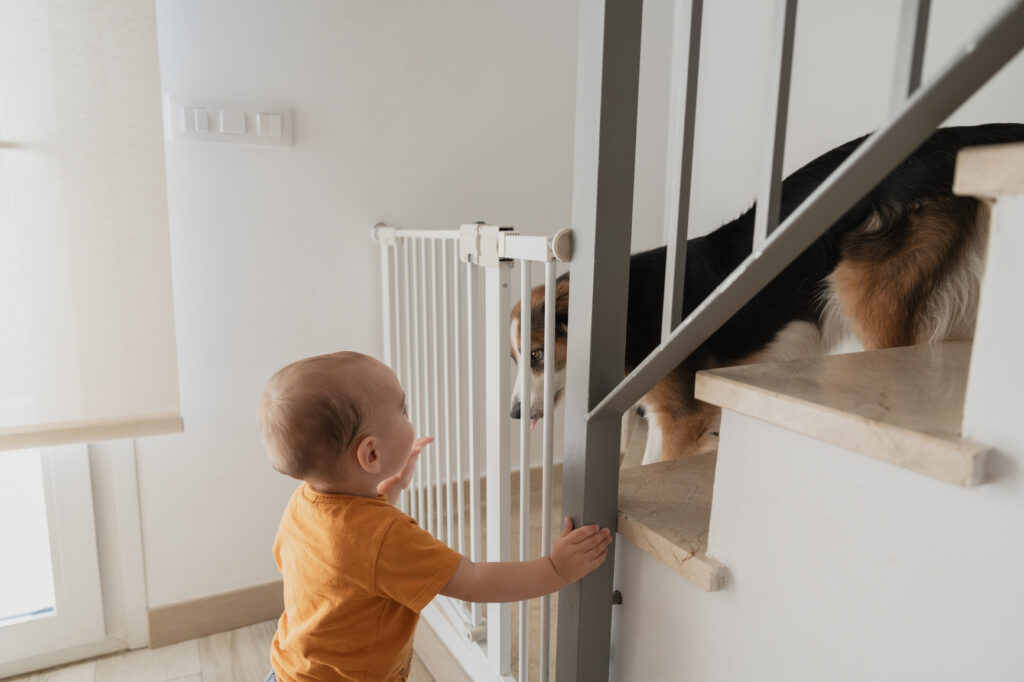
“Practice with your gates,” Shryock said. “Practice separation. The time to learn that is when you don’t have a baby crying, when you’ve gotten [more than] three hours of sleep.”
Gates are particularly valuable because they allow what Shryock calls “inclusion with safe, comfortable separation.” Rather than banishing the dog to another room entirely, gates let dogs observe family activities while maintaining boundaries.
“Separation allows for inclusion,” she said. “Otherwise people are putting the dogs outside and they’re excluded. If we’re using gates, we’re able to have the dogs see what’s going on, and that’s what we want.”
Feeney added additional management tools and training: a designated bed or mat, a tether to prevent your dog from accessing the kitchen, and positive-reinforcement training to help them learn that good things happen when they relax in their spot—which is definitely not directly below the high chair.
“You can teach your dog to relax on a mat while activities are going on in the kitchen,” Feeney says. Start this training before the baby arrives, using regular kitchen activity as your practice scenario. Once you add a baby to the mix, your dog will already understand the routine.
Shryock calls these setups “success stations”—designated areas where dogs can feel safe and comfortable while remaining included in family life.
“We want dogs to be comfortable and feel safe,” she said. “This stage is really hard because the dogs are very conflicted. The child is able to do a lot of different things and is making a lot of different noises and is moving in an unpredictable way, and that creates a lot of stress for the dog. Having a barrier can help the dog feel more safe and secure.”
What if I’m already in too deep?
Maybe you’re reading this with a ten-month-old who’s been flinging food for months, and your dog has become accustomed to a certain lifestyle. Can you still fix it? Yes.
“It’s not impossible,” Feeney says, though she acknowledges that some dogs have better frustration tolerance than others. Your dog may have strong feelings about suddenly losing access to this windfall of snacks. The key is being strategic about the change.
Feeney suggests setting up a bed or mat five to ten feet away from the high chair, paired with a tether to physically prevent your dog from accessing the feeding area. But here’s the crucial part: don’t just remove the opportunity for high-chair scraps and expect your dog to be thrilled about their new station. You need to make the alternative at least as rewarding.
How can I make “place” more appealing than the mess?
Her suggestion? “Planning ahead and stuffing those frozen puzzle toys, popsicles, slow feeders—that keeps them busy for a long time. Doing things like that during mealtime can save everybody.” Spreading fresh food on a lick mat can be useful here—everyone gets to have a relaxing mealtime this way.
Feeney added an even easier option: treat-dispensing technology. She recommends investing in an automatic treat dispenser that can be set to randomly dispense goodies while your dog relaxes on their mat. Many dispensers can be programmed to deliver treats on a random schedule—the same lottery-style reinforcement your dog was getting from the high chair, just relocated.
The treats should be at least as valuable as what was falling from the sky, and preferably more so. If your baby was dropping baked chicken, try their favorite treats cut up into small bites. This will help you stick to the 10% rule: for proper nutrition, a dog’s calories from all treats combined should be no more than 10% of their daily diet.
Feeney emphasized teaching your dog skills like “go to place” and “relax” outside of mealtimes first. Practice when the high chair is empty and there’s no baby present, so your dog learns the behavior without the added context of knowing what they’re missing. Once they’re getting the hang of their new skill, Feeney said, “add it to mealtime.”
Teaching your dog to go to and stay on a mat or bed also has the advantage of being portable. “It’s like target training,” Feeney notes. “You can kind of move it around.”
Whether you’re in a tiny apartment or a chateau, a towel or mat can mark your dog’s designated spot. Once they’re good at the behavior, they can perform it with some distance—maybe even in another room.
Is it possible to get a dog to actually relax?
Some dogs find relaxation genuinely challenging, especially if they’re naturally excitable or were bred for work. “Some dogs are going to be able to be up and aroused really quickly,” Feeney says. “We’ve bred selectively for that.”
If your dog gets overstimulated by food, she suggests considering alternative reinforcers beyond treats, or working with a trainer to specifically teach calm behaviors. “You can reinforce calming signals or patience—things like deep breaths, sighing, relaxing in the shoulders,” she explains. This is more nuanced work, but it’s possible.
What else can I do?
Both experts emphasized realistic expectations for overwhelmed parents—which is why their main recommendations were gates, X-pens, and tethers. “I’m big on management because to be honest, not many parents with toddlers want to train,” Shryock says. “It’s hard enough when you’re working with a toddler and you’re just trying to get food into the kiddo.”
A tether attached to your dog’s collar and a nearby sturdy object can work. A baby gate across the kitchen entrance can work. A crate in another room with a frozen Kong can work. Tailor your approach to what’s easiest and most comfortable for your dog.
“Sometimes management is the simplest [way],” Mitchell said. The goal isn’t perfection—it’s keeping both your baby and your dog safe.
The mess of early solid feeding is temporary—though it probably doesn’t feel that way when you’re wiping pea residue off the wall. Taking the time now to teach your dog an alternative behavior, or at minimum setting up an effective management system, will continue to come in handy as you work on building a positive relationship between your child and your dog.
Related Topics
Related Topics
More on Health & Wellness
Health & Wellness, Training & Behavior • 8 minutes
Why Do Dogs Love to Roll in Smelly Things?
Here’s where they get their passion for pungency, and what to do about it.
Health & Wellness • 8 minutes
How to Bond With Your Dog at Mealtime
Feeding time is a built-in chance to strengthen trust and communication.
Health & Wellness, Lifestyle, Science & Research • 8 minutes
Is It OK if My Dog Licks Me?
We all know where those mouths have been.
Health & Wellness, Training & Behavior • 8 minutes
Why Do Dogs Love to Roll in Smelly Things?
Here’s where they get their passion for pungency, and what to do about it.
Health & Wellness • 8 minutes
How to Bond With Your Dog at Mealtime
Feeding time is a built-in chance to strengthen trust and communication.
Health & Wellness, Lifestyle, Science & Research • 8 minutes
Is It OK if My Dog Licks Me?
We all know where those mouths have been.