Share article:


In this article:
- What does “food-motivated” mean when it comes to my dog?
- Why isn’t my dog taking treats?
- How do I discover what motivates my dog?
If you’ve ever tried to train your dog and found them completely uninterested in the treats in your hand, you’ve probably wondered: Is my dog just not food-motivated? And if that’s the case, how do I train them?
Many trainers, though, assert that nearly every dog is food-motivated. The real question isn’t whether a healthy dog cares about food—it’s what’s getting in the way of them showing it.
What “food-motivated” actually means.
“All dogs are food-motivated, if they are alive,” said Kate LaSala, a certified dog trainer, certified behavior consultant, and founder of Rescued by Training. “If they weren’t food-motivated, they would die of starvation. So unless the dog is sick, the dog is figuring out how to get up and walk to their food bowl. They’re figuring out how to navigate a food toy. They’re figuring out how to get their calories in some way. And by definition, that is motivation.”
Maddie Messina, a certified dog trainer and founder of Paws for Thought Dog Training, agreed that the label “not food-motivated” is often misapplied.
“Motivation is innate,” she said. “Most dogs are innately motivated by food because they eat to live. People tend to label dogs [as ‘not food-motivated’] if they don’t eat treats outside, or in certain [other] situations.”
So when people say their dog isn’t food-motivated, what’s really happening? It usually comes down to the context and the environment—that is, what else is competing for the dog’s attention.
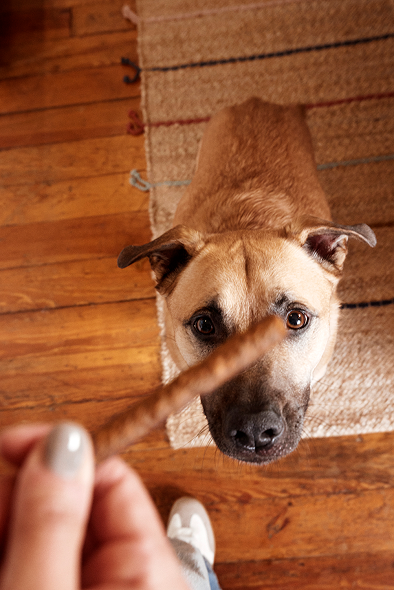
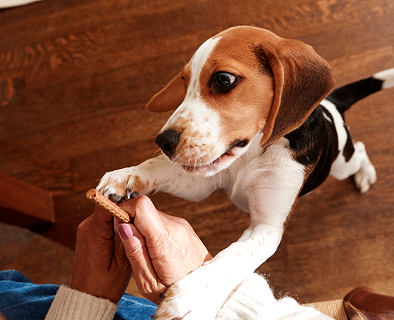
Why your dog might not be taking treats—and how to help them.
Fear and stress
The most common reason dogs refuse food during training is fear. “If a dog is fearful, they’re not going to take food. They have bigger things to worry about,” LaSala said. “If a dog is afraid, their body is preparing for fight or flight. Their amygdala is getting activated, stress hormones are being released, their heart rate is increasing, their respiration is increasing, and blood flow is going to muscles and not to systems like eating.”
In other words, if your dog is scared, the threat they’re perceiving is more powerful than their desire for calories at that moment.
Messina agrees that it would be incorrect to write off fearful dogs as untrainable with treats.
“The fear response can reduce food drive. So many fearful dogs, for example, won’t eat treats outside, but this doesn’t mean treat training won’t work for them in environments where they are more comfortable,” she said. “It also could mean that we need to gradually work up to eating treats in scarier environments through counterconditioning.”
If fear is indeed the issue, you can remove the fear-producing stimulus (or remove the dog from a fearful situation) and try training again later. Work counter-conditioning and desensitization tactics into your training regimen so that your dog can become more comfortable with the scary thing.
Competing motivations
Sometimes the problem isn’t fear—it’s that something else is more interesting than your treats. “Puppies and adolescent dogs are typically in the most social stages of their lives,” Messina said. “So if you’re trying to use treats in a dog park, you might find that your dog is more excited about playing with other dogs than focusing on the treats.”
LaSala offered an example: “If your dog is chasing a squirrel in [the park], and you’re like, ‘Fido, come’, and your history of calling him and giving him food is some sort of dry biscuit—what’s more motivating in that situation for the dog? The squirrel. Not your [treat].”
This is what LaSala called a “why problem”—as in, why should the dog listen when the alternative is so much better?
Here’s how to help a dog learn when they find non-treat stimuli more exciting than your lessons: Remove the more exciting thing while you are training with treats. Start training indoors where there are fewer distractions—be it sights, smells, sounds, or all of the above. And put away the pork loin cooling on the dining table, which might make your turkey treats seem less enticing by comparison. Only move outside once your dog masters the work inside.
Once outside, make sure the treats you’re using are high value—meaning the most delicious items you can find that are healthy for a dog (some options here). And only add distance and distraction as your dog reliably follows your cues at each step.
The wrong treats at the wrong time
Even the best treats won’t motivate your dog if you’re offering them at the wrong moment. LaSala used a Thanksgiving analogy: “If you come over for Thanksgiving, you’ve had seconds and thirds, and I’m like, ‘Hey, can you go help me with this really hard project? I’ll give you an extra piece of pie.’ And you’re like, ‘Oh my god, I’m so full already.’ That’s not motivating. But if I offered you $10,000, you’re gonna probably do that.”
The solution? Structure training around mealtimes—or better yet, use your dog’s food as training treats. LaSala makes homemade treats using The Farmer’s Dog food, creating about 2,000 tiny triangle-shaped treats from a single packet. “The dog can get their portion of food in little tiny treats that I’m able to use in the context of training,” she said. If you’re going to make frozen treats from our food, for safety reasons, make sure to re-freeze within one to two days of thawing in the refrigerator, and right after you shape them.
Medical issues
One major sign of illness in dogs, from puppies to seniors, is a lack of appetite—what veterinarians call “inappetence.” If your dog will usually take a treat, but is no longer interested—and you’ve ruled out fear or situational discomfort—keep an eye on them. If they continue to have a reduced or nonexistent appetite for more than 24 hours, or have additional signs of ill health like poor stool quality, lethargy, and/or vomiting, call your veterinarian.
A limited exception
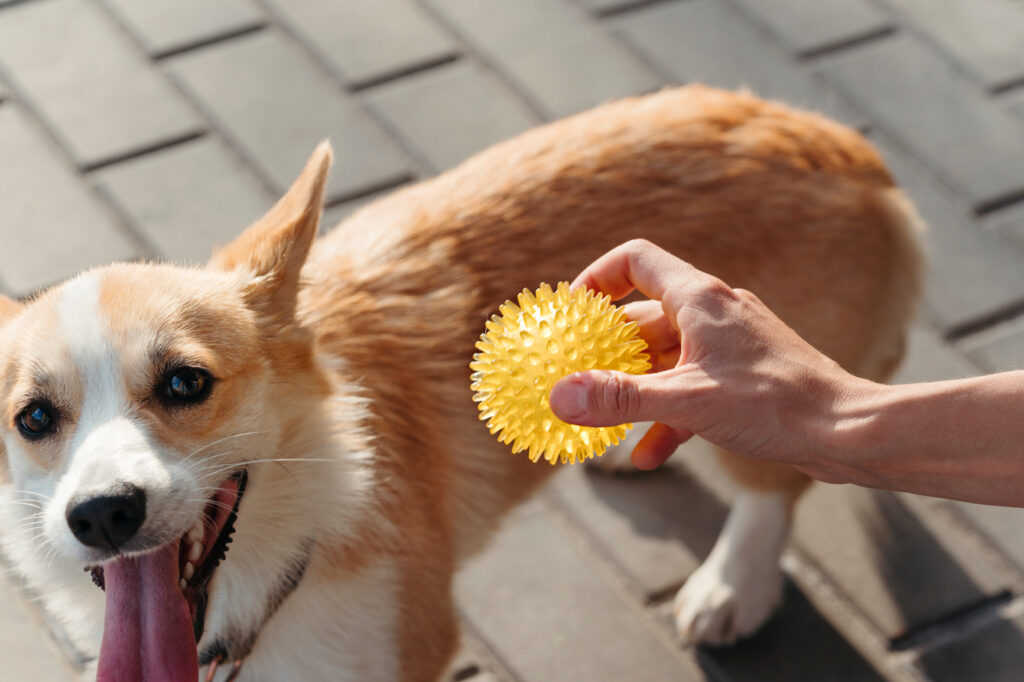
While LaSala maintains that food can and should be the primary tool for training—especially for fear issues and life-saving behaviors like recall—she acknowledges that a very small subset of highly driven working dogs might work primarily for toys or praise.
Many of these dogs are recruited for specific jobs that require professionals who will happily work hard in food-free workplaces. For example, when we spoke with team members at Working Dogs for Conservancy last year, they pointed out that their conservation dogs responded best to training with toys. It’s also essential to their work, since it often goes down in delicate environments where it’s best not to eat on the job.
Most dogs do respond to food, and it’s an excellent training tool, but Messina pointed out that there are ways to reinforce behaviors with a dog’s other favorite things besides treats—often behaviors they want to do. But, most of the time, it’s harder to get results with these non-food rewards than with treats.
For alternative reinforcement methods, Messina offered specific examples that would fall under the umbrella of the Premack Principle, which is a training framework that “uses naturally occurring reinforcers to reinforce a behavior,” she said. This essentially means allowing the dog to engage in a behavior that they want to engage in after they comply with a cue.
By way of example, Messina described a dog who loves greeting people. “If your dog tends to jump on people when they greet them, rather than letting your dog rush up to a person, first you cue a sit and you reward that calm behavior by then letting them greet the person,” she said.
For fearful dogs, distance itself can be the reward. “If your dog on a walk sees another dog and then looks away from it calmly or looks at you, mark and reinforce by providing distance from the other (scary) dog,” Messina said. “Distance from a scary thing can be reinforcing.”
She compared it to her own fear of spiders: “I’m terrified of spiders, and moving away from a spider feels great. So if my parents were trying to teach me to be braver around spiders, they would say, ‘Maddie, if you look at this spider calmly for one second, then you can move away.'”
This work takes a lot of noticing what the dog likes or wants, and then granting what the dog wants at the right time.
“It’s a much more elevated style of training,” Messina acknowledged. “Nine times out of 10,” she uses these alternative rewards “in addition” to treats—because the Premack Principle on its own usually isn’t enough to train a dog.
Incorporating natural reinforcements into training is probably work that’s best done with a qualified trainer first, until you get the hang of it.
Your dog probably is food-motivated
Before labeling your dog as “not food-motivated,” ask yourself: Does your dog have ongoing gastrointestinal issues or food allergies? Does your dog eat treats in certain environments but not others? Are they fearful, overstimulated, or just full from dinner? LaSala offers a testing option, too: try offering a free treat, as in not asking them to do anything in exchange for it.
“If they won’t take it for free, then they’re definitely not going to work for it,” LaSala said. “So either the environment is too distracting, maybe they’re done with training for that day, they’re full, whatever it is. If they’re not gonna take a freebie, you’re not gonna make any progress in training.”
With the right approach, timing, and high-value rewards, nearly every dog can be successfully trained with food. As LaSala put it: “Chicken is chicken, cheese is cheese. Most dogs are gonna love that.”
Related Topics
Related Topics
More on Training & Behavior
Health & Wellness, Training & Behavior • 8 minutes
Why Do Dogs Love to Roll in Smelly Things?
Here’s where they get their passion for pungency, and what to do about it.
Lifestyle, Training & Behavior • 8 minutes
Why Does My Dog Follow Me Into the Bathroom?
A dog’s love knows no bounds.
Health & Wellness, Training & Behavior • 8 minutes
Why Do Dogs Love to Roll in Smelly Things?
Here’s where they get their passion for pungency, and what to do about it.
Lifestyle, Training & Behavior • 8 minutes
Why Does My Dog Follow Me Into the Bathroom?
A dog’s love knows no bounds.