Share article:


In this article:
- Why is the “10% rule” important for dogs’ health?
- How do I calculate the right number of treats for my dog?
- How can I train my dog without giving them too many treats?
- How can I tell whether I’m giving my dog too many treats?
- What should I do if I accidentally gave my dog too many treats in a day?
- Is the 10% rule right for every dog?
Treats are wonderful, versatile tools in our dogs’ lives: They’re crucial for training, can help our best friends overcome fears, and can help reinforce the human-dog bond. But just because treats are useful does not mean that your dog can have an unlimited supply of them. In fact, veterinarians have a rule about how many treats are too many: Any food outside of a dog’s complete and balanced meals, including treats, should make up no more than 10% of their total calorie intake. That’s the “10% rule” for dog treats.
Here’s why, and how you can follow the rule to keep your dog happy and healthy.
Why the “10% rule” is important for dogs’ health
Dogs need to stay at a healthy weight
There are two big reasons that the “10% rule” is so crucial. One has to do with obesity. Research shows that dogs who maintain a healthy weight can live up to 2.5 years longer than those who are overweight. But, sadly, most American dogs are overweight or obese—as of 2022, the figure was 59%.
Even relatively small increases in weight can have serious health consequences for dogs. When we spoke to Dr. Ernie Ward, founder of the Association for Pet Obesity Prevention (APOP), he told us: “We think, ‘a few [extra pounds on] my Lab; what could the consequence of that be?’ But the consequences are that Lab’s hips are deteriorating, it’s causing damage to the kidneys, [and] it’s probably causing high blood pressure—which is causing a constellation of problems, and it’s increasing cancer risk.”
One way to keep your dog’s body condition healthy is by giving them the right amount of food at mealtimes. A fresh plan from The Farmer’s Dog can simplify feeding the correct amount because the food is delivered pre-portioned according to your dog’s needs, taking into account factors like age, spay/neuter status, activity level, and more.
But treats count toward a dog’s daily calorie budget—so if you feed them too many extras, even a dog whose meals are fastidiously planned and portioned may gain weight.
Dogs need complete and balanced nutrition
It’s important for a dog’s primary diet to be complete and balanced, which is a standard defined by the Association of American Feed Control Officials (AAFCO). If a food is complete and balanced, it meets dogs’ nutritional needs and is safe to feed every day. All recipes from The Farmer’s Dog are formulated by on-staff, board-certified nutritionists to be complete and balanced, and we’ve put multiple formulas through AAFCO feeding trials.
But even when your dog is eating healthy food, too many treats can upset their nutritional balance. Most treats are designed to be supplemental, meaning that they should only be fed as extras. When treats make up more than 10% of a dog’s daily calories, they can disrupt the ratios of protein, fats, vitamins, and minerals dogs need to thrive.
How do I calculate the right number of treats for my dog?
The best way to give your dog the proper number of treats is to set them aside ahead of training. When vets talk about the 10% rule, they are talking about calories rather than volume. Calories are required to be on the labels of all dog foods and treats, which makes it easier to determine the right amount. You can do so like this:
- Find your dog’s daily calorie count by logging into your account at The Farmer’s Dog. Calories are listed under “Plan” and then “Daily Portions.”
- Multiply that number by 0.10. The result is your dog’s treat budget. A dog who needs 500 calories a day, for example, can have 50 calories of treats.
- Check the treat package for calories. Look for a “kcal per treat” listing on the label, usually near the feeding guidelines. (Sometimes the calories are listed per bag or per serving. You’ll have to divide those by the number of treats in the bag or in a serving, respectively, to work out the number of calories per treat.)
- Divide your treat budget by the calories per treat. That’s how many treats your dog can have in a day. If your budget is 50 calories and each treat is 25 calories, that’s two treats.
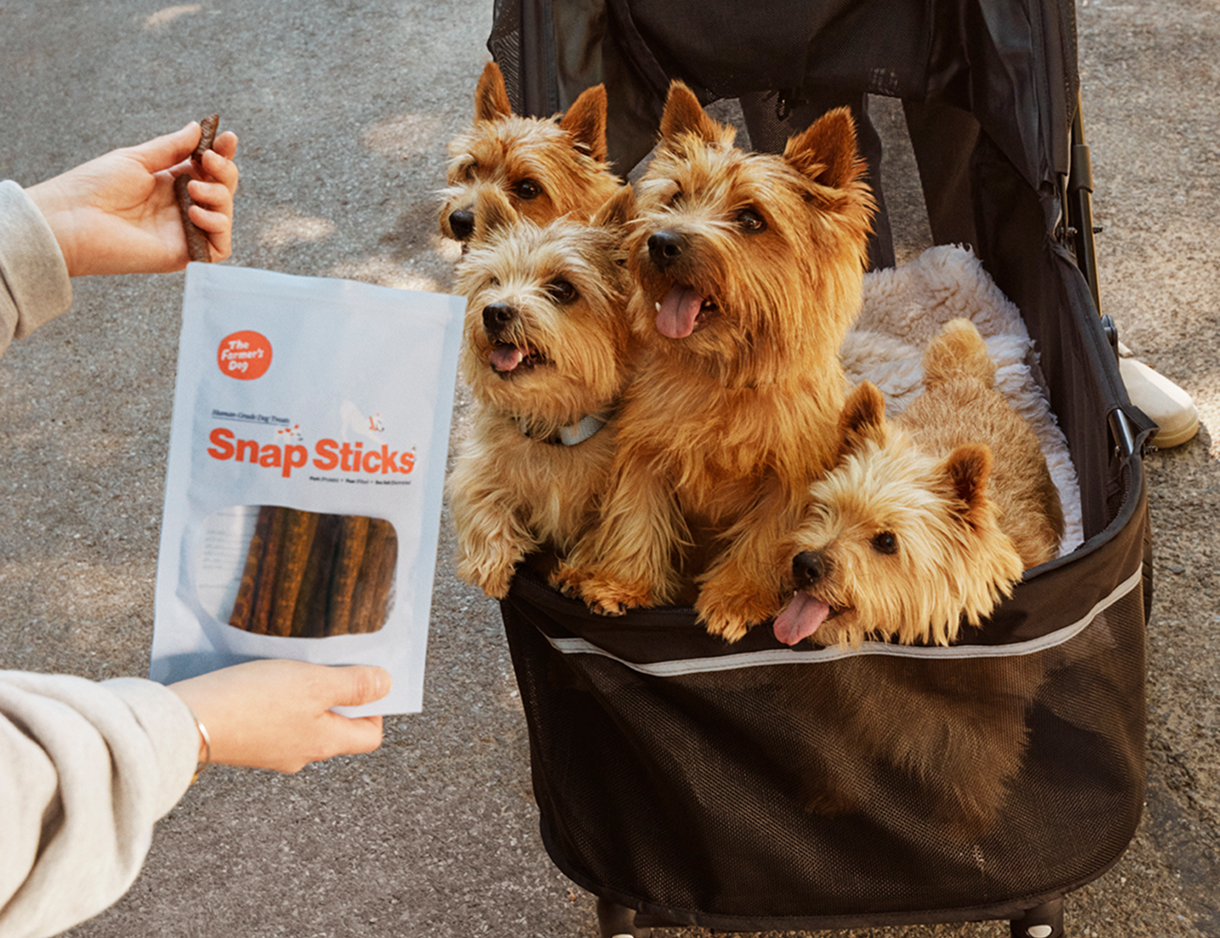
To make things easier, The Farmer’s Dog food is delivered pre-portioned for each individual dog’s needs, and we build in a personalized serving limit for our Snap Sticks treats, so you know exactly how many treats you can dole out while sticking to your dog’s daily calorie plan.
How can I train my dog without giving them too many treats?
Pre-measure daily treats
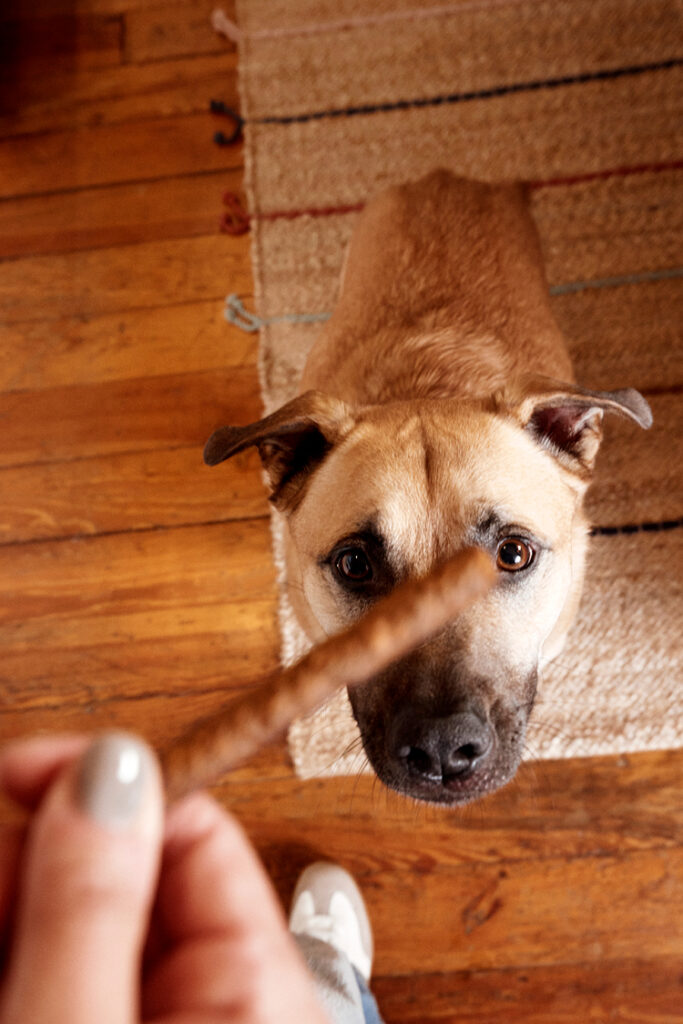
One reliable way to train a dog without giving them too many extras is by using a pre-measured quantity of treats, like Snap Sticks, throughout the day. Once that daily treat allotment is finished, don’t offer any more until the following day. You can still give positive reinforcement for good behavior, or simply to bond, through praise and play.
Use your dog’s complete and balanced food in place of extra treats.
To turn The Farmer’s Dog into bite-sized training treats, spread it in a silicone mold and freeze it. (If you’re going to make frozen treats from our food, make sure to re-freeze within two days of the package thawing in the refrigerator.) Set aside the amount of food you want to feed as treats, and deliver it to your dog that way. Just make sure that they get their full portion through a combination of training and mealtime, so they don’t miss out on necessary calories or nutrients.
How can I tell whether I’m giving my dog too many treats?
One way to make sure that your dog isn’t getting too many treats is to consistently check their body condition.
Veterinarians assess dogs’ body condition by sight and touch using something called a Body Condition Score. Typically, they use a scale ranging from 1 to 9. 1 means “too skinny,” 9 indicates obesity, and 4–5 is ideal. This score indicates whether your dog needs to lose, maintain, or gain weight.
You can use this same technique at home to determine how much fat is on your dog’s frame. It doesn’t require a scale, or any equipment—just your hands, eyes, and a few minutes of hands-on time and attention to your dog, which they’ll likely enjoy. Your vet can show you how to do this at your next visit, and you can also find instructions—including a video demonstration—here.
What if I accidentally gave my dog too many treats in a day?
Over-treating can happen occasionally. If you go overboard on a particular day, veterinarians still do not generally recommend reducing your dog’s portions of complete and balanced food.
This is because, while reducing a dog’s meal size may help them hit a calorie target, it could increase the risk of unbalancing their complete and balanced diet. Just get back to the correct helpings of treats and food the next day.
Is the 10% rule right for every dog?
Every dog is different, and has different needs. Some need fewer treats because of factors like medical conditions. Your dog’s veterinarian is the best person to ask whether the 10% rule is right for them. In fact, if you have any questions about your dog’s individual health or dietary needs, reach out to your vet.
Related Topics
Related Topics
More on Nutrition

Breeds, Health & Wellness, Nutrition, Training & Behavior • 17 minutes
The Corgi Care Guide
Don’t let the tiny legs and infectious smiles fool you—these working dogs need a lot of physical and mental exercise.
Health & Wellness, Nutrition • 14 minutes
Can My Dog Eat Halloween Candy?
Many spooky-season treats are downright scary for dogs. Here’s how to keep yours safe.
Health & Wellness, Nutrition • 16 minutes
What’s the Best Food for Senior Dogs?
Seniors should receive complete and balanced nutrition that meets their specific health needs—because every dog ages differently.
Breeds, Health & Wellness, Nutrition, Training & Behavior • 17 minutes
The Corgi Care Guide
Don’t let the tiny legs and infectious smiles fool you—these working dogs need a lot of physical and mental exercise.
Health & Wellness, Nutrition • 14 minutes
Can My Dog Eat Halloween Candy?
Many spooky-season treats are downright scary for dogs. Here’s how to keep yours safe.
Health & Wellness, Nutrition • 16 minutes
What’s the Best Food for Senior Dogs?
Seniors should receive complete and balanced nutrition that meets their specific health needs—because every dog ages differently.