Share article:


In this article:
- Do dogs wag their tails because they’re happy?
- Why do dogs have tails?
- Why did tail-wagging evolve in dogs?
- Can dogs break their tails?
- Why do some dogs have docked tails?
We can’t read dogs’ minds, but sometimes when we look at their tails it seems like we can come close. When you get home and see your best friend’s loose, wiggly wag, they don’t need any words to say it: They love you and are thrilled to see you.
But there’s so much more to dogs’ tails than that. They are so fascinatingly complex that a search will turn up almost half a million papers researching them. Whether you’re looking at the waggly appendage as a window into their emotional state, or just want to do what you can to keep it healthy, here’s everything you ever wanted to know about your dog’s tail.
Do dogs wag their tails because they’re happy?
Since dogs primarily use their tails to communicate, it’s important to learn the subtle signs they convey—and the most common ways to misread a wag
First and foremost, a wagging tail isn’t always a happy one.
“We do not recommend being potentially lulled into the sweeping generalized interpretation that [a] dog’s tail wag [means] ‘happy,’” said Katherine Pankratz, DVM, Diplomate of the American College of Veterinary Behaviorists, a veterinary behaviorist at the Animal Behavior Clinic in Portland, Oregon. “It can have many different and contradictory meanings.”
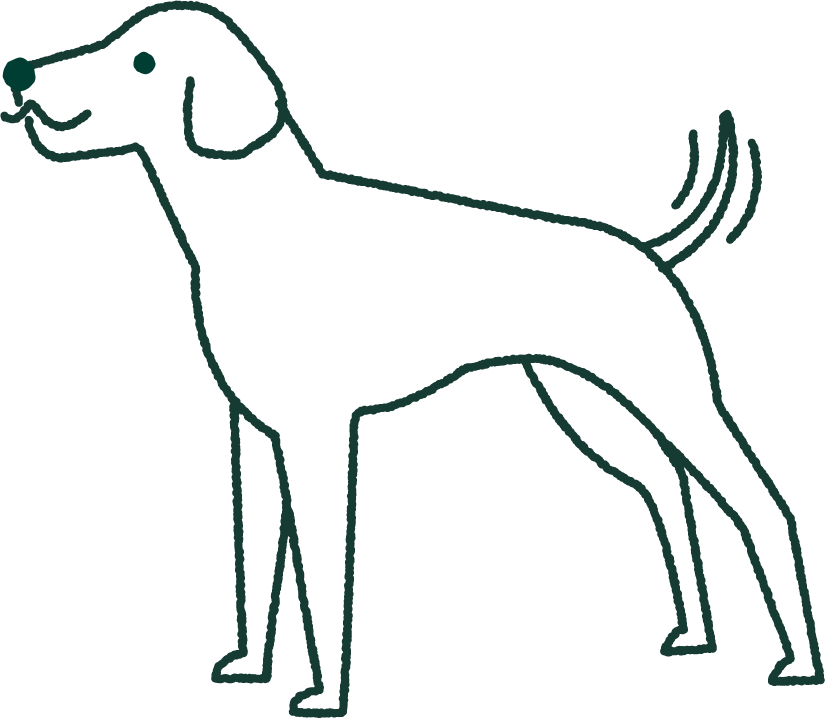
A happy dog’s tail wags in relaxed, loose sweeps or circles, swishing back and forth. On the other hand, tight movements and a stiff tail can indicate tension and alertness. Whether their tail is high, straight out, low, or tucked between the legs can also offer hints about a dog’s inner state.
Every dog is an individual, and context is an important part of figuring out what your dog’s body language means. But, even so, Dr. Pankratz said many behaviorists believe that “some tail movements and positions are universal across domestic dogs.” For example, she said, a tail held in a higher position “may be associated with confidence or aggression,” while a lowered one, like a tucked tail, “may reflect submissive behavior and/or fear.” There’s a reason why we say that somebody who’s embarrassed or ashamed “has their tail between their legs.”
Here are some feelings dogs may communicate with their tails:
- Agitation or alertness: A dog who’s preparing to confront something that they’re paying attention to may stand with their tail raised and ears up.
- Disengagement or negotiation: A dog who stops wagging their tail and freezes may be indicating that they don’t want to interact anymore—as with a friendly stranger who’s petting them.
- Aggression: A dog may be ready to aggress if their tail stands straight up like a flag pole or arches over their back, according to the Humane Society of Missouri. “The higher the tail, the greater the threat,” they wrote. This tail may be still or moving in quick, stiff wags.
- Submission: A tail tucked between the legs is a dog’s way of letting someone else know they are not a threat. If you see this tail signal, look at other signs of body language (such as ears pulled back or “whale-eye,” when you can see a lot of the whites of a dog’s eyes) that may indicate fearfulness, and try to determine if there’s something upsetting your dog.
- Joy: A fast, loose wag held in a neutral or slightly raised position is the wag of a dog who’s happy to see you.
Deciphering emotion from dogs’ tail movements isn’t always simple. “This behavior is much more complex than we had imagined,” said Silvia Leonetti, a biological sciences PhD candidate at the University of Turin who studies animal behavior, including why dogs wag their tails.
Researchers like Leonetti have dug into the relationship between a dog’s emotional state and their tail movements. Tail-wagging has many facets, including duration, speed, amplitude (how wide its movements are), direction (up-down or side-to-side), and bias (whether it wags just to the right or left side). And as ethologist Marc Bekoff, PhD, professor emeritus of ecology and evolutionary biology at the University of Colorado, Boulder wrote in Psychology Today, dog owners reading body language must look at the whole dog—aside from their tail, what are their ears and eyes doing? Environmental context matters, too: Are they interacting with another dog, a human, or an object?
Understanding these movements can inform our relationships with our dogs. “If we could better figure out what they are ‘saying’ with their tails, it would help guide pet parents,” said Margaret Gruen, PhD, an associate professor of behavior medicine at North Carolina State University’s College of Veterinary Medicine.
Why do dogs have tails?
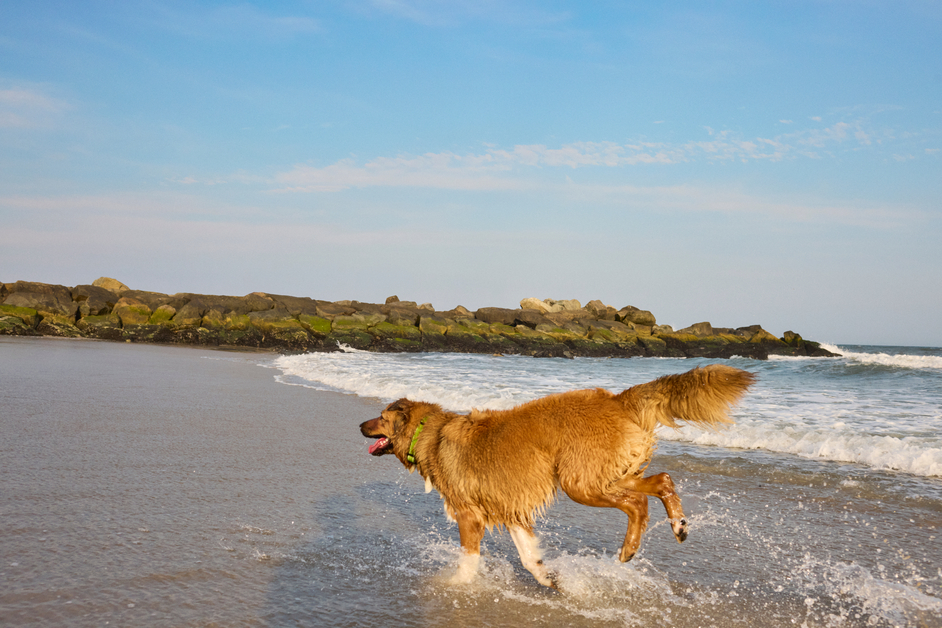
Vertebrates, or animals with a backbone, originally evolved tails to aid in movement and balance. But now, “the tail is predominantly used in dogs as a way to communicate,” said Scott Rutherford, Diplomate of the European College of Veterinary Surgeons, Fellow of the Royal College of Veterinary Surgeons, and assistant professor at The Ohio State University College of Veterinary Medicine.
Why did tail-wagging evolve in dogs?
A wealth of research probes this question. But “from a scientific point of view, tail movement remains an enigma,” Leonetti said.
One part of that enigma is the question of exactly how a tail’s motion is controlled; experts still aren’t sure whether its motions are voluntary or involuntary. “We believe in part that tail movements are connected to emotional states, and emotional states are involuntary,” Dr. Pankratz said.
In 2024, Leonetti and her team published a study analyzing over 100 papers covering the purpose and meaning of tail wags. They suggested two hypotheses: that tail-wagging evolved as a byproduct of humans selecting for other traits, such as docility and tameness; and that, during the domestication process, humans consciously or unconsciously selected dogs who wagged their tails because we’re drawn to rhythmic patterns.
Why does my dog wag their tail to the left vs. right?
If it looks like your dog is wagging their tail to one side, they’re not glitching. Wagging on only one side—called a wagging bias—arises from activity in one hemisphere, or side, of the brain. Each side of the brain controls the muscles on the opposite side of the body; so the right hemisphere controls left-wagging, and the left hemisphere right-wagging.
Research shows that a “right wag” and “left wag” may communicate different things. In a 2007 paper published in the journal Current Biology, researchers filmed dogs who encountered different stimuli: the dog’s owner, a stranger, an unfamiliar Belgian shepherd malinois, and a cat. The researchers found that dogs seeing their owner wagged their tails to the right side, while seeing the unfamiliar dog provoked them to wag to the left side.
In a 2022 study, the authors went a step further and linked right-side wagging with “positive affect” and left-side with “negative affect.” In this case, they had beagles interact with unfamiliar humans for just five minutes a day over three days, observing the dogs shift from left-side wagging to right-side.
What are dog tails made of?
An extension of the spine, dogs’ tails are made of bones called vertebrae—specifically, coccygeal vertebrae. As many as 23 coccygeal vertebrae comprise the tail, getting smaller and smaller toward the tip. Tough, fibrous bands of connective tissue called ligaments hold them together, and muscles woven throughout help them move. Nerve endings allow dogs to feel things through their tails.
What are the different kinds of dog tails?
Different breeds have different types of tails.
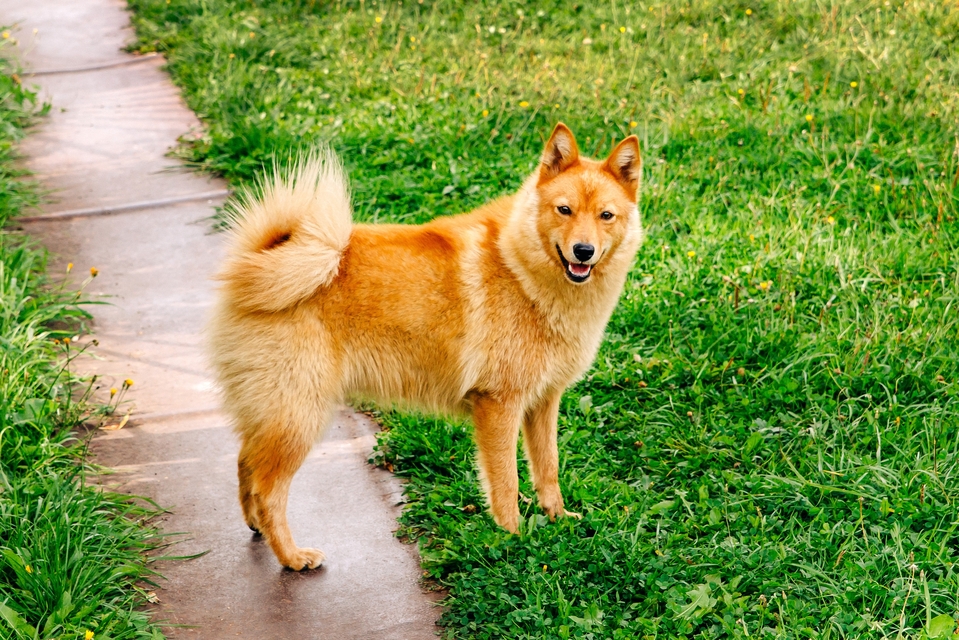
- Ringed/curly/sickle/corkscrew: These tails spiral into a curlicue shape. Samoyeds, akitas, chow chows, and Shiba Inus have ringed tails. Siberian huskies, Alaskan malamutes, and other dogs bred for cold climates have sickle tails that can curl around their faces to help keep them warm. Corkscrew tails, as seen in pugs and bulldogs, result from a vertebrae deformity, and they cannot straighten.
- Otter tail: These thick tails have a tapering, rounded end. Aptly named, this tail graces thick-coated dogs who love to swim, like Labrador retrievers, Chesapeake Bay retrievers, and of course otterhounds, functioning as a rudder as they move through water.
- Whip tail: These long, thin tails indeed resemble whips, and can be found on short-haired or hairless dogs with their length relative to the dog’s body size. Whip tails are particularly effective as a counterbalance, helping with stability, agility, and tight turns—so whip-tailed dogs tend to be breeds known for speed or hunting abilities, like greyhounds, whippets, and wolfhounds.
- Bobbed tail: Breeds considered naturally tailless actually have stubby appendages called bobbed tails. Breeds with bobbed tails include Jack Russell terriers, Pembroke Welsh corgis, Boston terriers, English and French bulldogs, Braque du Bourbonnais, and Brittany spaniels. Bobbed tails are distinct from docked tails, which are tails that have been surgically shortened or removed—a procedure which the American Veterinary Medical Association (AVMA) opposes.
Can dogs break their tails?
Dogs can injure their tails, and that includes breaks. Signs of a broken tail include wounds, less or no wagging, pain when touched, a kink or deviation, and swelling. If you suspect your dog has injured their tail, take them to the vet.
What is happy tail syndrome?
This condition arises when a forcefully wagging tail whacks against a hard surface, resulting in a wound. Basically, a dog wags their tail so hard against an object that they actually break their skin and bleed.
Happy tail is most common in large-breed dogs with long, skinny tails that have a powerful wag (see: whip tails), like greyhounds, lurchers, whippets, and Great Danes. It’s difficult to heal and fully treat, because you can’t simply ask your dog to stop wagging their tail.
These injuries “can be difficult to treat due to tail wagging, which can lead to non-healing wounds,” Dr. Rutherford said. But you can remove or pad hard surfaces your dog may wag their tail against. Skincare for a fragile tail may also help prevent or protect against infection if the skin breaks.
What is swimmer’s tail?
Also known as limber tail syndrome or, formally, acute caudal myopathy, this condition is a strain or sprain in the tail muscle. “Often it is due to overenthusiastic swimming, particularly in cold water,” Dr. Rutherford said, adding that it especially affects working dogs. In general, overuse can lead to limber tail.
One clear sign of swimmer’s tail is that your dog’s tail has “lost its wag.” Others include a limp tail, trouble squatting when they need to poop or pee, difficulty getting up, biting or licking at their tail, and vocalizations indicating that they’re in pain.
The best treatment for swimmer’s tail is rest. A warm compress on the tail can help, too.
Why do some dogs have docked tails?
A dog’s tail may be surgically removed. The procedure, called a caudectomy, is usually performed in the first five days of a dog’s life. Veterinarians oppose this procedure when it’s performed for “cosmetic or nontherapeutic reasons.”
While it’s been traditional to dock certain breeds’ tails, Dr. Rutherford said that “there is evidence that you harm far more dogs by preemptively docking than you help by preventing an injury.” In fact, evidence shows that hundreds of dogs would need their tails docked in order to prevent even a single injury. According to the AVMA, evidence shows that docking in puppyhood can permanently change normal development of the central nervous system.
Dr. Rutherford added that docking may be worth considering for dogs who have suffered certain significant injuries.
Tail docking deprives dogs of an effective means of communication. “Dogs are not physically disabled without a tail,” he said. “However, having a very short tail or almost none at all significantly impacts their ability to communicate how they are feeling between themselves and to other species such as humans.” A 2018 paper found that docking may interfere with interactions between two dogs, or dogs and humans, because a docked tail deprives a dog of one way to communicate positive and negative emotions.
All that said, your dog’s tail requires as much care and attention as the rest of them. And it’s part of how your best friend is constantly communicating with you. Watch it, and them, closely, and you may find that you understand them better than ever before.
Related Topics
Related Topics
More on Health & Wellness
Health & Wellness, Nutrition • 16 minutes
What’s the Best Food for Senior Dogs?
Seniors should receive complete and balanced nutrition that meets their specific health needs—because every dog ages differently.
Health & Wellness • 9 minutes
When Should I Spay or Neuter My Dog?
Talk through the timing with your veterinarian.
Health & Wellness, Training & Behavior • 8 minutes
Why Do Dogs Love to Roll in Smelly Things?
Here’s where they get their passion for pungency, and what to do about it.
Health & Wellness, Nutrition • 16 minutes
What’s the Best Food for Senior Dogs?
Seniors should receive complete and balanced nutrition that meets their specific health needs—because every dog ages differently.
Health & Wellness • 9 minutes
When Should I Spay or Neuter My Dog?
Talk through the timing with your veterinarian.
Health & Wellness, Training & Behavior • 8 minutes
Why Do Dogs Love to Roll in Smelly Things?
Here’s where they get their passion for pungency, and what to do about it.