Share article:


In this article:
- Why do dogs roll in smelly things?
- Do dogs roll in smelly things to hide their scent?
- Do dogs roll in smelly things to mark their territory?
- Do dogs roll in smelly things to stay cool?
- Do dogs roll in smelly things to show off for their friends?
- Do dogs roll in smelly things because it’s fun?
- What should I do if my dog rolls in something smelly?
What is it about our best friends and stinky things? From rotting garbage to dead animals to strange droppings in the dewy grass, some dogs love to roll in anything that might attract flies. In my household, we’ve got a running joke that our perennially malodorous 5-year-old hound, Rosey, is on a mission to curate the most distinctive scent imaginable by rubbing her back against any strange-smelling surface she can find.
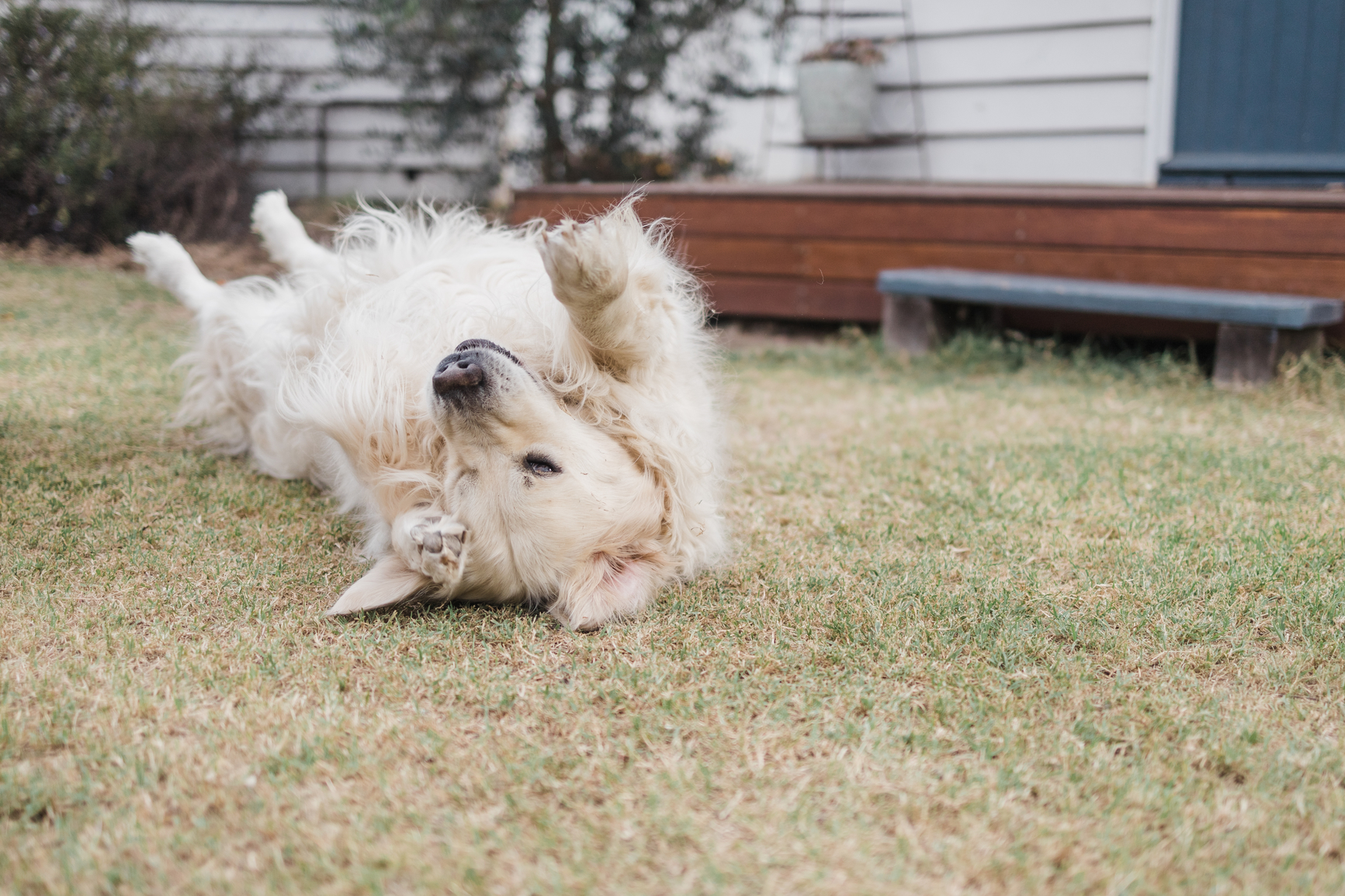
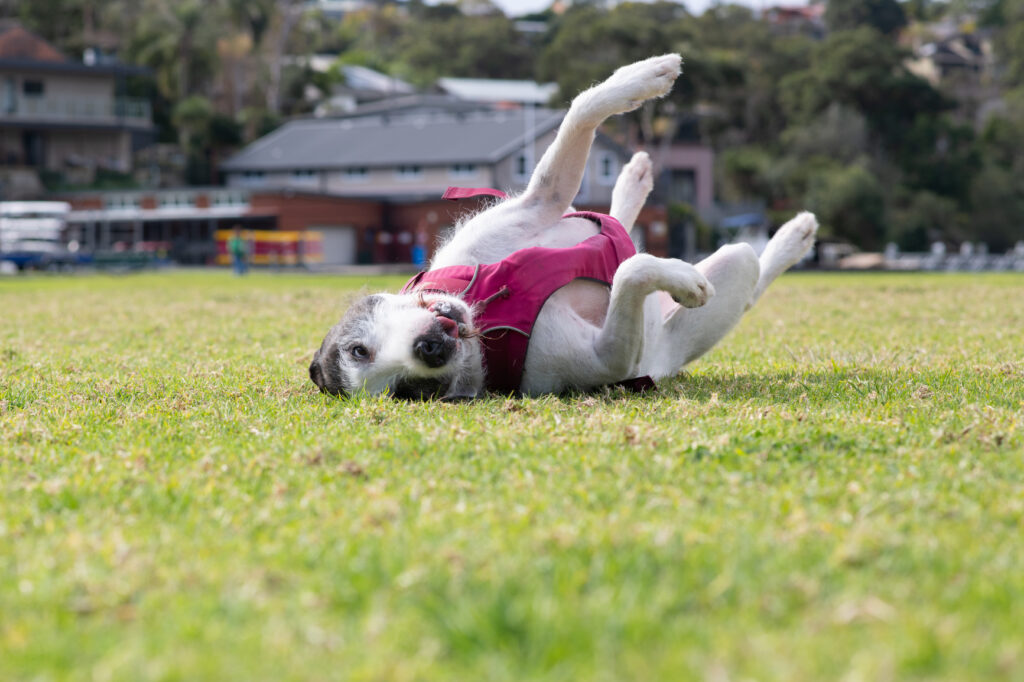
Whenever Rosey finds a good patch of grass—especially with anything pungent in it—she’ll press her cheek to the ground, drag it along for a pace or two, and then flop onto her back, wriggling back and forth to absorb as much stench as possible. Then, she’ll jump up with what I swear is a grin and, often, wait just a few seconds before doing it again. So far, her grossest discovery has been a dead rabbit. Yikes.
Not all dogs share Rosey’s passion for pungency. Still, for all those dogs out there who love a good, nasty roll, one has to ask: What, exactly, is the appeal?
According to Stanley Coren, PhD, Professor Emeritus at the University of British Columbia, there’s one obvious reason domestic dogs love to do this: It’s really, really fun. In fact, he said, “They revel in it.” If you’re looking for a deeper reason, however, that becomes harder to prove. For all their skill at tracking down objectionable odors, our dogs are less adept at explaining themselves.
If you’ve ever caught your dog rolling and wondered what on earth they’re doing, here are a few of the most popular explanations—along with notes from experts about how plausible they are (or aren’t).
Why do dogs roll in smelly things?
Ready to solve this rank riddle? Here are our best theories.
To hide their scent
One common idea you’ll see floating around is that dogs might roll in nasty things for the same reasons their wolf ancestors did: to hide their scent and improve their odds of catching prey while on the hunt. Research has also suggested that dogs’ cousins, foxes, might use scent rolling to shield themselves from would-be predators.
According to Dr. Coren, the wolf-carryover explanation is popular among scientists. That said, there are some quirks in the research. For example: a 1986 study published in the Canadian Journal of Zoology found that when presented with the scent of other herbivores, food odors, carnivore odors, and manufactured scents, wild wolves were most likely to roll in the latter two—neither of which would make them smell less conspicuous.
Beyond that, two animal behaviorists who spoke with Digest—Fairview Behavior Associates founder and certified behaviorist Jessica Lockhart, PhD, CAAB, and Mary Huntsberry, ACAAB and founder of Helping Pets Behave—also expressed doubt that we can blame ancestral hunting instincts. After all, what reason would there be for the instinct to persist? We feed our homed dogs, and, as Huntsberry pointed out, “Street dogs survive by scavenging, not by hunting.” So, what other reason could there be?
To leave a message for other dogs
I’ve heard this idea before in casual conversation—that a grassy lawn can be a kind of guestbook for dogs, where each one leaves a message by rolling around on one specific spot. As adorable as that sounds, our sources did not seem convinced.
According to Dr. Lockhart, some experts theorize that dogs could be rolling on repulsive things in order to claim them. “It’s like, ‘This is mine. I’m going to come back and get it in a second,’” she said, “or, ‘This is being reserved for my family. Don’t touch it!’”
Although this seems plausible, Dr. Lockhart pointed out that dogs don’t have the same robust scent gland system that cats have, where rubbing up against something can leave basically their whole essence behind. If a dog really wants to leave their signature scent behind, they’ll make a way stronger mark by lifting a leg and doing what they do best.
To stay cool
This one applies specifically to icky mud puddles. Where we see scum and potential giardia, dogs see a relaxing summer spa.
In addition to mud’s cooling effect, Dr. Lockhart said, “It also has a bunch of fun smells in it. It also has a bunch of edible microbes, and it might be something that is healthy for them.” Having said that, we don’t recommend intentionally letting your dog eat mud that you find out in the world. It could contain dangerous microbes as well, and your dog’s complete and balanced food provides them with the nutrition they need.
Even better? All that mud can offer some protection from the blistering sun. As Dr. Lockhart put it, “Mud is sort of the first sunscreen out there.” In our modern world, of course, there are dog-safe sunscreens you can use on hairless dogs. Ask your vet for recommendations, and never use sunscreen for people on your dog—it contains ingredients that could harm your pet.
To share something cool with their pals
Some experts believe that dogs roll in gunk for attention, or to bring information back to their friends and family. Their ancient ancestors, at least, might’ve done this to bring information back to their packs.
According to Dr. Lockhart, rolling around in something smelly could be a way of saying, “Hey, I’ve got access to yummy food. It smells like this.” Or maybe they’re thinking something like, “This is really appealing. I’m gonna get all the attention if I put this on.”
Still, Huntsberry pointed out one big catch: “Yeah, they’re gonna get attention for rolling in stinky stuff,” she said. But for dogs who live with humans, the sad irony is that this attention usually results in a bath.
To break up the monotony of a long day
This explanation seemed to strike all three experts as the most likely—and Dr. Coren offered a particularly colorful reason.
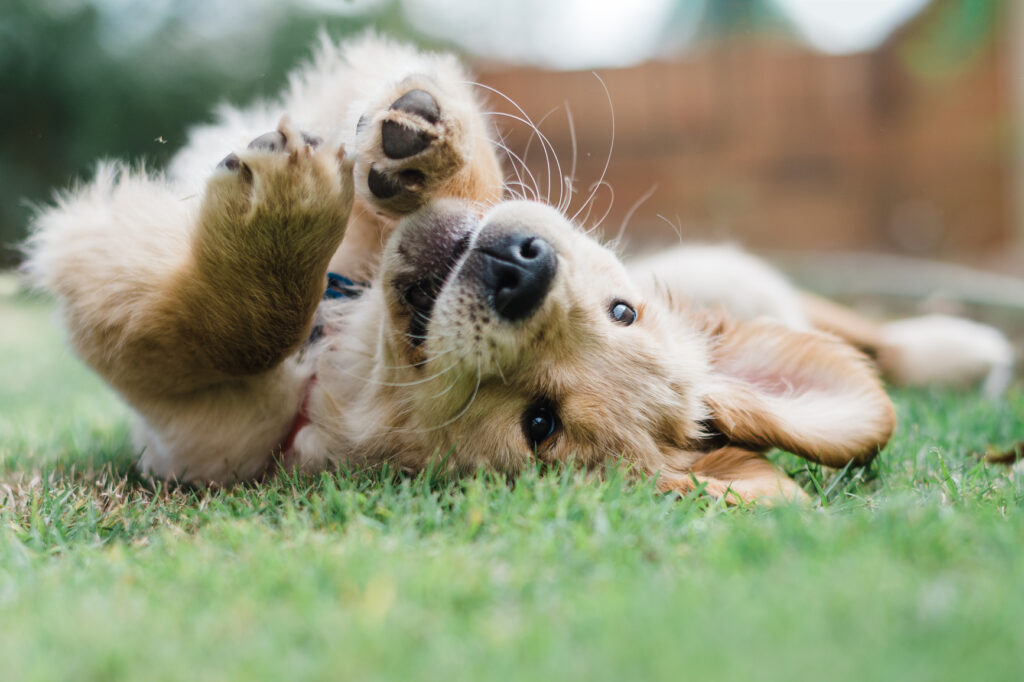
Dogs, like people, can get bored and want their lives to be interesting. But they don’t always agree with us on what “interesting” means.
Humans love to play around with our most dominant sense, sight. We coordinate colors, appreciate bright patterns, and wear splashy clothing items like Hawaiian shirts. For dogs, though, smell is the most powerful sense.
According to Dr. Coren, “There are some researchers who believe that since our dogs are no longer hunting, what they are doing by rolling around in these smells is essentially putting on the scent equivalent of a Hawaiian shirt.”
Huntsberry agreed that the brain-nose connection is very strong in dogs, which helps explain why they love nosework—a sport similar to scent tracking. “We can’t even begin to imagine what they are picking up and sensing, but it is highly rewarding for that reason,” she said. Dr. Lockhart characterized the reward as a “pleasure bump” that increases dopamine.
What do you know? Sometimes, the answer can be as simple as, “Because it’s fun.”
My dog rolled in something gross. What should I do now?
As gag-inducing as some of our dogs’ favorite rolling spots might be, some demand remedy faster than others. It probably goes without saying, but if your dog has rubbed up against something dead or, um, poopy, be sure to bathe them as soon as possible with a good dog-safe shampoo (don’t use the human stuff, which is no good for them).
Brian Collins, DVM, DABVP, a veterinarian at the Cornell Richard P. Riney Canine Health Center, said that standard dog shampoo should be sufficient. That said, he added, “Some dogs may require more than one cycle of shampooing and rinsing to remove the substances and odor.” If your dog has a pre-existing skin condition, your vet might also recommend a medicated shampoo.
If you’ve got a dog who loves to roll, Dr. Lockhart suggested keeping them on a leash to curtail the behavior if desired—“or be prepared to do lots of bathing.” A strong “leave it” skill and reliable recall will also be helpful on this front. Another option could be to teach your dog a cue like “here,” which demands their attention in exchange for an instant treat. That said, if you’re hoping to stop the rolling entirely, be warned: this habit is a lot of fun for dogs who’ve got the itch, so it might be hard to break. As Dr. Lockhart put it, “It just feels too good.”
Related Topics
Related Topics
More on Health & Wellness
Health & Wellness • 8 minutes
How to Bond With Your Dog at Mealtime
Feeding time is a built-in chance to strengthen trust and communication.
Health & Wellness, Lifestyle, Science & Research • 8 minutes
Is It OK if My Dog Licks Me?
We all know where those mouths have been.
Health & Wellness, Nutrition • 4 minutes
4 Reasons to Treat Your Dog With Crunchy Biscuits
Our new human-grade treats are a healthy way to celebrate with your best friend.
Health & Wellness • 8 minutes
How to Bond With Your Dog at Mealtime
Feeding time is a built-in chance to strengthen trust and communication.
Health & Wellness, Lifestyle, Science & Research • 8 minutes
Is It OK if My Dog Licks Me?
We all know where those mouths have been.
Health & Wellness, Nutrition • 4 minutes
4 Reasons to Treat Your Dog With Crunchy Biscuits
Our new human-grade treats are a healthy way to celebrate with your best friend.