Share article:


In this article:
- Do all dogs like to go outside?
- Why is my dog afraid to leave the house?
- Can a dog be afraid to leave the house because of trauma?
- Can unfamiliar surroundings make a dog afraid to go outside?
- Can a dog be afraid to go outside because of anxiety?
- Can a dog be afraid to go outside because they’re getting older?
- Can a dog be afraid to go outside because they’re in pain?
- When should I call a professional about a dog who’s afraid to go outside?
- Should I make a dog who’s afraid to go outside “face their fear?”
- Can a veterinarian or a trainer help a dog who’s afraid to go outside?
- Can medication help a dog who’s afraid to go outside?
- How fast can a dog get over their fear of going outside?
There’s a reason why so many dog owners stereotypically have to spell out the word W-A-L-K. Say the full word out loud, and some dogs will come bounding into the room from across the house, buzzing with energy, tail wagging in big circles.
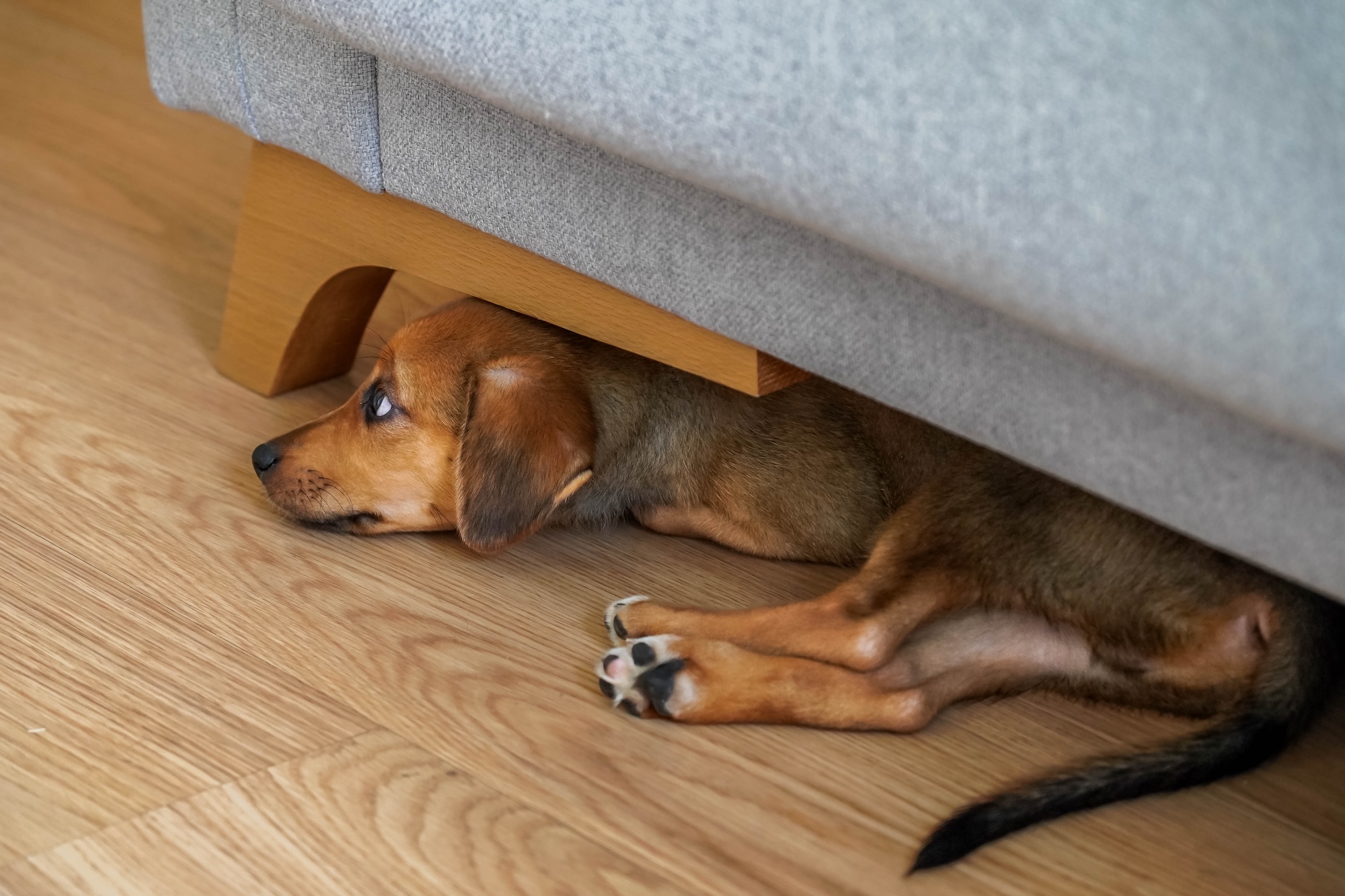
Others, however, will have the exact opposite reaction; they might cower away from their leash, or even hide under the bed. Once outside, they show fearful body language: stiff posture, tail tucked, eyes wide, ears pinned back, lips pulled taut. Sometimes, they try to walk right back to the front door. Whatever the signs, it’s clear these dogs don’t love being outside—they loathe it.
If the latter sounds like your dog, it might be tempting to believe they’ll come around after spending enough time outdoors. According to experts, however, that’s not usually the case. If your dog is visibly scared, you’ll need to make a plan to address it.
“Generally, with fear issues, I always want people to reach out as soon as possible,” said certified dog behavior consultant Kate LaSala, CTC, CBCC-KA, PCBC-A, CSAT, FFCP-E, owner of Rescued By Training. “Because otherwise, they’re potentially making the issue worse.”
Ready to help your dog conquer their fear of the outdoors? Here’s how to get started.
Figure out why your dog is afraid to leave the house
If your dog trembles at the thought of leaving home, your first stop should be the veterinarian. Fear sometimes arises due to pain from injury or illness, and may be more likely if your dog seems to have suddenly become afraid with no obvious explanation. After you’ve ruled out medical issues, it’s worth considering a few common causes.

Trauma
Sadly, our dogs can’t sit on a couch and tell a therapist exactly what’s wrong. But if your dog is scared to walk out the front door, there’s a chance they’ve come to associate the outside world with some kind of traumatic event or trigger. Maybe there was a car accident, a scary run-in with another dog or human, or a loud or scary object that set them off. Or maybe they didn’t receive enough socialization as puppies, and almost the whole world feels scary. Whatever the reason, even things that seem innocuous to us can be terrifying to our dogs.
If your dog suddenly exhibits fear when going outside, it’s worth asking yourself when the change occurred, and what might’ve been going on or happened in their environment during that time. At the same time, experts warn against fixating too much on the cause; it’s far more productive to zero in on your dog’s triggers and tailor your training exercises around them.
“People get really hung up on the whys,” LaSala said. “Was he abused? Did he have a bad experience? It actually doesn’t matter. We treat it the same way.”
In other words: however you got here, it’s far more important to identify what is upsetting your dog and help them get comfortable with it.

Unfamiliar surroundings
Big-city trainers see it all the time: dogs who’ve moved from quieter areas can quickly become overwhelmed by all of the strange noises, crowds, and sights. Moving from one place to another can be its own kind of trauma, even for young humans—and dogs who’ve never encountered certain stimuli as puppies might need some help feeling safe in their new environments.
Anxiety
For dogs with generalized anxiety, going outside can feel like falling into a horror movie. For these dogs, medication is often necessary.
Jennifer Abrams, ACAAB, behavior consultant and owner of Abrams Animal Behavior Consulting, also suggested trying some incremental work inside, wherever your dog feels safest—things like offering rewards when they hear little noises that might make them nervous, or playing games inside before slowly shifting to the doorway, and then the hall, and then, if you live in an apartment, the building lobby. “Dogs will really only play when they feel relatively safe,” Abrams said, “so it’s a good indicator of how they’re feeling.”
Aging
Age-related issues like joint pain, confusion, and dulled vision and hearing can all leave dogs “hypersensitized to protecting themselves,” according to LaSala, and that can turn walks into “this horrible video game that [they] have to navigate blindfolded.” Whatever behavior changes you might notice as your dog ages, it’s important to discuss them with a vet. In some cases, like arthritis, treatments and medications can help your dog enjoy their walks more.
Pain
Most of us probably know what it means when our dogs yelp, limp, or hold up their paws. But according to LaSala, those behaviors usually follow subtler signs—and by the time we see them, our dogs are in a lot of pain. Quieter signs of injury or age-related joint pain can include not wanting to go outside, not jumping on the furniture as much, circling a lot before lying down, licking certain body parts, and hesitating before walking across slippery floors or getting in and out of the car.
Dogs who feel pain while walking might come to associate pain with the outdoors, becoming more and more reluctant when you break out the leash. LaSala also noted that the pain doesn’t necessarily need to come from your dog’s body; certain collars, for example, can teach dogs to associate walking with pain or discomfort. “Then they begin to say, ‘Well, I don’t like walks because walks predict pain.’”
Intervene sooner than later
If you notice more than once or twice that your dog is scared to go outside, the problem probably won’t resolve itself. Intervening quickly will increase your dog’s chances of recovery and minimize the amount of distress that they’re feeling.
Schedule an exam with your dog’s vet to make sure they’re not sick or injured. From there, proven methods like desensitization and counterconditioning can help your dog build confidence and feel safer outside. If you’re familiar with these techniques and are well-versed in canine body language, you can try some of this work on your own. In most cases, however, both LaSala and Abrams believe it’s best to consult a professional.
“Dealing with fear is a little bit specialized,” Abrams said, “because so many of the tools in a typical tool basket aren’t going to work.” For example, a dog who’s terrified outside might not even accept the treats trainers often use for positive reinforcement. This would be because they’re what trainers call “over threshold,” or in a state where they’re too afraid to learn.
Avoid “flooding” your dog with scary experiences
You might hope that your dog just needs to get used to the outdoors by spending more time there, but dragging your dog outside without an incremental, expert-backed plan won’t work. Aversive or punishment-based methods should also be avoided. You can’t punish your dog out of feeling afraid, and trying often makes it worse.
“The more we force a dog into a scary situation, the more scary it becomes — and the higher likelihood there is that that dog is going to start to associate you with being mean or scary,” LaSala said. None of us want to become untrustworthy to our dogs, so it’s important to let them show us where they do and don’t feel comfortable. Techniques like desensitization and counterconditioning are careful, incremental processes that help dogs feel safer in their environments and more comfortable around triggers.
When in doubt, call a professional
Especially when dealing with fear, experienced trainers and behaviorists can help us support our dogs without unintentionally causing harm. They know what it looks like when a dog is afraid, including subtle cues most of us miss. Depending on the severity of your dog’s condition, your veterinarian can refer you to an appropriate specialist.
In most cases, you don’t need to sign up for a months-long program of weekly sessions. According to Abrams, “Even one session with a good trainer or behavior consultant can show you the things that perhaps you’re not seeing, explain the counterconditioning and desensitization process, and show you how to get started.”
Once you have that foundation, you can progress on your own. Still, Abrams said, “Having a good understanding of how we work with fear and what your dog is telling you in all of their very subtle body language is essential to start.” As LaSala put it, “The dog gets to decide what’s scary, not us.”

Medications can help, too
Some dogs, especially those with generalized anxiety, might need medication before they can begin to learn it’s safe outside. According to Abrams, medication can “create a little bit of space in their brain” so that you can begin training without causing trauma. Your veterinarian can walk you through your options. In some cases, they might refer you to a veterinary behaviorist—basically the closest thing we have to a psychologist or psychiatrist for dogs.
Let your dog set the pace
We love our dogs, and we never want to force them into situations where they feel unsafe. “As hard as it is for us, it is much harder for them,” Abrams said. “Short, safe exercises are better than pushing too far.” And don’t feel defeated if your dog isn’t immediately champing at the bit to go outside. According to Abrams, working with real, deep-seated phobias tends to go “very slowly.”
Every dog is an individual, and what works for one might not for another. Instead of making assumptions, watch your dog and let them show you which training exercises help them the most. The better we get at listening to their cues, the safer our best friends will feel in our company.
Related Topics
Related Topics
More on Training & Behavior
Breeds, Dog People, Lifestyle, Training & Behavior • 11 minutes
All About Dubs, the University of Washington’s Live Dog Mascot
Here’s what it takes to keep the talented sled dog happy and healthy.

Dog People, Training & Behavior • 6 minutes
What Do Dogs Think About Daylight Saving Time?
Here’s how to help your best friend adjust when you spring ahead or fall back.
Training & Behavior • 8 minutes
So You Want to Start Your Dog at Nose Work
The benefits of this canine sport are nothing to sniff at.
Breeds, Dog People, Lifestyle, Training & Behavior • 11 minutes
All About Dubs, the University of Washington’s Live Dog Mascot
Here’s what it takes to keep the talented sled dog happy and healthy.
Dog People, Training & Behavior • 6 minutes
What Do Dogs Think About Daylight Saving Time?
Here’s how to help your best friend adjust when you spring ahead or fall back.
Training & Behavior • 8 minutes
So You Want to Start Your Dog at Nose Work
The benefits of this canine sport are nothing to sniff at.