Share article:


In this article:
- Can dogs be optimistic and pessimistic?
- How do researchers study judgment bias in dogs?
- What’s the connection between nose work and optimism?
- How can I train my dog to be more optimistic?
In 2018, a dog named Devo made headlines after his owner posted on social media that he ran to the same bush whenever he passed it because once, four years earlier, he’d reportedly found a lasagna there. Another lasagna had yet to materialize—but that didn’t stop Devo from checking.
The post inspired other people to share stories of their dogs finding unlikely snacks—including pizza, a baguette, and half a pie—in the wild, then returning to the places where they once struck gold, optimistic that luck would strike again.
“I think his optimism is a beautiful thing,” Devo’s owner told The Dodo. We agree, which is why we investigated whether scientists have researched the question of dog optimism, feeling positive that we’d find valuable and interesting insights on this topic. We were right.
Can dogs be optimistic and pessimistic?
Devo’s owner wasn’t anthropomorphizing; dogs really can be optimistic.
Perhaps nothing exudes optimism more than a dog looking up with hopeful eyes and a loose, wiggly wagging tail. But while their sunny dispositions may make them all seem like optimists, dogs vary in how they perceive the likelihood of something good happening in the face of uncertainty.
This perception—and subsequent behavior—is key to something called “judgment bias”—a psychology term that describes the extent to which someone is optimistic or pessimistic. Optimism is “positive judgment bias,” while pessimism is “negative judgment bias.”
“I think [people are] always surprised at first that you can think about what an optimistic dog is,” said Zazie Todd, PhD, a psychologist and certified dog trainer, and the author of Bark! The Science of Helping Your Anxious, Fearful, or Reactive Dog.
But you can, and scientists have studied it extensively.
How do researchers study judgment bias in dogs?
Researchers studying the behavior of captive animals—including rats and pigs—use a standard assessment called a “cognitive bias test.” Typically, this test involves training an animal on two stimuli with predictable outcomes (meaning that the same thing always happens), and then introducing a third stimulus with an unpredictable outcome (meaning different things happen). The animal’s reaction to the third, ambiguous stimulus reveals their judgment bias.
Dr. Todd regularly teaches her students about a 2019 study in the journal Applied Animal Behaviour Science, whose authors sought to learn how different types of training affected a dog’s perception and well-being. Participating dogs learned that a bowl in one location always contained food, while a bowl in a second location never did. A bowl in a third location contained food only some of the time. Dogs who approached that third bowl more slowly were considered pessimistic, while dogs who approached it more quickly were considered optimistic; why rush if they didn’t think they’d find food?
Led by Alexandra Horowitz, PhD, head of the Dog Cognition Lab at Barnard College, the researchers used that test to examine how different types of enrichment impacted dogs’ judgment bias. They split participating dogs into two groups. Over 16 days, the experimental group practiced nose work, or scent work, in which dogs use their noses to track or find a target, while the control group practiced heelwork, in which dogs follow their humans. The scent-work group learned to find treats hidden in a single box before moving on to search multiple boxes for the one containing food. The heelwork group, on the other hand, practiced following their owners for a number of steps in different directions.
Both groups completed a cognitive bias test before and after training. Dr. Horowitz and her team measured optimism based on how quickly each dog walked to the ambiguous bowl. After training, the dogs who had practiced nose or scent work approached the bowl considerably faster on average, indicating a connection between scent work and optimism.
Another study from 2018 found evidence of a relationship between personality traits and judgment bias. It showed that dogs who displayed higher levels of sociability and excitability were more likely to express optimism at an ambiguous stimulus, while dogs who displayed higher levels of fear and aggression were more likely to express pessimism.
Dogs are more likely to be optimistic if they’re in a good mood, and how you train them can impact that mood. A 2021 paper suggested that dogs trained using aversive methods, meaning punishment, showed more negative moods, as well as pessimism in the face of ambiguity, than dogs trained with rewards. Another study from 2020 found that dogs trained with punishment performed more pessimistically on a cognitive bias test than dogs trained through reward-based methods.
The connection between nose work and optimism
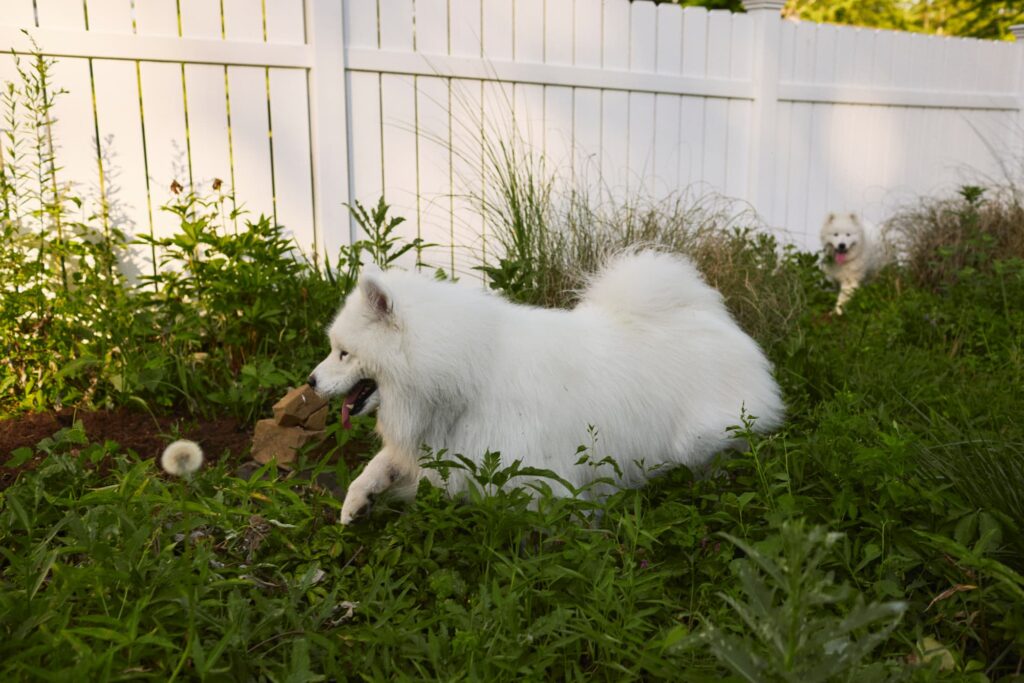
Anyone with a dog knows that they love to sniff. Researchers in the 2019 study hypothesized that letting dogs sniff around as they choose would give them a healthy dose of enrichment, improving their welfare and creating a positive judgment bias. After all, dogs doing nose work learned that, when they sniffed and explored, they might get something good.
The scientists underscored that nose work allows dogs to “act autonomously and by their own initiative.” Meaning: Dogs who do scent work get to make choices and feel in control. That’s the kind of thing that’s liable to make humans and dogs happier. The experimental group had the opportunity to follow their noses, learn from their mistakes, and navigate their environments as they saw fit. The dogs in the heelwork group, on the other hand, relied on their humans for guidance and food.
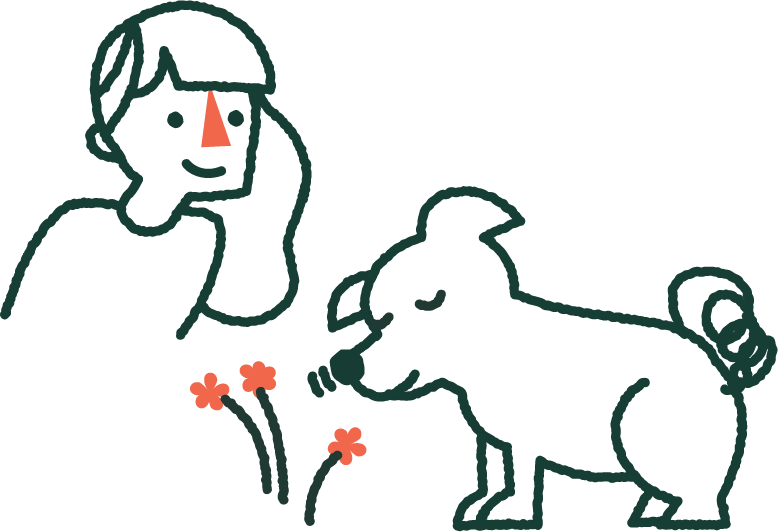
Dr. Todd emphasized this choice element of the scent work. While the heelwork dogs had to obey their humans, the more optimistic scent-work group exercised choice. “We don’t know for sure if [the optimistic behavior] was specifically because [the dog was] using their nose, or if it was because they were doing an activity in which they got to have choices,” she said.
Finding moments when our dogs can make their own decisions is especially important considering the amount of control we must exercise for their safety, said Nicholas Dodman, BVMS, Diplomate of the American College of Veterinary Anesthesia and Analgesia, and of Veterinary Behavior, a professor emeritus at Tufts University. “We can’t let [our dogs] loose to run in the streets, so necessarily their wings are somewhat clipped,” he said.
This point, according to Dr. Todd, is key for any dog owner. “We should give dogs more choices in life because we make practically all the decisions,” she said. “If we can give them opportunities to make choices, that is good for them, too.”
How to train your dog to be an optimist
If you want to make an optimist of your dog, give them more opportunities for choice. You can let them choose which way to go on a walk, which toy to play with, or which scents to investigate.
Scent work, as the 2019 study’s authors found, is one effective way to offer dogs choice—the choice to literally follow their nose.
“It’s easy to find free ways to let your dog use their nose, and what we call a ‘sniffari’ is one of those opportunities,” Dr. Todd said. On a “sniffari,” you let your dog follow their nose on a walk instead of rushing to get somewhere. They can follow the scents that interest them.
“Everything [dogs] smell is sending a message to them,” Dr. Dodman said. “It’s a travesty to yank them along when they’re trying to sniff things.” He also suggested hiding treats at home to keep them engaged indoors; toys like snuffle mats also let dogs play with smell.
You don’t have to put together a formal scent-work training program for your dog to benefit; just working choices and sensory stimulation into their daily routine can go a long way. If you do that, we have a feeling things will be looking up for both of you.
Related Topics
Related Topics
More on Training & Behavior
Training & Behavior • 9 minutes
How to Help a Dog Who’s Afraid to Leave the House
Not every dog is psyched to hear about a
“W-A-L-K.”
Breeds, Dog People, Lifestyle, Training & Behavior • 11 minutes
All About Dubs, the University of Washington’s Live Dog Mascot
Here’s what it takes to keep the talented sled dog happy and healthy.

Dog People, Training & Behavior • 6 minutes
What Do Dogs Think About Daylight Saving Time?
Here’s how to help your best friend adjust when you spring ahead or fall back.
Training & Behavior • 9 minutes
How to Help a Dog Who’s Afraid to Leave the House
Not every dog is psyched to hear about a
“W-A-L-K.”
Breeds, Dog People, Lifestyle, Training & Behavior • 11 minutes
All About Dubs, the University of Washington’s Live Dog Mascot
Here’s what it takes to keep the talented sled dog happy and healthy.
Dog People, Training & Behavior • 6 minutes
What Do Dogs Think About Daylight Saving Time?
Here’s how to help your best friend adjust when you spring ahead or fall back.