Share article:


In this article:
- What did a recent study find about whether petting dogs could reduce stress?
- How did the study work?
- Were there limits to the findings?
- Is there more research on whether petting dogs relieves stress?
- Does petting dogs help them with their own stress?
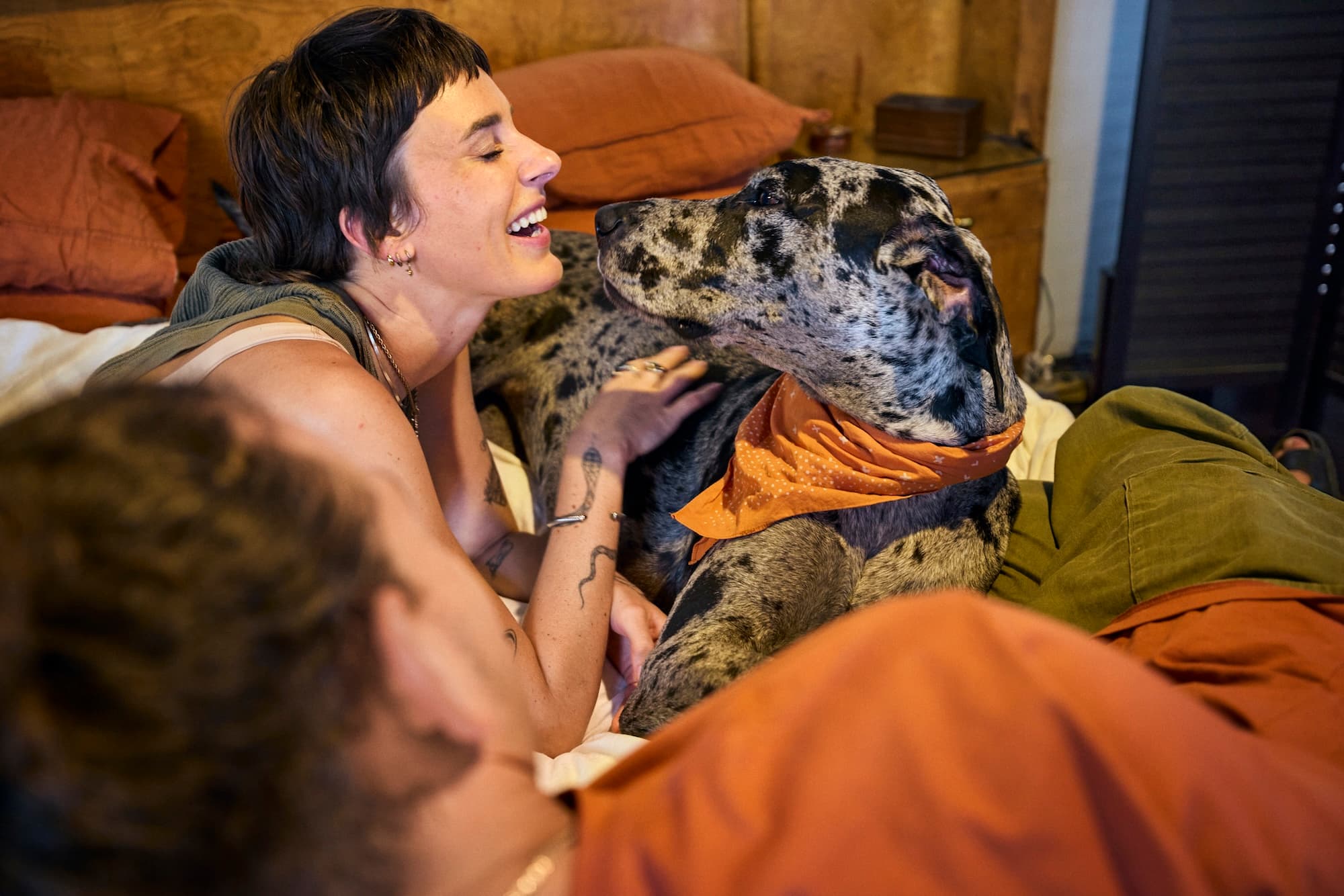
In times of strife, you can usually find me in one place: hiding under the covers, cuddling with one or preferably both of my dogs. Their soft fur soothes my weary soul, and the intoxicatingly strange aroma of their paws transports me—spiritually, at least—to a calmer place.
There’s a reason therapy dogs are popular in schools, universities, and other places where emotions can run high; research suggests that the affection we give our dogs does something for us as well. A study published in Biological Psychology this October, for example, found that hands-on time with dogs helped buffer their owners against stressful experiences.
The inspiration behind the study was both scientific and personal. “When I see animals, they have an immediate positive effect on me,” said study author Vanessa Kaufmann, a PhD student and university assistant at the University of Innsbruck in Austria. But while there are tangible, proven benefits to owning or interacting with a pet, researchers are still working to understand the exact mechanisms behind those benefits: is it the interaction itself that makes us feel better, or do specific lifestyle habits, like daily walks, contribute more?
Like Kaufmann, I’ve anecdotally experienced benefits from petting my dogs. But let’s dig into what the research says.

The Biological Psychology study found that participants were more resilient after petting their dogs.
Kaufmann stops short of saying her work proves that petting a dog can help us weather stress better, but she does agree it points in that direction.
Researchers stressed their subjects out.
Kaufmann and her team invited 64 dog owners to the lab. First, they had the participants complete a time-sensitive knowledge test and an arithmetic task to induce stress.
Then, researchers let subjects pet their dogs… or not.
Next, the scientists gave participants a recovery period during which they could interact with their dogs. During one interaction phase, the humans could touch, look at, and talk to their dogs. During the other, they could see and talk to their dogs, but weren’t allowed to make physical contact.
Owners seemed to benefit after petting their dogs.
After petting their dogs, the owners’ heart rates did not spike as much during the next stress period. Their heart rate variability—meaning, the time differences between heartbeats—was higher, indicating more adaptability. And EEG data showed that patterns of activity typical for people under stress were reduced.

The findings had some limits.
Going into the experiment, the researchers thought that petting dogs would also help participants relax immediately after the stress period. Kaufmann was surprised when they found no such evidence, but she doesn’t believe this disproves the idea that human-dog interactions can relieve stress.
In this experiment, she explained, the human participants didn’t stay stressed long enough for researchers to tell whether dogs helped them calm down after the knowledge test and arithmetic tasks. By the time they reached the room with their dogs, their stress markers had already returned to normal.
Still, humans who got to pet their dogs experienced fewer physiological stress markers when they performed the tasks afterwards. And the study provided evidence that the stress buffer wasn’t just a coincidence—the human-dog interactions caused it.
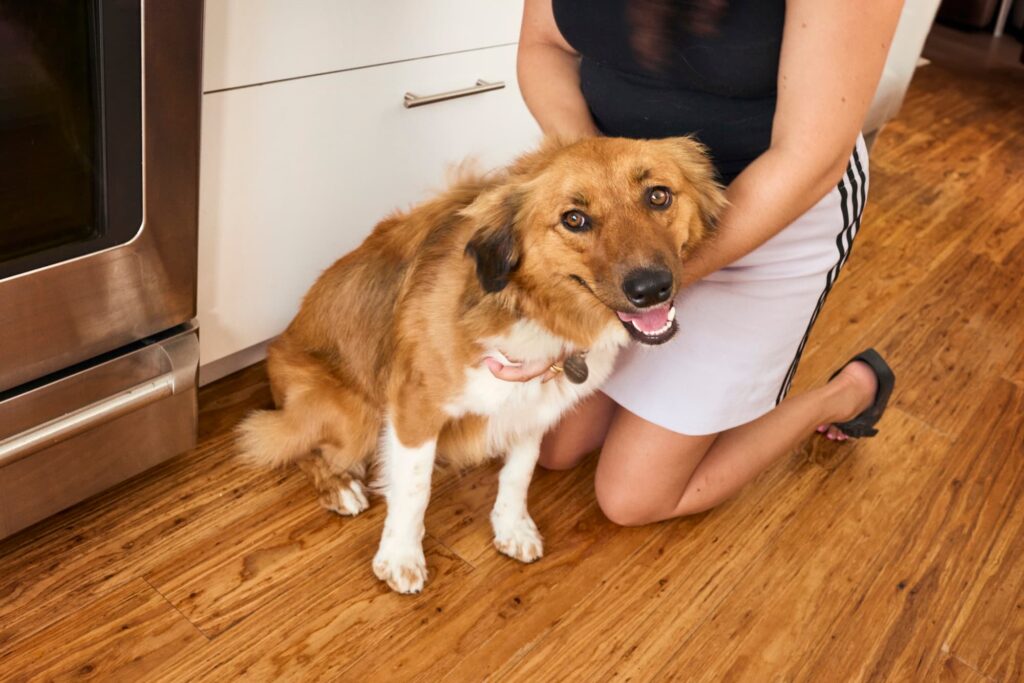
Other studies have shown that petting your dog may relieve stress.
Researchers have repeatedly provided evidence that physical contact with our best friends can make us feel better. For example:
- A 2017 study published in Frontiers in Psychology found dog-owner interactions led to increasing oxytocin levels in owners and dogs.
- A 2019 study published in AERA Open found that students who interacted with dogs and cats experienced a drop in cortisol.
- A 2022 study published in PLOS One showed that dog-assisted interventions helped lower stress levels among schoolchildren over a period of four weeks.
Patricia Pendry, PhD, professor in human development at Washington State University, was an author on the 2019 study, which, like Kaufmann’s, was able to show that petting a dog caused a physiological change in participants.
The AERA Open study showed that petting dogs (and cats) could lower cortisol levels.
Dr. Pendry and her team recruited students who were already planning to participate in a visitation program with shelter cats and dogs.
Researchers let some students pet cats and dogs, while others couldn’t.
Researchers showed the students how to take a saliva sample so they could measure their cortisol levels at the moment they woke up on the day of the experiment. Then they sent each student to do one of four things:
- One group interacted with the cats or dogs for 10 minutes.
- One group watched others pet the animals.
- One group received photos of the animals to look at instead of seeing them in person.
- One (in this writer’s unscientific opinion, unlucky) group was told to wait quietly and did not get to see the animals.
All four groups gave another saliva sample 25 minutes after the start of their activity to establish a baseline, because that’s about how long it takes for cortisol in the bloodstream to show up in saliva. The 25-minute waiting period ensured the cortisol level being measured represented the amount of cortisol in the students’ bloodstream just before they began interacting with the animals (or waiting, watching, or looking at photos). Ten minutes after that, the students gave another sample to show how the activity changed their cortisol levels. Using this setup, the team could determine which intervention provided the most benefit.
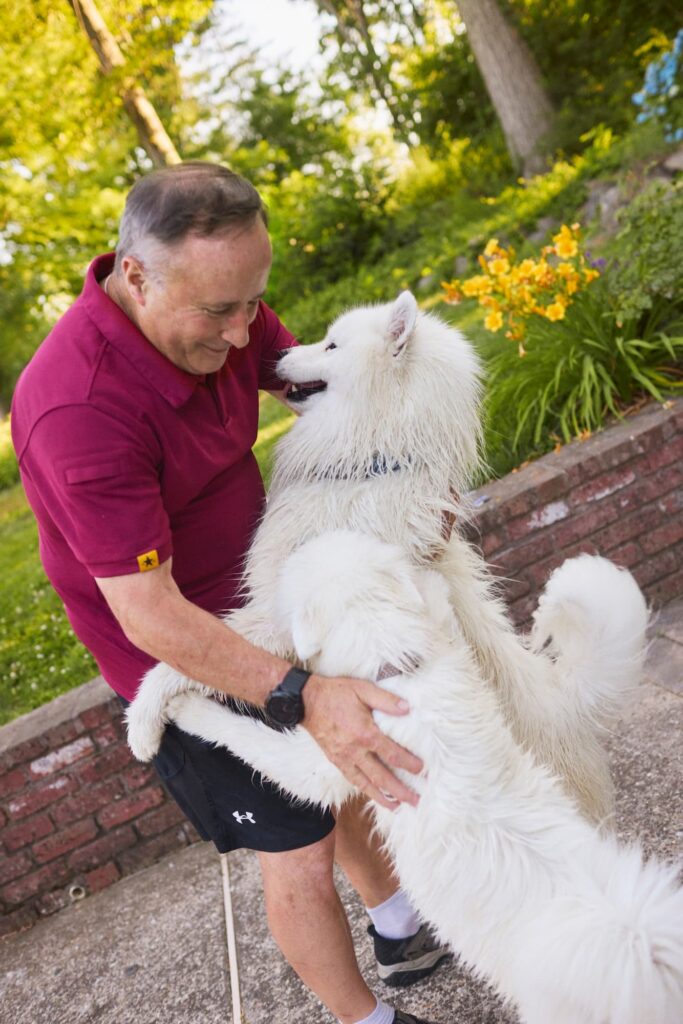
Students who petted dogs and cats had lower cortisol levels.
Dr. Pendry and her team saw a clear distinction in the data. The students showed similar cortisol levels in the morning upon waking. But, after they split up into groups, those who got to pet dogs and cats had significantly lower cortisol levels than the others.
There’s much more to learn about this topic, which is why Dr. Pendry is continuing to conduct research examining whether repeated human-animal interactions can change a person’s daily cortisol patterns, and whether physically touching the dogs while being exposed to a stressful scenario leads to less cortisol activation.
Does petting our dogs relieve their stress, too?
For all we know about how petting our dogs benefits us, it’s also important to consider how they feel about these interactions. The 2017 study mentioned above found that while oxytocin levels rose for both humans and dogs during petting time, the dogs’ cortisol levels actually increased while the humans’ decreased.
Given that most of us don’t have the equipment to check our dogs’ cortisol levels anyway, it’s best to watch their body language. If your dog pulls away, stiffens, or begins showing other signs of stress, like wide eyes, lips pulled taut, and ears up and alert or pinned back, give them space and try another time.
Signs that your dog is actually enjoying the scratches or belly rubs include:
- Loose, relaxed body posture
- Leaning into the touch
- Nudging for more contact
- Soft eyes, possibly squinting closed like they’re dozing off
One simple way to make sure your dog is into it is a “consent test.” Pet them for a little bit and stop. If they ask for more, keep it up. If they look stressed or walk away, take a break.
We never want to treat our dogs like living stress balls—that’s why I always let my dogs decide if they’re up for affection. (They’ll let me know by scooching up next to me or, when they’re feeling more direct, shoving their head under my hand for a pat.) When our dogs are on the same page as us, there’s nothing quite like a snuggle—or even a shared nap—to chase the Sunday (or Monday, Tuesday, Wednesday, Thursday…) scaries away.
Related Topics
Related Topics
More on Lifestyle

Dog People, Featured, Lifestyle, Nutrition, Press • 6 minutes
The Farmer’s Dog Is One of “Oprah’s Favorite Things” for 2026
Real, pre-portioned food could be your dog’s favorite, too.

Health & Wellness, Lifestyle, Science & Research • 15 minutes
How to Keep Your Dog Safe and Happy During the Holidays
Your dog is always on the nice list, so protect them from decorations and other possible hazards.
Dog People, Lifestyle • 7 minutes
Why Do Some People Call Themselves a Dog’s “Mom” or “Dad”?
And why do some other people really not like that?
Dog People, Featured, Lifestyle, Nutrition, Press • 6 minutes
The Farmer’s Dog Is One of “Oprah’s Favorite Things” for 2026
Real, pre-portioned food could be your dog’s favorite, too.
Health & Wellness, Lifestyle, Science & Research • 15 minutes
How to Keep Your Dog Safe and Happy During the Holidays
Your dog is always on the nice list, so protect them from decorations and other possible hazards.
Dog People, Lifestyle • 7 minutes
Why Do Some People Call Themselves a Dog’s “Mom” or “Dad”?
And why do some other people really not like that?