Share article:


- How often should my dog poop?
- How can I tell if my dog is constipated?
- What causes constipation in dogs?
- What are signs of constipation in dogs?
- Should I take my constipated dog to the vet?
- Can I give my dog pumpkin for constipation?
- Should I give my constipated dog a stool softener or a laxative?
- How long can my dog go without pooping before it’s concerning?
- What are home remedies for constipation in dogs?
This article was originally published in July of 2022, and has been updated.
If your dog usually poops every day like clockwork, going more than a few outings without pooping can raise some red flags. You may wonder if they’re constipated.
Constipation—the condition in which a dog experiences abnormally infrequent or difficult defecation—is a reason to watch closely and take necessary action, but there’s no need to panic. If you notice your dog’s pooping frequency isn’t normal, call your veterinarian.
“An important first step if you think you’re seeing signs of constipation in your pet is to take them to the vet to be evaluated,” said Alison Manchester, DVM, PhD, Diplomate of the American College of Veterinary Internal Medicine (Small Animal), an assistant professor of small animal medicine at the Cornell University College of Veterinary Medicine, “because there’s a lot of basic stuff that needs to be ruled out to make sure you’re not missing anything treatable.”
Here’s what to know about constipation in dogs.
How often should my dog poop?
Most healthy adult dogs poop between one and three times a day, according to Brian Collins, DVM, Diplomate of the American Board of Veterinary Practitioners, with the Cornell Richard P. Riney Canine Health Center, though what’s considered normal varies by dog—so knowing your dog’s usual frequency is critical.
If your dog continues what’s normal for them—whether that’s pooping without fail at the same time every day or even every other day—there’s likely no issue. But if their routine shifts, that may be a sign that something is wrong.
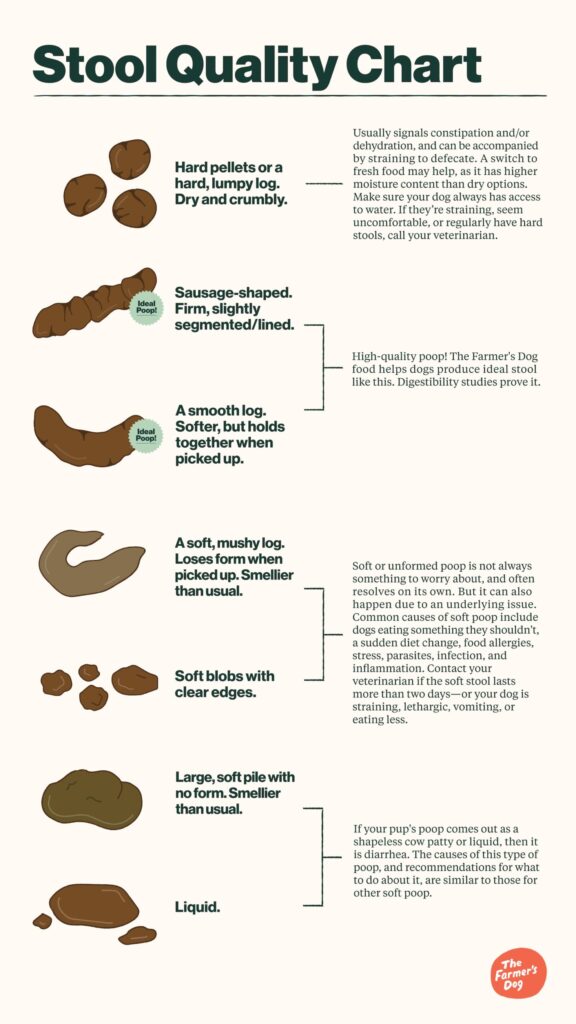
In addition to regularity, stool quality is also important. Healthy poops tend to be firm, log-shaped, easy to scoop, and a chocolate-brown color. As with frequency, healthy stool quality exists within a range based on factors such as your dog’s diet and size.
Constipation affects stool regularity and quality, resulting in bowel movements that are less regular, less frequent, and “smaller, firmer, and dry-looking,” Dr. Manchester said.
Dr. Collins explained that, the longer waste stays in a dog’s colon, the more dehydrated it becomes and the harder it is for the dog to pass. On the other hand, waste that moves through the colon too quickly doesn’t dehydrate enough, and can result in diarrhea.
How can I tell if my dog is constipated?
Constipation means a dog poops less often than usual—or sometimes not at all—and has more difficulty pooping. You can tell your dog is constipated if the quality, frequency, and regularity of their poops have changed, and if they’re behaving differently.
Dr. Collins said to call your vet if your dog hasn’t had a normal bowel movement in two or three days. Call or bring your dog to the vet sooner if you notice them straining to poop with nothing coming out, or if they vocalize while trying to poop.
The vet will evaluate your dog for potential causes, like the mechanical and functional ones Dr. Manchester mentioned. They’ll want to rule out possibilities like a foreign object obstructing their bowel, or an enlarged prostate, or a medical condition like chronic kidney disease or hypothyroidism. You can let your vet know what your dog’s usual poop schedule is, their diet, any medications they’re on, and descriptions, pictures, or even samples (refrigerated in a sealed container until the appointment) of atypical bowel movements to provide context.
The visit will include a discussion of your dog’s behavior at home and their signs of constipation, and will often include a rectal exam. The vet may order tests such as blood work, urinalysis, a fecal exam, or imaging such as X-rays based on findings during the physical exam.
They’ll also want to rule out some of the aforementioned medical conditions, as constipation can be a sign that something else is wrong, such as chronic kidney disease or hypothyroidism.
What causes constipation in dogs?
Waste can build up in the colon due to an underlying medical condition, dehydration, diet, or other factors. Dr. Manchester grouped potential causes into “functional” and “mechanical” categories.
“Functional” causes affect the defecation process. Here are some examples of functional causes of constipation:
- Diet
- Dehydration
- Hormonal diseases, such as Cushing’s disease and hypothyroidism
- Chronic kidney disease
- Medication side effects
“Mechanical” causes are anatomical abnormalities or conditions that can interfere with healthy pooping. Here are some examples of mechanical causes:
- Dogs born with an abnormally shaped anal gland
- An abnormally shaped pelvis
- An enlarged prostate (prostatitis)
- Orthopedic disease affecting the hips so a dog can’t get into their usual posture to poop
- A foreign object, like a piece of bone or a toy, obstructing the bowel
- An acute injury that may fracture the pelvis, altering its shape
- A chronic condition, like arthritis, that may prevent your dog from getting into a pooping stance, or cause pain when they attempt it
- A tumor in the colon
Treatments for mechanical causes vary. Veterinarians may treat an enlarged prostate with antibiotics and pain medications. Dogs with a pelvic injury may need surgery, as well as stool softeners and a change in diet to help them pass stool.
Flat-faced (aka brachycephalic) dogs, like French bulldogs, English bulldogs, pugs, and Boston terriers, can be born with neurological problems and other anatomical abnormalities unrelated to their face shape that could lead to health issues like constipation, Dr. Manchester said.

What are signs of constipation in dogs?
Signs of constipation, in addition to difficult, less-than-usual poops that are hard and dry, include scooting or licking around the anus, straining while in a poop position without anything coming out, and vocalizing while trying to poop, Dr. Collins said.
Here’s what to watch out for:
- Hard, dry, pebble-like stools
- Going longer than usual without pooping
- Straining to defecate with little or no result
- Vocalizing or crying out while trying to poop
- Scooting on their butt
- Licking around the anus
- Lethargy
- Poor appetite
- Vomiting
Sometimes hard, dry stools may precede watery diarrhea, indicating that your dog has been backed up for a while, Dr. Manchester said.
She also said that you should look at all aspects of your dog’s health and behavior—are they eating normally, and are they as energetic as usual? Recent changes, like a new medication or a particularly rich treat, can also explain temporary constipation.
Vocalizing while trying to poop can indicate that a dog is in pain. This and non-productive straining are reasons to visit the vet immediately.
Should I take my constipated dog to the vet?
If you think your dog might be constipated, take them to the vet to investigate the cause. Treatments can include vet-prescribed laxatives, surgical procedures, and dietary interventions. What the veterinarian recommends will depend on your dog’s particular circumstances and needs.
Diet is an “early-line intervention,” Dr. Manchester said, once you’ve ruled out mechanical issues like an abnormal anal gland, prostate, or pelvis.
“Diet is a great way that we can change the aspects of what’s being delivered to the colon,” she said, “and that’s going to change how the bacteria [in the gut] process it and how it moves.”
Fiber is a frequent dietary suggestion to boost healthy bowel movements. This carbohydrate comes from plants and can’t be digested. Insoluble fiber comes from whole grains, leafy greens, and vegetables, and doesn’t dissolve in water; as a result, it moves all the way through the digestive system, promoting regularity. Fiber is associated with a slew of health benefits for dogs (and people). However, any dietary changes should be discussed with your veterinarian, and introduced gradually to prevent further gastrointestinal upset.
While helpful in the right cases, fiber isn’t always the answer. “If you have a very functional colon, insoluble fiber helps move things along quickly,” Dr. Manchester said. “However, if you have poor motility [the bowel’s ability to move digested food along], when you add that extra bulk, it’s too much for the intestine.”
An effective way to add more fiber to your dog’s diet is psyllium. Talk to your veterinarian about whether this could benefit your dog, either in a single case of constipation or as a regular part of their diet, and how much you should feed them based on their size and the severity of their constipation.
In addition to diet, increased hydration and exercise can help alleviate and prevent constipation.
Never attempt to give your dog an enema, and don’t give them a laxative unless prescribed by a vet.
Can I give my dog pumpkin for constipation?
Pumpkin is safe for dogs to eat and contains fiber, so you can feed some to your dog for constipation. However, it’s not a very dense source of fiber, so depending on how much fiber you and your vet determine could best help your dog, psyllium may be a better option, Dr. Manchester said.
“You’d actually have to feed tons of cans of pumpkin to get the same amount of fiber you could get with a teaspoon or a few teaspoons of psyllium powder,” she said.
If you do try feeding your dog pumpkin to help with their constipation, give them one to four tablespoons with their regular food, depending on their size and daily calorie needs. Only use plain canned pumpkin puree with no other additives. Never use pumpkin pie filling, which can be full of spices, sugar, and artificial sweeteners like xylitol, which is toxic to dogs.

Should I give my constipated dog a stool softener or a laxative?
If you and your vet have ruled out underlying medical causes, they may prescribe a stool softener or laxative, or suggest you add fiber to their diet.
Again, never give your dog an enema or laxative without a prescription from your veterinarian. Any diet changes are best made gradually and with supervision from your vet.
You don’t need to panic about occasional constipation, but you should call your vet if you notice it. If left untreated, it can cause serious health problems for your dog. Keep an eye on the quality and quantity of your dog’s poops. And remember that the things that promote good digestion and regular poops also help set your dog up for good overall health: lots of clean water, high-quality fiber in a healthy diet, and ample exercise.
Frequently asked questions
How long can my dog go without pooping before it’s concerning?
How long your dog can go without pooping before it constitutes a problem depends on their normal schedule; some dogs poop more often than others. But call the vet if any dog hasn’t pooped after two days, or if they’re showing signs of distress around pooping—such as non-productive straining and vocalizing while trying to poop.
What are home remedies for a constipated dog?
If your dog shows signs of constipation, take them to the vet to ensure there’s not a serious underlying condition. Ask them whether it’s a good idea to feed your dog some pumpkin puree or psyllium. Ensuring your dog drinks enough water, adding some fiber to the diet gradually, and increasing exercise can all help, Dr. Collins said.
Related Topics
Related Topics
More on Health & Wellness
Health & Wellness • 12 minutes
What Should I Do If My Dog Isn’t Eating?
Here’s veterinarians’ advice for what to do if your dog loses their appetite.
Breeds, Health & Wellness, Nutrition, Training & Behavior • 17 minutes
The Corgi Care Guide
Don’t let the tiny legs and infectious smiles fool you—these working dogs need a lot of physical and mental exercise.
Health & Wellness, Nutrition • 14 minutes
Can My Dog Eat Halloween Candy?
Many spooky-season treats are downright scary for dogs. Here’s how to keep yours safe.
Health & Wellness • 12 minutes
What Should I Do If My Dog Isn’t Eating?
Here’s veterinarians’ advice for what to do if your dog loses their appetite.
Breeds, Health & Wellness, Nutrition, Training & Behavior • 17 minutes
The Corgi Care Guide
Don’t let the tiny legs and infectious smiles fool you—these working dogs need a lot of physical and mental exercise.
Health & Wellness, Nutrition • 14 minutes
Can My Dog Eat Halloween Candy?
Many spooky-season treats are downright scary for dogs. Here’s how to keep yours safe.