Share article:


In this article:
- Why did my dog vomit?
- What do different colors of dog vomit mean?
- What does green dog vomit mean?
- What does yellow dog vomit mean?
- What does red dog vomit mean?
- What does brown dog vomit mean?
- What does black dog vomit mean?
- Should I be worried about the frequency of my dog’s vomiting?
- What’s the difference between regurgitation and vomiting for a dog?
- What should I do if my dog vomits?
- Should I give my dog water after vomiting?
- Should I give my dog food after vomiting?
- What can I feed my dog after they vomit?
This article was originally published in May of 2020, and has been updated.
No matter how hard you try to monitor your dog, vomiting happens. Like humans, dogs vomit occasionally to expel food (or other substances) they shouldn’t have ingested. In many cases, this type of one-and-done vomiting isn’t a major cause for concern.
However, dogs can throw up for a variety of reasons, many of which can be serious. Here are some of the keys to understanding what your dog’s vomit is telling you about their health.
Causes of vomiting
Common reasons that dogs may vomit include:
- Dietary indiscretion (eating something they shouldn’t have)
- Parasites (e.g., giardia, roundworms, and hookworms)
- Infections
- Food allergies
- Toxins
- Ingestion of a foreign object
- Sudden diet changes
- Eating too quickly (sometimes resulting in regurgitation, not vomiting)
According to Alex Schechter, DVM, founder of Burrwood Veterinary, the causes of vomiting fall into two major categories—primary gastrointestinal and extra-gastrointestinal. Primary gastrointestinal causes include a sudden diet change, food allergies, dietary indiscretion, obstruction of the stomach or intestines, medication side effects, infections, and other conditions. Extra-gastrointestinal causes include metabolic, endocrine, neurologic, and systemic diseases like kidney or liver failure and pancreatitis.
Color
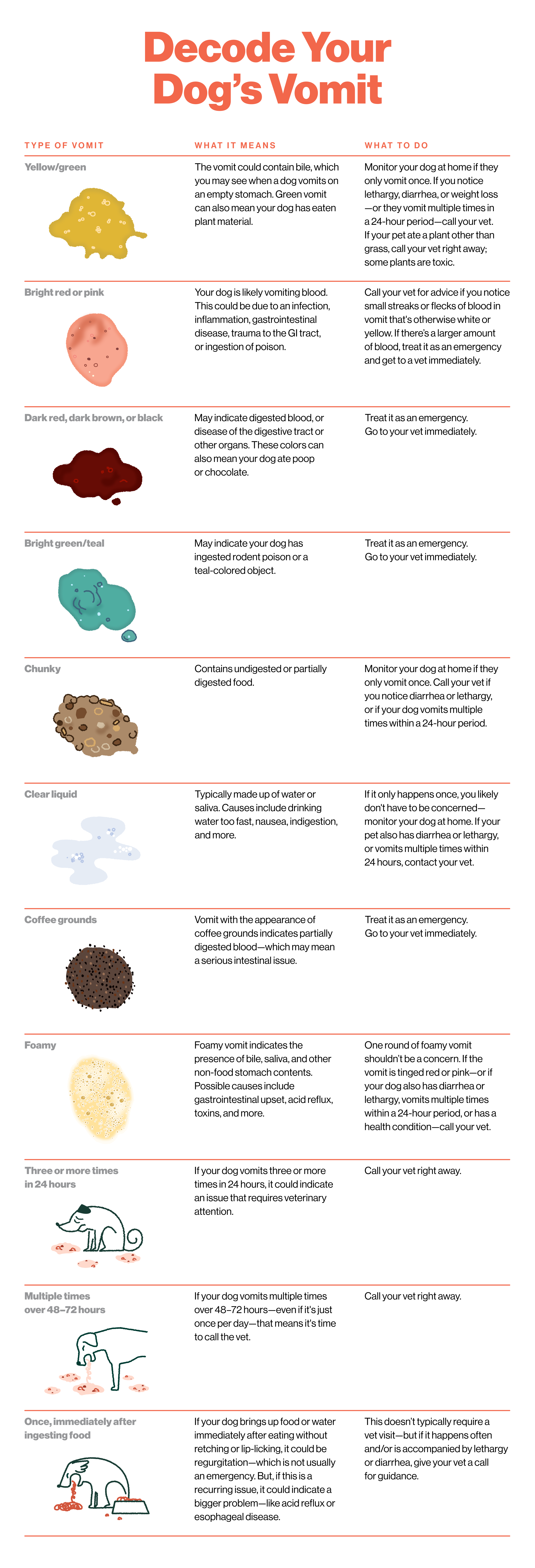
The color of your dog’s vomit can provide some indication as to what might be going on inside their body, and whether there’s an underlying issue to be concerned about.
“Vomit can be any color, from clear to yellow to red to brown,” said Carol Osborne, DVM, of the Chagrin Falls Pet Clinic in Ohio. “And it can be a reflection of whatever the dog ate—for instance, something with food coloring. If it’s bright green or teal-colored, it could mean that your dog ate mouse or rat poison, in which case you should visit the vet right away.”
One thing to note, though: any of the conditions above can cause vomit to be any number of colors, so don’t rely on color as the sole indication of what the underlying problem might be. Also look at the vomit’s consistency, the frequency of your dog’s vomiting, and any other signs of illness (for example, if they are lethargic or have lost their appetite).
Green and yellow vomit
Vomit that’s yellow or green, or that looks foamy, usually contains saliva, stomach acid, and/or bile, a substance that is produced by the liver and that assists with the digestive process. Sometimes dogs will vomit bile if they go too long without eating, or if they are vomiting on an empty stomach.
Vomiting bile in the morning or late at night can be an indication of bilious vomiting syndrome (BVS). Feeding your dog smaller, more frequent meals may resolve this issue—but you should consult your vet for an evaluation to rule out other problems.
Green vomit can also occur if your dog ate grass, leaves, or other plant material that irritates the stomach. It’s a common assumption that dogs eat grass when they’re feeling ill in order to induce vomiting, but there’s no conclusive research proving it.
Still, it’s always worth a trip to the vet if your dog is exhibiting symptoms like lethargy, diarrhea, or weight loss, whether in conjunction with grass-snacking or not. And, since some plants are toxic to dogs, call your veterinarian right away if your dog eats unknown plant material and starts to vomit. If you can, tell the vet exactly what your dog ate.
Red, brown, and black vomit
Bright-red vomit indicates that your dog is vomiting blood. This can be a sign of an infection, a gastrointestinal disease, a traumatic injury, or ingestion of poisons. Dark-red vomit, dark-brown vomit, black vomit, or vomit that looks like coffee grounds can also mean that your dog is vomiting blood, but that it has been digested. This dark vomit can be a sign of stomach ulcers, an intestinal blockage, or another serious condition, and calls for an immediate vet visit (please note, though, that vomit of any color can be a sign of a blockage or another serious condition).
Some dogs will have dark-brown vomit if they eat something colored brown—like poop or chocolate, which is toxic to dogs. If you suspect that your dog has ingested chocolate, seek immediate veterinary care. Coprophagia—or poop-eating—is not usually a cause for immediate concern, but should be discouraged because dogs who do it risk picking up infections. Poop-eating can also be a sign of an underlying issue like anxiety or a nutritional deficiency.
“One of the most common causes of vomiting and diarrhea we see in the New York dog population is secondary to GI parasites,” said Dr. Schechter. “Many of these parasites are transmitted through fecal-oral contamination. Meaning that if your pet is eating feces or sniffing poop on the sidewalk, they are at a much higher risk of picking up one of these parasites.”
Frequency
How many times has your dog vomited? One or two vomits are typically less concerning than many episodes of vomiting that don’t seem to slow down.
“All dogs vomit every now and then. If they just vomit one time, that is not a cause for alarm in most cases,” Dr. Osborne said.
Persistent vomiting (more than twice in 24 hours and/or once a day for 48–72 hours) means it’s time to call your veterinarian for advice and next steps.
Regurgitation versus vomiting
Regurgitation can look like vomiting, but it’s different. The word describes the passive expulsion of undigested food or fluid from the esophagus. “With regurgitation,” Dr. Osborne said, “the food comes up the same way it went down—it looks the same. It occurs effortlessly, and sometimes it surprises the dog as much as the owner. With vomit, the dog is nauseated. A lot of dogs will look apprehensive.”
If a dog brings up food or water without retching, abdominal contractions, or lip-licking—or it comes up faster than you’re able to get a bowl under their mouth—then it’s likely regurgitation.
If your dog regurgitates their food just once, it’s probably nothing to worry about. However, frequent regurgitation is not normal and can indicate a serious health issue.
“Regurgitation normally occurs because of an esophageal problem—the tube from the mouth to the stomach,” said Dr. Osborne.
Other causes of regurgitation include, but are not limited to: esophagitis (inflammation of the esophagus), a foreign body in the esophagus, stricture (narrowing) of the esophagus, megaesophagus (reduced mobility leading to dilation of the esophagus), delayed emptying of the stomach, neuromuscular disease, and systemic disease. Discuss regurgitation episodes with your veterinarian to determine the root cause.
What to do if your dog is vomiting
Vomiting can be a minor issue—simple stomach upset that resolves quickly on its own—or a full-blown emergency. But how can you determine the seriousness of your dog’s vomiting?
First, if the vomiting is persistent (more than twice in 24 hours, or daily for 48–72 hours), call or visit the vet no matter what. And call a vet right away if your dog may have ingested chocolate, xylitol, medication, or any other dangerous items.
Additionally, any significant amount of blood in the vomit can be a sign of an emergency. Although a small fleck of red blood could be caused by simple esophageal or stomach irritation, vomit that is uniformly bright red, black, dark red, or dark brown—or vomit that looks like coffee grounds—is an emergency. Seek veterinary care immediately. Your dog could be experiencing internal bleeding and need emergency medical attention.
Vomiting can also be a sign of food allergies. Allergy-related vomiting might occur hours or days after food consumption, and appear with additional signs like red, inflamed skin; itching; or ear infections. If you suspect that your dog has a food allergy, talk to your vet.
Be sure to observe your dog’s behavior. Are they showing other signs of illness (e.g., reduced appetite, depression, lethargy, diarrhea, weight loss, or constipation), or do they seem normal in between vomiting episodes? Other signs of illness paired with any vomiting mean the dog should visit the vet.
If your dog vomits or regurgitates routinely, it’s a sign that something is not right, even if your dog seems to recover quickly from these episodes. “If the dog is vomiting a few times a week for a period of time, that’s something that should be addressed,” Dr. Osborne said.
While occasional, one-off vomiting or regurgitation (every other week or every month) may turn out to be nothing to worry about, it’s important, as always, to stay aware and look out for red flags. Waiting too long to bring your dog in for a veterinary visit can allow a smaller issue to become a more significant health problem.
Should I give my dog water after vomiting?
For a healthy adult dog, you can withhold water for an hour or two after vomiting so that their stomach can settle down. Then re-introduce water a little bit at a time—a few sips every half hour or so—gradually increasing the amount if they can tolerate it. But puppies should always have access to fresh water, and you should check with your veterinary care team about what to do in your dog’s particular situation.
If your dog is unable to hold down water, or continues to vomit, stop offering it and call your vet.
Should I give my dog food after vomiting?
If your dog vomits once, vets usually recommend withholding food for up to 12 hours and then starting them on smaller portions of bland food. This guidance may vary in certain cases—for example, for puppies and dogs with BVS—so always consult your dog’s vet for specific advice.
What can I feed my dog after they vomit?
If your dog only vomits once after a dietary indiscretion—and you know that what they ate isn’t dangerous—you can withhold food for up to 12 hours. Then temporarily switch to a bland diet like boiled chicken and white rice, and make sure they have fresh water to drink so they don’t get dehydrated. Start them with small sips.
In general, don’t hesitate to contact your vet-care team for advice. And don’t switch to a diet like boiled chicken and white rice permanently, as it won’t provide all of the nutrients your dog needs.
Related Topics
Related Topics
More on Health & Wellness
Health & Wellness • 12 minutes
What Should I Do If My Dog Isn’t Eating?
Here’s veterinarians’ advice for what to do if your dog loses their appetite.
Breeds, Health & Wellness, Nutrition, Training & Behavior • 17 minutes
The Corgi Care Guide
Don’t let the tiny legs and infectious smiles fool you—these working dogs need a lot of physical and mental exercise.
Health & Wellness, Nutrition • 14 minutes
Can My Dog Eat Halloween Candy?
Many spooky-season treats are downright scary for dogs. Here’s how to keep yours safe.
Health & Wellness • 12 minutes
What Should I Do If My Dog Isn’t Eating?
Here’s veterinarians’ advice for what to do if your dog loses their appetite.
Breeds, Health & Wellness, Nutrition, Training & Behavior • 17 minutes
The Corgi Care Guide
Don’t let the tiny legs and infectious smiles fool you—these working dogs need a lot of physical and mental exercise.
Health & Wellness, Nutrition • 14 minutes
Can My Dog Eat Halloween Candy?
Many spooky-season treats are downright scary for dogs. Here’s how to keep yours safe.